by Precieux Fassinou
Personal tutor built from your notes: guided lessons, quizzes, timed challenges and spaced review (FSRS). Runs your own local Claude Code.
Mentor
A personal tutor for your Obsidian vault. Mentor reads the notes you choose and turns them into a guided lesson, a quiz, a timed challenge and spaced-repetition cards, using the study methods that research ranks as the most effective.
What it does
- Guided lesson. Mentor builds a lesson plan from your notes, then takes you through one concept at a time: a question before the explanation, a worked example when you need it, and a check question you answer in your own words. It moves on only once you got it right on your own. A hint, an example or another explanation is always one click away.
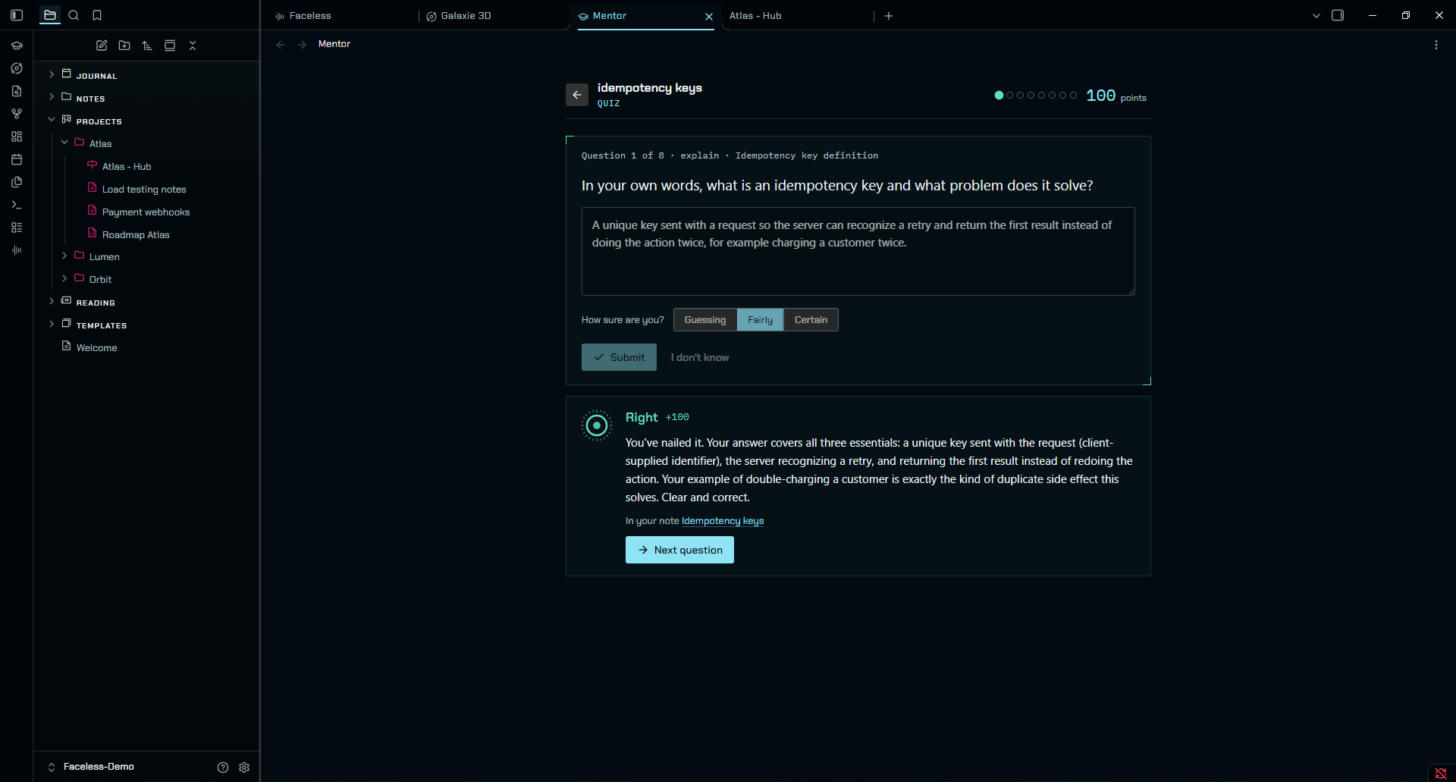
- Quiz. Mostly written-answer questions, graded on meaning rather than wording, with your confidence level for each answer. Mistakes made while feeling sure are flagged, since they are the ones you correct best. "Explain it to me" gives a deeper explanation after any answer.
- Timed challenge. Fast multiple-choice questions, 20 seconds each, with more points for quick right answers.
- Spaced review. Missed questions and the key points of each lesson become cards, scheduled with FSRS (the algorithm used by Anki) and mixed across topics.
- Lesson summary. At the end of a lesson, Mentor can save a Markdown summary with links to your source notes.
Start from the Mentor icon in the ribbon, the command palette, or right-click a note or a folder. You can also type a question: Mentor finds the matching notes in your vault.
The interface is in English and French (it follows Obsidian's language, or choose it in the settings).
Requirements
Mentor does not contain an AI model. It runs Claude Code, Anthropic's command-line tool, already installed on your computer.
- Install Claude Code: see Anthropic's setup guide.
- Open a terminal, run
claudeonce and sign in. - In Obsidian, open Mentor's settings and click Detect, then Test.
Desktop only (Windows, macOS, Linux).
Disclosures
- Account and payment. Claude Code needs your own Anthropic account: a paid Claude plan (Pro, Max, Team…) or a Claude Console account billed by usage. Mentor's usage is billed to that account under your own agreement with Anthropic. Mentor never sees, stores or asks for your credentials; sign-in happens in Claude Code itself.
- Network use. To build a lesson or a quiz, Mentor sends the text of the notes you selected (up to the size set in the settings) and your answers to Claude Code, which sends them to Anthropic's servers. Nothing is sent until you start a lesson, a quiz, a challenge or a test. Mentor itself has no server and no telemetry.
- Runs a program on your computer. Mentor starts the
claudeprogram installed on your computer (found in its usual install folders or on your system path, or the path you enter). Your notes and instructions are passed to it directly, without writing any file. It runs from your system's temporary folder with no tools, so Claude Code cannot read or change your files. Mentor itself only reads and writes inside your vault, through Obsidian. - Your progress (topics, cards, review history) is stored in the plugin's
data.jsonin your vault.
Mentor is an independent project. It is not made, endorsed or supported by Anthropic.
Settings
- Language: automatic, English or French.
- Claude Code path and Model (Sonnet by default, Opus for more depth).
- About you: your level and goals, so examples and difficulty fit you.
- Go beyond the notes: let Mentor complete incomplete notes with general knowledge, always flagged.
- Questions per quiz, new cards per day, target retention, amount of notes sent, ignored folders and the folder for lesson summaries.
The learning science behind it
- Testing yourself (retrieval practice) and spacing reviews are the two most useful study techniques (Dunlosky et al. 2013).
- Questions asked before a lesson improve learning (St. Hilaire et al. 2023).
- Worked examples help beginners, then guidance fades as you progress (Sweller; Kalyuga).
- Explaining in your own words is a generative activity that deepens understanding (Fiorella & Mayer 2016).
- High-confidence errors, once corrected, are the best remembered: the hypercorrection effect (Butterfield & Metcalfe 2001).
- A concept counts as learned after one correct recall without help (Rawson & Dunlosky, successive relearning).
- AI tutors work when they guide step by step and the learner does the thinking (Kestin et al. 2025; Bastani et al. 2025).
Build from source
npm install
node build.mjs
Copy dist/main.js, manifest.json and styles.css into .obsidian/plugins/mentor/ in your vault, then enable Mentor in Settings → Community plugins.
License
MIT
En français
Mentor est un tuteur personnel pour ton vault Obsidian. Il lit les notes que tu choisis et en fait une leçon guidée, un quiz, un défi chrono et des fiches de révision espacée (FSRS), avec les méthodes d'apprentissage que la recherche juge les plus efficaces. L'interface est en français et en anglais.
Mentor ne contient pas de modèle d'IA : il lance Claude Code, l'outil en ligne de commande d'Anthropic, installé sur ton ordinateur et connecté à ton propre compte (abonnement Claude payant ou clé API). L'usage est facturé sur ce compte. Pour préparer une leçon ou un quiz, le texte des notes choisies et tes réponses passent par Claude Code jusqu'aux serveurs d'Anthropic ; rien n'est envoyé avant que tu lances une séance. Mentor n'a ni serveur ni télémétrie. Mentor est un projet indépendant, ni conçu ni soutenu par Anthropic.
For plugin developers
Search results and similarity scores are powered by semantic analysis of your plugin's README. If your plugin isn't appearing for searches you'd expect, try updating your README to clearly describe your plugin's purpose, features, and use cases.