Quick Review
approvedby Bitcoming
Multi-agent review and polish plugin for Obsidian notes. - This plugin has not been manually reviewed by Obsidian staff.
QuickReview
QuickReview is a multi-agent review and polishing plugin for notes. It helps you inspect facts, improve wording, expand ideas, and optionally write a polished version back into the editor.
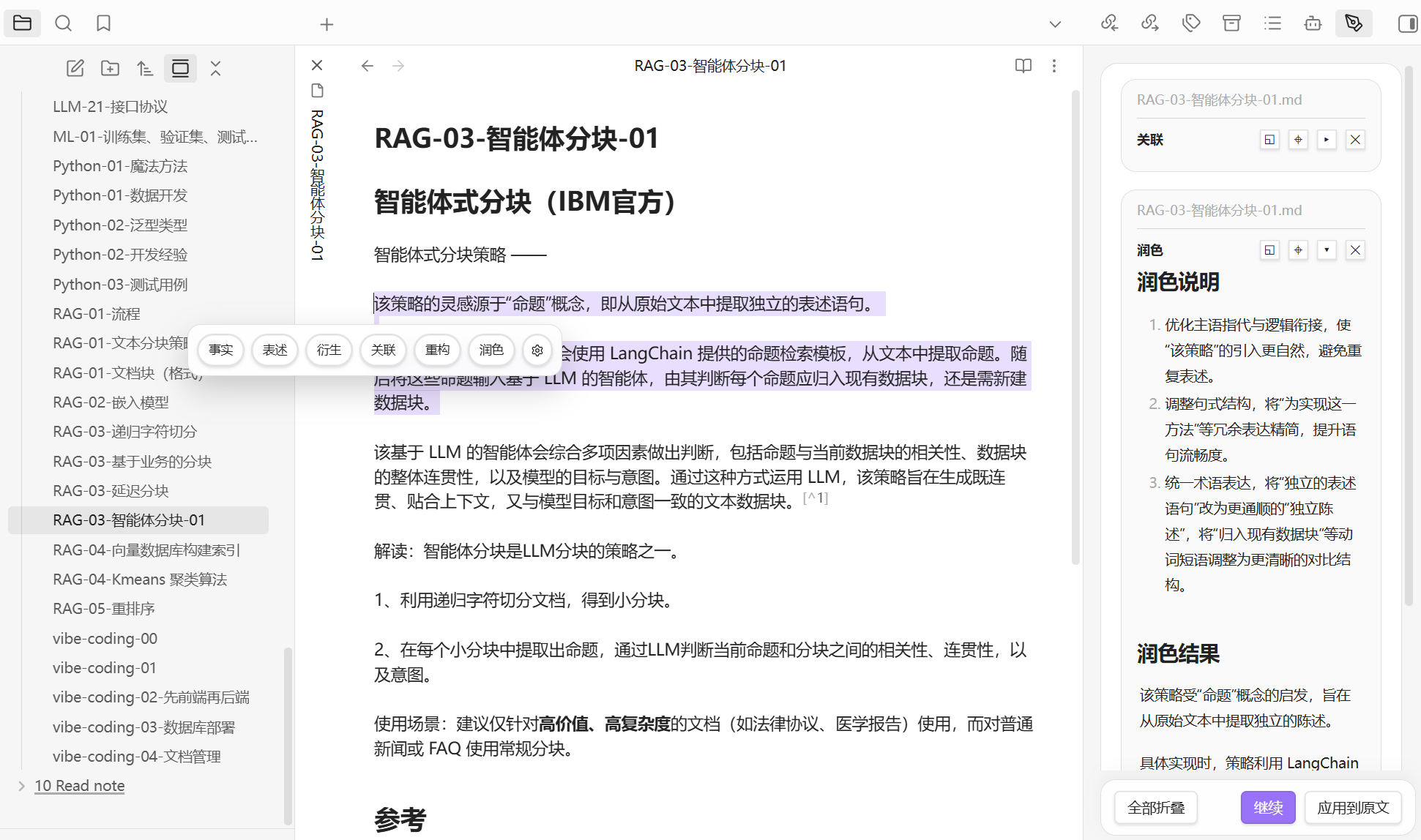
It is useful when you want to:
- review a newly written note for factual, logical, or wording issues
- inspect only the selected text without touching the whole note
- gather feedback from multiple agent roles with different focuses
- polish the current selection and replace it in place
- continue asking follow-up questions based on the review results
Features
- Multi-agent review
- Built-in agents for factual review, wording, expansion, connection, restructuring, and polishing
- Run a single agent or a combined review
- Selection and full-note modes
- Review only the selected text
- Review the entire active note
- One-click polish
- Rewrite the selected text conservatively
- Apply the polished result directly back to the editor
- Follow-up chat
- Review results open in a dedicated view
- Continue the discussion with follow-up questions
- Configurable agents
- Customize each agent's
id,label,title,systemRole, andfocus - Add, remove, or restore built-in agents
- Customize each agent's
- Configurable tools
current-date: returns the current local date, weekday, timezone, and UTC offsetweb-search: searches for recent public information on the web
- Configurable context menu
- Show or hide action buttons
- Reorder them with drag and drop
- Multiple API styles
OpenAI-compatibleAnthropic Messages
Default agents
The plugin includes these roles by default:
Facts: checks factual errors, concept confusion, timeline issues, and weak evidenceWording: checks clarity, structure, readability, and logical flowExpansion: suggests topics, context, and examples worth addingConnection: adds frameworks, classic concepts, study paths, and authoritative viewpointsRestructure: distills the core point, reorganizes structure, and compresses redundancyPolish: improves language without changing the original meaning
Installation
This plugin is currently intended for manual installation.
- Open your vault folder.
- Go to
.obsidian/plugins/. - Create or open a folder named
quick_review. - Copy these files into that folder:
manifest.jsonmain.jsstyles.css
- Enable
QuickReviewfrom the community plugins settings.
Configuration
After enabling the plugin, open Settings -> QuickReview.
1. LLM API settings
Required:
API typeOpenAI-compatibleAnthropic Messages
API URLAPI KeyModel name
Optional:
TemperatureMax output tokensCustom headersOutput language
Notes:
- Settings are saved in the plugin's
data.json API URLshould be the full endpoint URLCustom headersmust be valid JSON
2. Tavily API settings
To let some agents search recent information, configure:
Tavily API KeyTavily API URLSearch result count
Notes:
- If no
Tavily API Keyis provided, the plugin attempts Tavily keyless mode - Web search is most useful for fact checking, recent events, changing rules, and date-sensitive content
3. Agent settings
In the Agent settings tab you can:
- add an agent
- delete an agent
- restore built-in agents
- change display names and role instructions
- attach tools to an agent
Each agent supports:
id: unique identifier, preferably kebab-case Englishlabel: short display label for buttons and commandstitle: title shown in the result viewtools: enabled tool listsystemRole: system role promptfocus: review focus
4. Context menu
In the Context menu tab you can:
- control which buttons appear in the selection toolbar
- drag to reorder buttons
Usage
Review selected text
- Select text in the editor.
- Click the QuickReview action button.
- Choose an agent,
Combined review, orPolish. - Read the result in the review pane.
Run from the command palette
The plugin registers commands for each agent, including:
Review selectionReview full noteCombined review: selectionCombined review: full notePolish selection
Ask follow-up questions
In the result view you can:
- click
Follow up - enter another question
- continue in a dedicated chat view
Apply polished text
After running Polish, click Apply to original to replace the current selection with the generated version.
Result view
QuickReview shows results in a dedicated pane and supports:
- multiple results in sequence
- collapse or expand individual items
- collapse all or expand all
- delete a result
- jump back to the original selection
Tools
current-date
Returns local date information including:
- ISO date
- year, month, and day
- weekday
- timezone
- UTC offset
Useful for:
- interpreting relative dates such as today, yesterday, tomorrow, or this week
- checking logs, journals, reports, and retrospectives
web-search
Uses Tavily to search recent public information and returns:
- summaries
- source links
- result snippets
Useful for:
- checking whether recent information is accurate
- cross-verifying facts, rules, dates, news, and public references
Recommendations
For more reliable results:
- use
Factswithcurrent-dateorweb-search - use
WordingorRestructurefor medium or long notes - use
ExpansionorConnectionto extend study or research notes - use
Polishas a final language pass, not as a fact-checking tool
Development
Install dependencies
npm install
Build
npm run build
Test
npm test
Verify
npm run verify
Project structure
src/
  core/        core actions, prompts, and agent definitions
  llm/         model requests, streaming responses, tool calls
  services/    review flow, editor context, view coordination
  settings/    settings tab and agent configuration UI
  views/       result views and follow-up chat views
test/          unit tests
Known limitations
- This is currently a desktop-only plugin and
manifest.jsonsetsisDesktopOnly: true - Web search depends on Tavily availability
- Review quality depends heavily on your configured model and prompts
- Reviewing long full-note content increases token usage and response time
License
This repository includes an MIT license in LICENSE.
For plugin developers
Search results and similarity scores are powered by semantic analysis of your plugin's README. If your plugin isn't appearing for searches you'd expect, try updating your README to clearly describe your plugin's purpose, features, and use cases.