by chogerlate
Give your AI agents memory from your vault via MCP. Syncs notes to a local aether-mcp server and keeps private notes on disk.
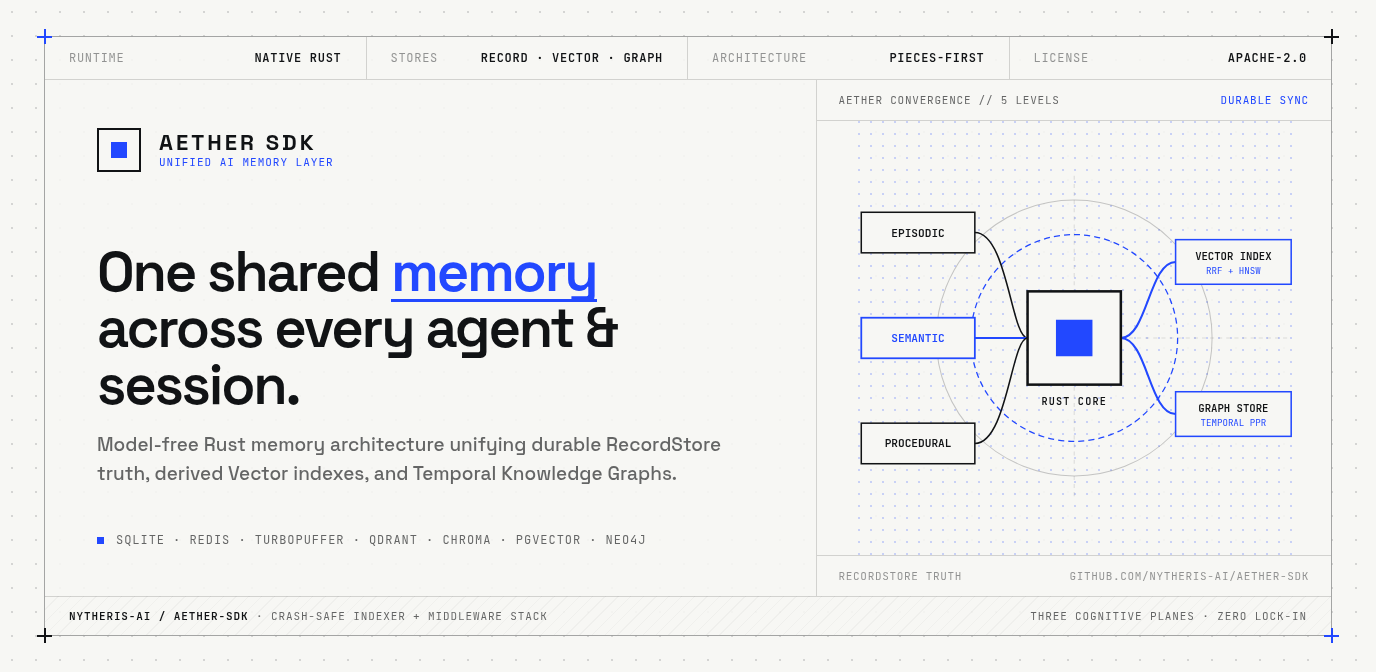

Aether Memory
Your Obsidian vault, every AI agent's memory.
Privacy-preserving two-way vault sync, Inbox memory review, Git lattice sync, and KV-cache warming for aether-mcp.




Launch video · How it works · Installation · Configuration · Commands · Privacy · Aether SDK · Docs
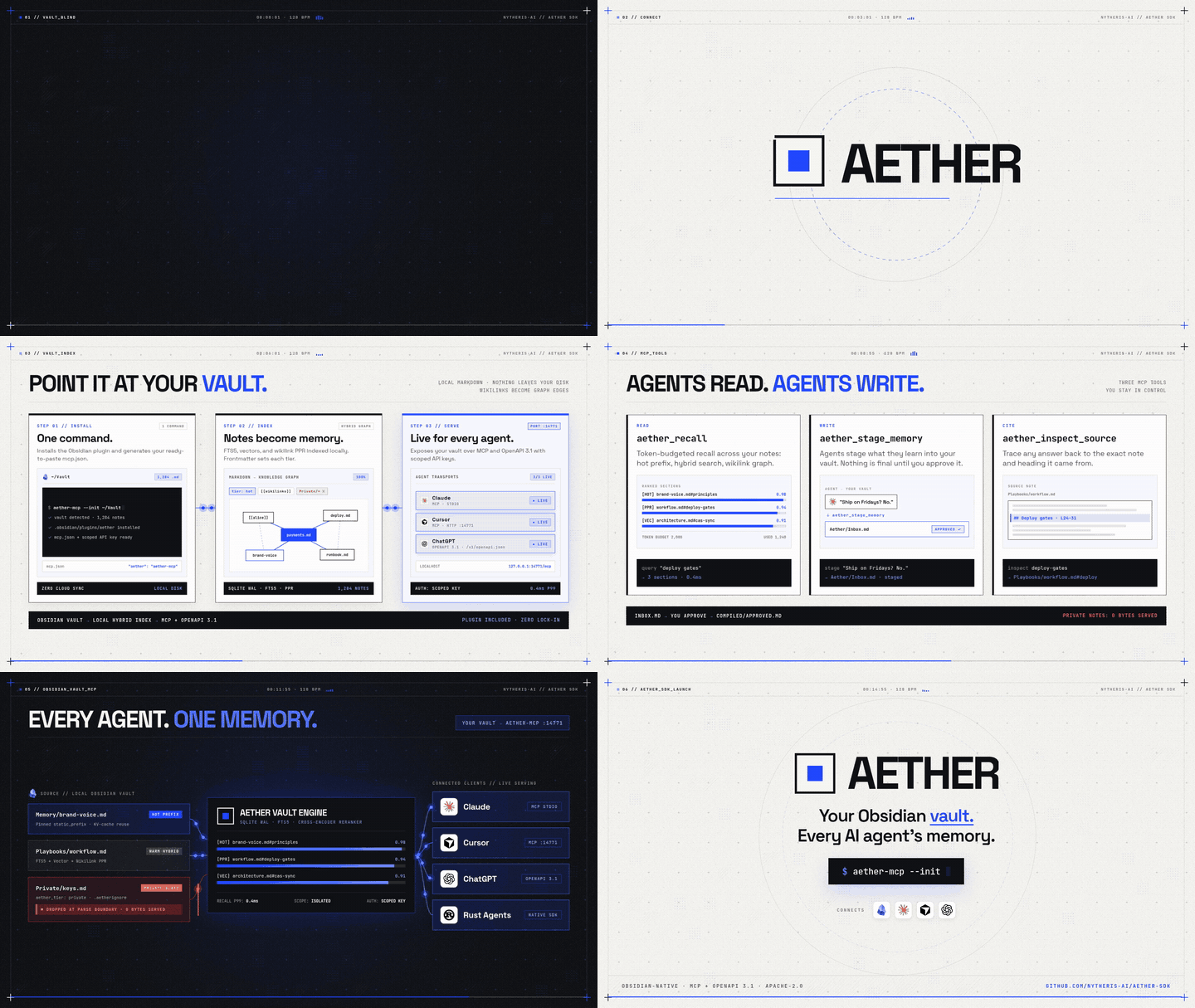
Launch video
How it works
AMC connects Obsidian Desktop to an aether-mcp control-plane server so your public notes stay indexed for AI agents while private notes never leave disk.
flowchart LR
    Vault["Obsidian Vault"] -->|"Client-side filter: aether_tier: private & .aetherignore"| Filter["AMC Plugin"]
    Filter -->|"Public notes (SHA-256 delta push)"| Server["aether-mcp (127.0.0.1:14771 or HTTPS)"]
    Server -->|"Aether/Inbox.md & Aether/Compiled/Approved.md"| Filter
    Server <-->|"MCP / OpenAPI 3.1"| Agents["Claude · Cursor · ChatGPT · Rust Agents"]
- Client-side privacy boundary. Notes marked
aether_tier: privateor matched by.aetherignoreare filtered locally before any HTTP request is built. - Human-in-the-loop memory review. AI agents propose new memories to
aether-mcp, and you approve or reject them from the Aether inbox sidebar pane before they enterAether/Compiled/Approved.md. - Local-first or team gateway. Run
aether-mcplocally over loopback HTTP (http://127.0.0.1:14771) or connect to a remote team gateway over HTTPS with a scoped bearer API key (aek_...).
Installation
You can install Aether Memory directly from Obsidian Community plugins, manually from a GitHub release, or with the aether-mcp CLI.
Obsidian Community plugins (recommended)
- Open Settings → Community plugins in Obsidian Desktop (
1.7.2or later) and turn off Restricted Mode if prompted. - Select Browse, search for Aether Memory (or open Aether Memory in the Obsidian Community directory), and select Install.
- Select Enable.
Manual release installation
- Download
main.js,manifest.json, andstyles.cssfrom the latest release. - Create the directory
<vault>/.obsidian/plugins/aether-memory/. - Copy
main.js,manifest.json, andstyles.cssinto that directory. - Reload Obsidian and enable Aether Memory under Community plugins.
CLI setup with aether-mcp --init
Install aether-mcp and run --init to install the plugin bundle into your vault and generate your mcp.json configuration snippet:
aether-mcp --init --vault /path/to/vault --http-addr 127.0.0.1:14771
Start the HTTP control plane before syncing in Obsidian, or install it as an auto-starting service with aether-mcp service install --vault /path/to/vault. The Local server quickstart buttons in plugin settings copy these commands with your vault path pre-filled.
aether-mcp --vault /path/to/vault --http-addr 127.0.0.1:14771 --http-only
Configuration
Open Settings and select Aether Memory to configure the connection, sync behavior, and optional KV-cache warming. The settings tab stores values in AetherPluginSettings.
Connection and authentication
- Aether control-plane URL. Sets
endpointUrl(defaulthttp://127.0.0.1:14771). Accepts loopbackhttp://URLs (127.0.0.1,localhost,::1) or remotehttps://endpoints foraether-mcp --http-addr. - API key. Sets
apiKey(default empty) using a masked password input. Remote hosts and loopbackhttps://endpoints require a bearer token (aek_...). - Connection card. Checks the server with
GET /v1/vault/pullwhenever you open the settings tab and after you change the URL or API key. It shows Connected to aether-mcp with the number of indexed notes, Can't reach aether-mcp with how to start it, or The server rejected the API key. Select Test connection to check again.
Live sync
- Live vault sync. Sets
liveSyncEnabled(defaulttrue). Automatically pushes note creates, edits, deletions, and renames after Obsidian finishes loading the workspace layout. - Sync debounce (ms). Sets
syncDebounceMs(default1500, range500to10000). Delays rapid create and modify pushes per path while executing deletions and renames immediately in order. - Auto-pull interval (seconds). Sets
autoPullIntervalSec(default0). Polls the server in the background to refreshAether/Inbox.mdandAether/Compiled/Approved.md, or disables polling when set to0. - Run Dream consolidation on push. Sets
runDreamOnPush(defaultfalse). Requests Dream consolidation during manual vault sync. Requires an Admin-scoped API key whenaether-mcpenforces authentication.
Advanced: GPU KV-cache warming
This section is for users who run their own vLLM or SGLang server and want the vault's most-used context kept warm in its KV cache. Most users can leave this off.
- Enable GPU KV-cache warming. Sets
kvWarmingEnabled(defaultfalse). Shows the two settings below and adds the Warm GPU KV cache command. Existing installs that already set a KV endpoint or model keep the feature on after upgrading. - KV endpoint (optional). Sets
kvEndpoint(default empty). Records the inference endpoint associated with KV-cache warming telemetry. - Default KV model. Sets
kvModel(default empty in settings, falling back tollama-3.1-8binAetherCompanionPlugin). Sets themodel_idparameter sent by the Warm GPU KV cache command.
Obsidian commands
The plugin registers four commands in the Obsidian Command Palette, plus a fifth when GPU KV-cache warming is enabled. The status bar updates between Aether: Idle, Aether: Syncing…, Aether: Synced (HH:mm), Aether: Offline, and Aether: N to review when AI agents propose memories. Clicking the status bar item opens the inbox when memories are waiting, and otherwise triggers a vault sync.
- Open Aether inbox review (
aether-open-inbox-review). CallsGET /v1/inboxand opens the Aether inbox pane in the right sidebar with Approve and Reject buttons. - Trigger dream pass (
aether-trigger-dream-pass). CallsPOST /v1/dream, refreshes local mirror notes and pending Inbox counts, and displays a summary notice. - Sync vault with Aether (
aether-sync-vault). Pulls the server manifest (GET /v1/vault/pull), hashes local Markdown files with SHA-256, pushes changed public notes (POST /v1/vault/push), and writes updatedAether/Inbox.mdandAether/Compiled/Approved.mdfiles back to the vault. - Git sync team vault (
aether-git-sync). CallsPOST /v1/git/syncto fetch, merge, and reconcile vault and Aether lattice conflicts, then refreshes local mirror notes. - Warm GPU KV cache (
aether-warm-kv-cache, only when Enable GPU KV-cache warming is on). CallsPOST /v1/kv/warmfor the configured default KV model and reports warmed blocks, tokens, and estimated time-to-first-token reduction.
Frontmatter and exclusions
You control which notes sync to aether-mcp with YAML frontmatter, ignore files, and built-in path rules.
Frontmatter
Add aether_tier: private in YAML frontmatter to keep a note exclusively on disk.
---
aether_tier: private
---
When isPrivateMarkdownNote detects aether_tier: private, the plugin omits the note body from all HTTP requests and sends only the relative path in private_paths and deleted_paths so aether-mcp drops any earlier copy from its index. Notes without private may also set aether_tier (hot, warm, cold), aether_scope, aether_kind, aether_status, valid_from, superseded_by, and tags for aether-mcp indexing.
.aetherignore and .aetherhot
Create .aetherignore at the vault root with newline-separated path rules, directory rules ending with /, or * and ? globs. The parser skips blank lines and # comments. Editing or deleting .aetherignore triggers a delta sync so aether-mcp removes excluded paths from its index.
Create .aetherhot at the vault root using the same pattern syntax to promote matching notes into the hot profile tier on aether-mcp when frontmatter does not specify an explicit aether_tier.
Built-in exclusions
isIgnoredVaultPath skips these paths before reading or uploading file contents:
- Non-Markdown files.
- Any path containing
.obsidian,.git,.trash, or.aether. - Vault mirror and plugin state prefixes
Aether/Inbox.md,Aether/Compiled, and.obsidian/plugins/aether-memory/data.json. - Drawing files ending with
.canvas,.excalidraw, or.excalidraw.md.
Privacy and network disclosure
- Configured endpoint only. Outbound HTTP requests go strictly to your configured
endpointUrlthrough Obsidian'srequestUrlAPI. The plugin sends zero telemetry, crash reports, or third-party requests. - Client-side private note filtering. The plugin evaluates
aether_tier: privatefrontmatter,.aetherignorerules, and built-in exclusions locally before buildingPOST /v1/vault/pushrequests. Excluded note bodies never leave your disk. - Transport policy.
assertControlPlaneBaseUrlrejects non-loopback plainhttp://URLs by default and requires an API key for any non-loopback endpoint or loopbackhttps://endpoint. - Local credential storage. Obsidian stores your
apiKeyand plugin configuration locally in<vault>/.obsidian/plugins/aether-memory/data.jsonthroughsaveData. Keep.obsidian/plugins/aether-memory/data.jsonout of version control.
Development
Install dependencies, run unit tests, check types, build the production bundle main.js, and verify release compliance:
npm ci
npm test
npm run typecheck
npm run build
npm run verify:release
To verify a tagged release archive against a specific SemVer release tag, pass --tag without a v prefix:
node scripts/verify-release.mjs --tag 0.4.5
License
Apache-2.0. See LICENSE.
For plugin developers
Search results and similarity scores are powered by semantic analysis of your plugin's README. If your plugin isn't appearing for searches you'd expect, try updating your README to clearly describe your plugin's purpose, features, and use cases.