by atlas-vtt
Run TTRPG battle maps with tokens, fog of war, grids, dice and a separate player view.
AtlasVTT
A game system agnostic virtual tabletop for tabletop RPGs that runs inside Obsidian.
The guides, with screenshots and clips of every feature, are on atlas-vtt.dev.
I built Atlas as part of my bachelor's thesis to give the TTRPG community a virtual tabletop that's open source, hackable, and free to use. Every file Atlas creates, every token, every map, every world you build, stays yours and stays local. It follows the same philosophy as Obsidian: your work lives on your machine, in formats you control, with no account and no server in between. Atlas VTT also has an online play service, Atlas Online, to share your maps with players over the internet. Atlas Online requires an account and an internet connection.
TTRPG worlds in my opinion are something very personal and players and DMs get attached to them. That attachment deserves better than a subscription and someone else's database. Atlas makes sure your creative output stays yours, just like a sheet of paper would.
Ease of use matters just as much to me. Atlas aims for a minimal, streamlined interface that feels native to Obsidian, with clear controls and simple workflows that keep your attention on the game.
AtlasVTT is desktop only for now
Documentation at: atlas-vtt.dev
At the table
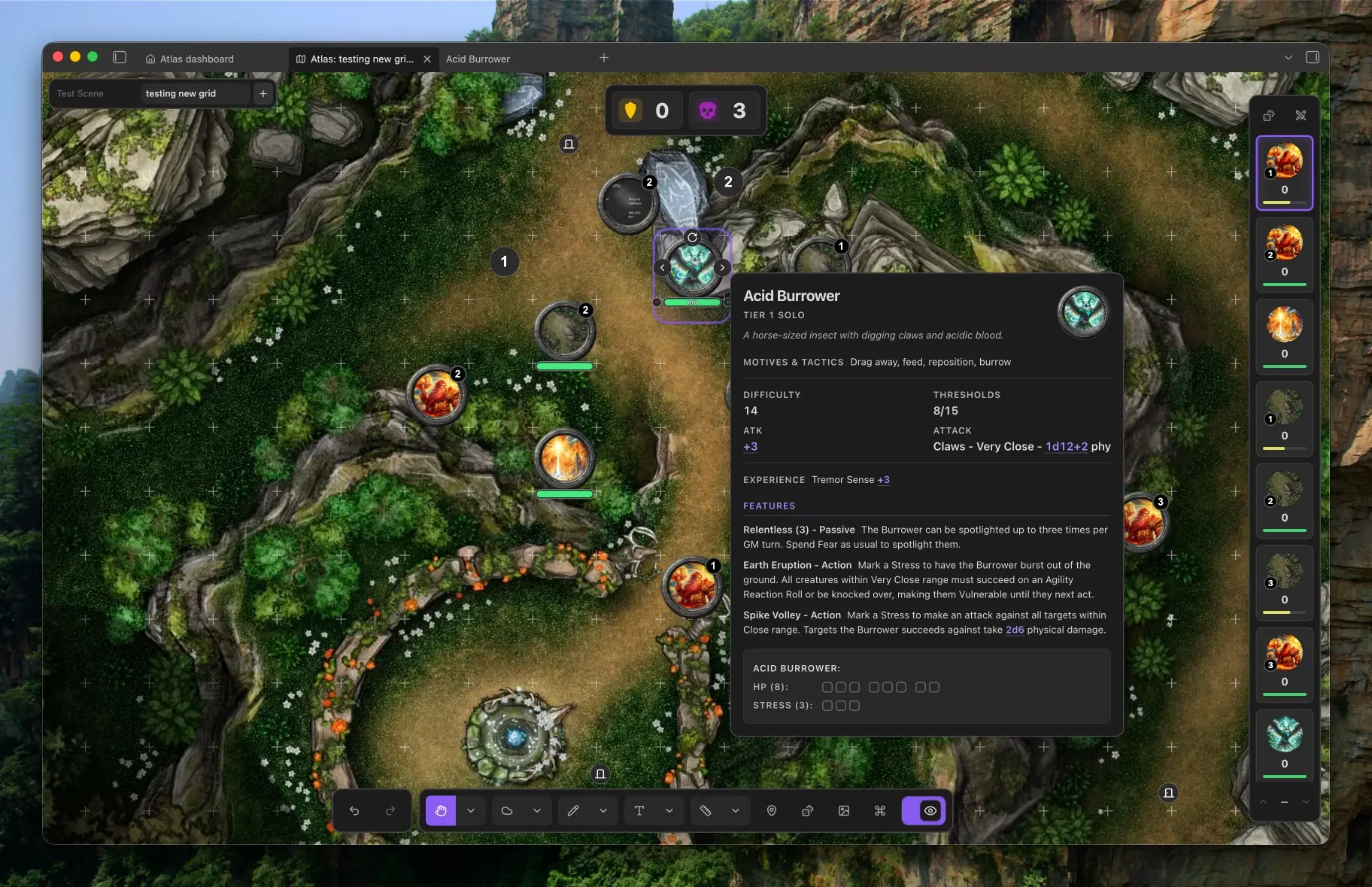
- Maps and grids: Build scenes from your own map images. Align square or hex grids manually or with automatic detection.
- Tokens and encounters: Import characters, move and resize tokens, and save groups as reusable encounters. Link creature notes with the optional Fantasy Statblocks plugin. Simple die syntax like 2d8+2 will be turned into a clickable dice roll.
- Fog and player view: Reveal the map as your players explore. Show a separate player window on a second screen while keeping GM information hidden.
- Drawing and notes: Sketch, add text, measure distances, and pin Markdown notes or other Atlas maps to locations.
- Dice and initiative: Roll dice, review the roll log, track turns, and keep counters and timers close at hand.
- Online play (closed beta): Host a table that your players join from their web browsers. It is off until you turn it on, and hosting needs an Atlas account with closed beta access.
Your notes, right on the map
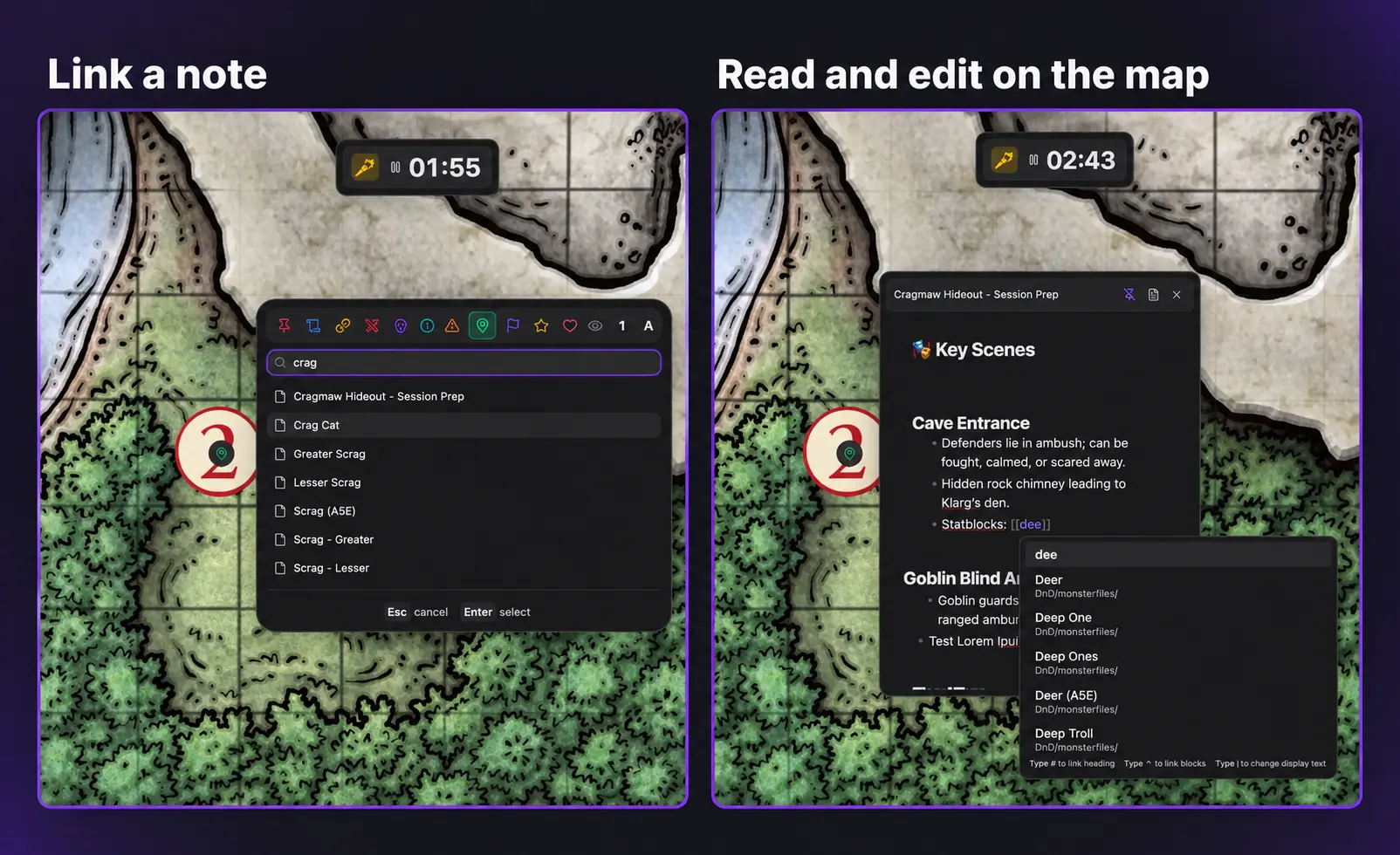
Pin an Obsidian markdown note or even another Atlas map to a location, then read and edit it in a floating panel without leaving the map. Keep room descriptions, session prep, and character details close at hand, with Obsidian's familiar note linking built in.
Organise your campaign
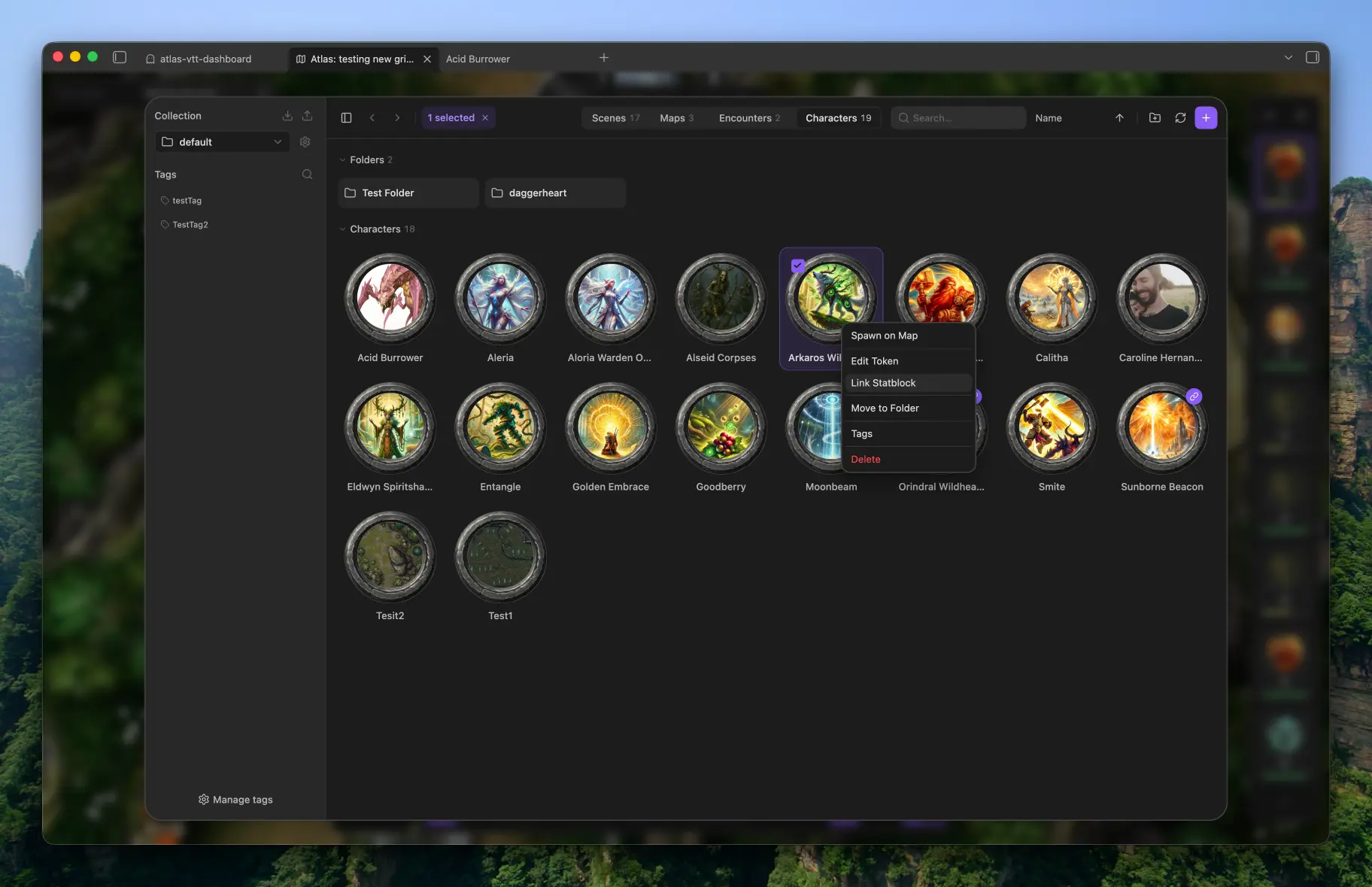
Keep scenes, maps, encounters, and characters together in collections. Use folders and tags to find what you need, then bring it onto the map.
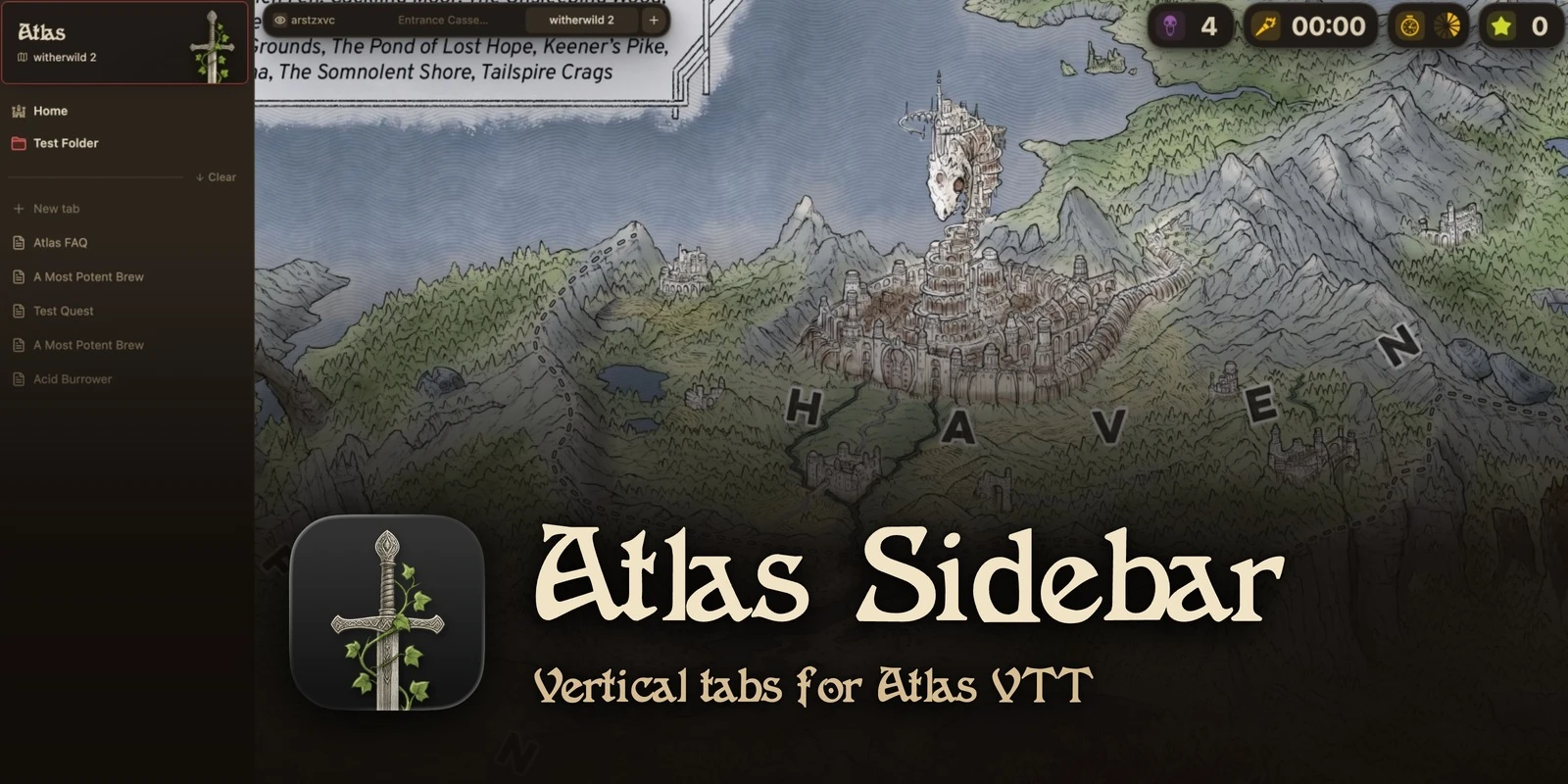
Atlas Sidebar
Atlas Sidebar is an optional companion plugin. It turns Obsidian's tabs into a vertical list with pinned tabs, folders, essentials and spaces, and keeps a pin at the top that takes you back to your scene in one click.
Install
Requires Obsidian 1.8.7 or newer on desktop. Atlas VTT is available through Obsidian's community plugins.
- Open Settings → Community plugins and turn off Restricted mode if it is enabled.
- Select Browse and search for Atlas VTT.
- Select Install, then Enable.
Check for updates under Settings → Community plugins.
New to Atlas? Start here takes you from installing it to showing your first map to your players.
Want to try upcoming features early? Beta builds are available through BRAT, see .github/beta-testing.md.
In the beta, Random tables → New table turns pasted text into a Markdown table in your collection. Copy a table from a PDF, spreadsheet, website or Markdown note, enter its name and review the preview before choosing Save and roll.
The imports stay on your device. The XLSX reader uses the http://schemas.openxmlformats.org XML namespace identifiers locally and makes no requests to that address.
Manual installation
Download main.js, manifest.json, and styles.css from a GitHub release. Place them in <your vault>/.obsidian/plugins/atlas-vtt/, then enable Atlas VTT under Settings → Community plugins.
Your first scene
- Run Atlas VTT: Open dashboard from the command palette.
- Use the + button in the asset manager to import a map image, then create a scene using that map.
- Align the grid with automatic detection or the manual alignment tool.
- Import tokens and place them on your scene.
- For a local game, open the player view and move it to your second screen.
Privacy and network use
Atlas works offline with files in your vault. It has no telemetry or ads, and you need no account to use it. Scenes are saved as .atlasmap files, and the rest of your library (tokens, encounters, collection settings, game system presets) as JSON files in the atlas-vtt folder, so it syncs with your vault. With Obsidian Sync, turn on "Sync all other types".
Network use
Atlas connects to the internet only for the features below, each of which you start yourself, except the update check. Unless a line says otherwise, nothing about you or your vault is sent; the server sees your IP address, as with any web request. Atlas never downloads code to run, and never installs or updates itself; the documentation and the Armarium are web pages shown in a sandboxed frame, kept apart from Obsidian and your vault.
- Update check (
raw.githubusercontent.com): to tell you when an update is out, Atlas reads the version number of its newest release from GitHub once when Obsidian starts and then every hour. Switch it off in Settings → Atlas VTT → Updates. Obsidian, not Atlas, installs the update. - Images from a web address: if you use an external image URL for a token or map background, or copy an externally hosted image from a note, Atlas downloads that image from the address you gave. Images in your vault need no network.
- Starter ambience (
assets.atlas-vtt.dev): when you press Get starter ambience on the Sound page, Atlas downloads six CC0 ambient sounds (about 9 MB, audio only) into your ambience folder. - Music packs (
assets.atlas-vtt.dev): when you choose a pack under Get starter music on the Sound page, Atlas downloads Vindsvept's music for it (CC BY 4.0, audio and a credits note; ten packs, about 1.2 GB in all) into the folderVindsveptof your music folder. - Starter tokens (
assets.atlas-vtt.dev): when you press Get 155 free tokens in an empty Tokens tab of the asset manager, Atlas downloads 155 tokens (about 19 MB, images and a credits note; creatures from Oozejar's art under CC BY-SA 4.0, class tokens from Sketch Studio's icons under CC BY 4.0) into the collection you have open, and, if you choose them, their statblocks from the 5E SRD 5.2.1 (CC BY 4.0) or the Cairn bestiary (CC BY-SA 4.0). - Documentation (
atlas-vtt.dev): when you open the documentation panel, Atlas showshttps://atlas-vtt.dev/docsin a frame inside the map view. - Armarium (
atlas-vtt.dev,api.atlas-vtt.dev,atlasvttusercontent.com,raw.githubusercontent.com): when you open the Armarium, Atlas showshttps://atlas-vtt.dev/armariuminside the asset manager. When you install a free collection from it (or open itsobsidian://atlas-vtt-installlink), Atlas reads the list of installable collections fromhttps://atlas-vtt.dev/api/armarium/v1, downloads the collection throughhttps://api.atlas-vtt.dev, which counts the download, fromatlasvttusercontent.com(orraw.githubusercontent.com), checks it against its listed fingerprint and writes it into your vault only after you confirm the import review. A collection is data (maps, images, notes, JSON), never code. To mark what you already have, the Armarium's page is told which of the Armarium's own collections your vault holds, and at which version. - Atlas account (
api.atlas-vtt.dev, optional): only sharing in the Armarium and hosting online play need one. You sign in from Settings → Atlas VTT → Atlas account and approve the sign-in athttps://atlas-vtt.dev/device. The token is kept in Obsidian's secret storage on this device and sent only tohttps://api.atlas-vtt.devand, while online play runs,https://play.atlas-vtt.dev. - Sharing in the Armarium (
api.atlas-vtt.dev, needs an account): when you choose Share in the Armarium for one of your collections, Atlas packs it in memory as Export collection would, uploads it, shows what the Armarium's checks found, and publishes it with the listing details you write only when you confirm; if you stop before that, the upload is discarded. - Issue reports (
srv1871379.hstgr.cloud): only when you submit a report does Atlas send it, with the versions and system details listed in PRIVACY.md, tohttps://srv1871379.hstgr.cloud/atlas/reports, which publishes it as a public GitHub issue. - Online play (closed beta;
play.atlas-vtt.dev,assets.atlas-vtt.dev, needs an account): off until you turn it on in the command palette's Experimental features page. Hosting a table needs an Atlas account with closed beta access. A running table connects tohttps://play.atlas-vtt.dev, which passes what your players may see (the shared scene, dice, chat, handouts, their sheets and quests, the sound that plays) on to their browsers and keeps none of it. The files players need for it, sound from the Sound page included, are uploaded tohttps://assets.atlas-vtt.devand kept there for up to 30 days after you last shared them. Players need no account.
Stream Deck
Control Atlas from a Stream Deck (Settings → Atlas VTT → Stream Deck, off by default, desktop only) makes Atlas listen on this computer alone (127.0.0.1, port 47823) for the Atlas plugin for Stream Deck. It accepts only requests from programs on this computer, never from web pages, and does nothing until you allow a controller in the prompt Atlas shows; the controller then gets a key that only this device stores (as a fingerprint, in Obsidian's local storage, never synced) and that Revoke cancels. It plays moods, stops, pauses, skips and sets levels, starts and ends the fight and rolls initiative, presents the map, freezes the players' camera, hides the map, shows and takes back images, and rolls saved dice. It hears which mood plays, the moods' names, crests and colours, the name of the track that plays and the levels, whether a fight runs with its round and number of combatants, what the player window shows, and the names, formulas and colours of the saved rolls. Nothing of it leaves your computer.
Files outside your vault
Atlas reads files outside your vault only when you pick them for an import, or link a folder of music or ambience on the Sound page, so that you can play a sound library you keep elsewhere without copying it into your vault. Atlas then lists that folder and reads the sounds you play. Only if you agree, it converts the sounds there to Opus in the same folder (keeping or trashing the originals, as you choose), and it renames, moves or trashes files there only when you tell it to. Nothing from that folder leaves your computer unless you play it at an online table.
See PRIVACY.md for the details of every connection and what each service keeps.
Help and contributing
Found a bug or have an idea? Run the Report an issue command inside Obsidian or use Settings → Atlas VTT → Help and feedback. Atlas fills in your versions and submits your report directly, without a GitHub account or a second form; see .github/reporting-issues.md. To contribute code, see CONTRIBUTING.md.
Build from source
Requires Node.js 22 or newer.
npm ci
npm run build   # production build into ./dist
npm run dev     # watch build
npm test
The build also copies the plugin into local test vaults when they are present.
Game system templates
Atlas VTT comes with statblock templates for 5E, Cairn, Draw Steel and Fate. Each holds the fields and layout of a statblock, not rules text or creatures. Atlas VTT arranged the stat block structure as an editable template.
- 5E (2014 rules): This work includes material taken from the System Reference Document 5.1 ("SRD 5.1") by Wizards of the Coast LLC and available at https://dnd.wizards.com/resources/systems-reference-document. The SRD 5.1 is licensed under the Creative Commons Attribution 4.0 International License available at https://creativecommons.org/licenses/by/4.0/legalcode.
- 5E (2024 rules): This work includes material from the System Reference Document 5.2.1 ("SRD 5.2.1") by Wizards of the Coast LLC, available at https://www.dndbeyond.com/srd. The SRD 5.2.1 is licensed under the Creative Commons Attribution 4.0 International License, available at https://creativecommons.org/licenses/by/4.0/legalcode.
- Cairn: The Cairn template is based on Cairn by Yochai Gal (https://cairnrpg.com), licensed under CC BY-SA 4.0 (https://creativecommons.org/licenses/by-sa/4.0/). Atlas VTT adapted the creature format into an editable template; this template is available under CC BY-SA 4.0 or GPL-3.0.
- Fate: This work is based on Fate Core System and Fate Accelerated Edition (found at https://www.faterpg.com/), products of Evil Hat Productions, LLC, developed, authored, and edited by Leonard Balsera, Brian Engard, Jeremy Keller, Ryan Macklin, Mike Olson, Clark Valentine, Amanda Valentine, Fred Hicks, and Rob Donoghue, and licensed for our use under the Creative Commons Attribution 3.0 Unported license (https://creativecommons.org/licenses/by/3.0/).
The Draw Steel statblock template and system preset in Atlas VTT are an independent product published under the DRAW STEEL Creator License and are not affiliated with MCDM Productions, LLC. DRAW STEEL © 2026 MCDM Productions, LLC.
Credits and license
Widget icons, map pin icons, the sound moods' crests, light marker icons, the dashboard's icons, the token icon and the end-combat icon are by Lorc, Delapouite, Skoll, sbed, Carl Olsen, and Caro Asercion from game-icons.net, under CC BY 3.0. Their backgrounds were removed and glyphs recoloured. The music packs on the Sound page are by Vindsvept, under CC BY 4.0, converted to Ogg Opus. The starter class tokens are icons by Sketch Studio, commissioned by Maatlock of maatlockstavern.com, under CC BY 4.0, redrawn as pencil sketches on parchment. Other asset and library credits are in THIRD_PARTY_NOTICES.md.
Atlas VTT is free software. Copyright (C) 2025-2026 Fabian Urbanek.
You can use it for any purpose, including streamed, recorded, and paid games. You can redistribute and modify it under the terms of the GNU Affero General Public License, version 3 (AGPL-3.0-only) as published by the Free Software Foundation. If you distribute Atlas VTT or a modified version, or let others use a modified version over a network, you must make the complete source code available under the same license. It is distributed in the hope that it will be useful, but without any warranty; see the license for details.
Additional permission under GNU AGPL version 3 section 7: if you modify this program, or any covered work, by linking or combining it with Obsidian (or a modified version of that program), the licensors of this program grant you additional permission to convey the resulting work.
Releases up to and including 0.1.6 were published under the PolyForm Noncommercial License 1.0.0. If you want to use the code under different terms, contact Fabian Urbanek.
Your campaign content remains yours. Third-party components retain their own licenses.
For plugin developers
Search results and similarity scores are powered by semantic analysis of your plugin's README. If your plugin isn't appearing for searches you'd expect, try updating your README to clearly describe your plugin's purpose, features, and use cases.