by phoenixyun
Obsidian 内完全本地运行的数据自动补全引擎:直接解析 vault 内 Excel/CSV,按报告上下文从真实数据检索候选数值并强制溯源;无外部服务、无 LLM。支持占位符补全、指标缺值波浪线 + 下拉/Tab 补全、语义兜底、手动搜索、备份恢复。
Data Autocomplete
A fully local data autocomplete engine for Obsidian: it parses Excel/CSV files inside your vault and retrieves real values by report context, with forced source tracing. No external services, no LLM, no Python backend — your data never leaves the vault.
- Version: 0.1.8
- Category: Desktop plugin (
isDesktopOnly: true) - Install: copy this folder to
<vault>/.obsidian/plugins/data-autocomplete/, then enable it in Settings → Community plugins (turn off restricted mode).
What it does
When writing reports or documents, you often need to fill "metric name + value" into the text. This plugin automates that:
- Put your Excel/CSV files into the vault's data directory (default
data-autocomplete-data/); - While writing, mark missing data with a placeholder (e.g.
本月试驾量为【待补充】), or just write the metric name without a value; - The plugin parses the report context (first-line title + current paragraph) to extract "metric / entity / date", then retrieves candidate values from real data;
- Every candidate carries a source trace (file / sheet / row number). If nothing matches, it shows
NO_RESULT— it never fabricates values.
It depends on no external service. Data stays inside the vault and works fully offline.
How the context recommendation works
When you type a placeholder (【待补充】) or a metric name without a value, the plugin runs a 5-stage retrieval state machine — it never invents numbers:
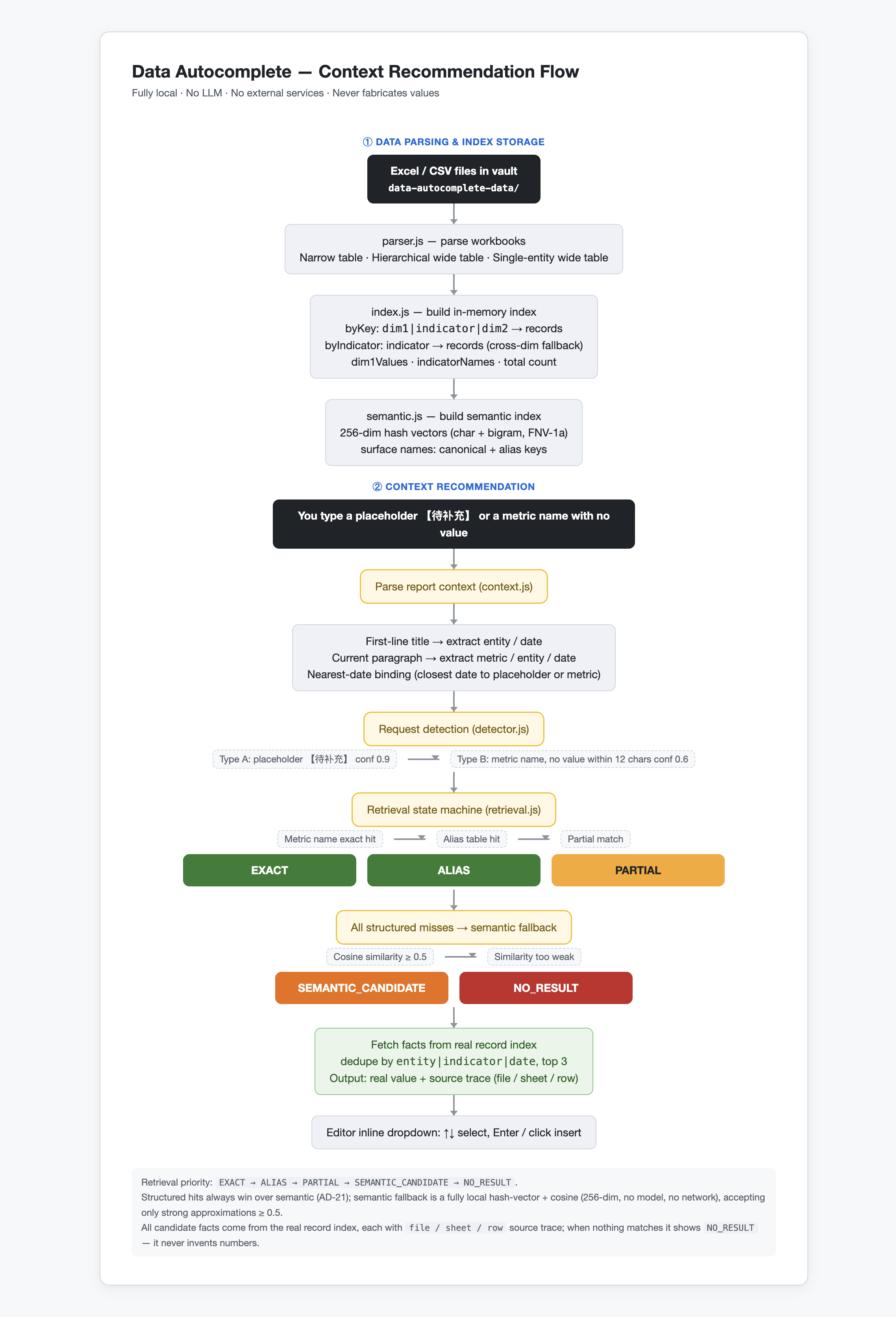
Retrieval priority: EXACT → ALIAS → PARTIAL → SEMANTIC_CANDIDATE → NO_RESULT. Structured hits always win over semantic (AD-21); the semantic fallback is a fully local hash-vector + cosine similarity (256-dim, no model, no network), accepting only strong approximations ≥ 0.5 to prevent weak substring overlaps from creating misleading candidates. All candidate facts come from the real record index, each with file / sheet / row source trace.
Demo
Watch a short demo of the plugin in action (placeholder completion, wavy-underline + dropdown, source tracing):
Or download it directly: demo.mp4
Install (3 steps)
- Add data: create a
data-autocomplete-data/folder in your vault root and put Excel/CSV files inside (supported layouts:- Narrow table:
dimension1/dimension2/month/metric/value/metric description - Hierarchical wide table / single-entity wide table: row 1 headers (
…/specific metric/metric description/entity), row 2 date columns (累计值/2026-07月数据/ranking columns), data starts from row 3) - The directory name can be changed in settings.
- Narrow table:
- Install the plugin: copy this folder to
<vault>/.obsidian/plugins/data-autocomplete/, then enable it in Settings → Community plugins (turn off restricted mode). - Rebuild the index: run 「重建数据索引(解析 vault 内 Excel/CSV)」 from the command palette, or click "Rebuild index" on the settings page.
Usage
-
Mark missing data with placeholders while writing, for example:
华东区 2026年7月经营数据 本月试驾量为【待补充】,成交量为【待补充】,客流量是【待补充】。 客单价【待补充】,单车毛利为【待补充】,成交率【待补充】。 -
Run 「分析当前笔记(数据自动补全候选)」 (
Ctrl/Cmd+P), and a popup lists every data request:- Request type (
placeholder/metric_no_value), confidence, metric word, original sentence - Parsed dimensions: metric (match mode) · entity (scope) · date (scope) · missing item
- Retrieval status (
EXACT/ALIAS/PARTIAL/NO_RESULT) with explanation - Each candidate fact: real value + entity + date + match mode + source trace (file/sheet/row)
- "Copy candidate text" writes it into the note in one click.
- Request type (
-
NO_RESULTis a normal path: it means there is no matching record in the real data. This plugin never invents numbers.
Commands
重建数据索引(解析 vault 内 Excel/CSV)— rebuild the data index分析当前笔记(数据自动补全候选)— analyze the current note for autocomplete candidates数据索引概览— data index overview手动搜索数据(查询理解 + 排序)— manual search with natural-language query understanding and ranking数据预览:单主体单指标全部历史— preview all history for one entity + one metric浏览数据:全量明细分页— browse all records with pagination多表管理:切换活跃数据表— switch the active data table (each subfolder = one named table)创建数据备份(打包数据目录)— back up the data directory as a zip恢复最新备份— restore from the latest backup确保数据目录存在(幂等)— ensure the data directory exists (idempotent)一键补全全部占位符(auto/manual/nodata)— fill all placeholders in one pass (auto / manual / nodata)展开省略号为【待补充】占位符— expand ellipses (。。。/.../……) into placeholders
Settings
Data source & basics
- Data directory: default
data-autocomplete-data(relative to vault root) - Auto-rebuild index on startup: parse automatically when the vault opens (default on)
- Rebuild index now: rebuild manually after data files change (or use the command palette)
Retrieval & semantics
- Semantic fallback (approximate match, fully local): when structured retrieval misses, use local hash-vector approximation to find metrics, then query real data; turn off for strict structured matching only
- Semantic candidate count: how many candidate metrics the semantic fallback shows (default 3)
- Semantic hit threshold: below this similarity, "approximate metrics" don't count as hits (default 0.5)
Editor completion & detection
- Inline completion (placeholder + metric-name dropdown): typing
【shows a real-data candidate dropdown in place (↑↓ to select, Enter/click to insert and auto-close】); typing a metric-name prefix (e.g.成交/本月成交) pops up a metric-name dropdown, Enter completes the name (default on) - Type-B missing-value detection (wavy underline + Tab/dropdown completion): when a metric name has no value within 12 characters, candidates are generated: a red wavy underline under the metric name; when the cursor stops at the end of the metric name, a real-value candidate dropdown pops up (↑↓ to select, Enter/click to insert); Tab inserts the first candidate directly
- Record completion history: every popup copy / inline insert appends a line to
数据目录/history.jsonl
Local self-test
# Engine regression tests against real data (no Obsidian needed, plain node)
node test/engine.test.mjs
Current engine 25 assertions, wavy-mark 9 assertions, dropdown 29 assertions all pass: narrow table 1008 records, hierarchical wide table 498 records, single-entity wide table 10 entities × 20160 records, 21666 real records total / 13 entities / 263 metrics; all 7 placeholders in the sample note hit EXACT real values (试驾量 235.3, 成交量 35.2, 客流量 1086.5, 客单价 301569.4, 单车毛利 42552.6, 成交率 11.2, 总利润 8127), each with file/sheet/row source trace.
Development
npm install          # esbuild + xlsx
npm run build        # src/main.js → single-file main.js (2.1MB, includes xlsx)
npm run test:engine  # engine regression
node test/marks.test.mjs    # wavy-mark + Tab chain
node test/dropdown.test.mjs # dropdown decision
Module layout (mirrors the Python pipeline):
parser.js (narrow/hierarchical wide tables) → index.js (in-memory index) → context.js (context/entity/date/metric extraction) → detector.js (placeholder/metric-missing detection) → retrieval.js (EXACT→ALIAS→PARTIAL→NO_RESULT) → engine.js (orchestration, output shaped like the Python /analyze-report).
M2: Semantic fallback (implemented in this version)
When structured retrieval (exact/alias/partial) all miss, semantic fallback kicks in:
- Local hash-vector + cosine (
semantic.js): embed metric "surface names" (canonical name + alias keys) as 256-dim unit vectors via character/bigram hashing; embed the query the same way, compute cosine, take top-3. - Threshold gating: cosine ≥ 0.5 to accept a candidate, preventing weak substring overlaps (e.g.
人数/数量) from creating misleading approximations (外星人数量always staysNO_RESULT). - Structured always wins (AD-21): semantic only acts as
SEMANTIC_CANDIDATEfallback after EXACT → ALIAS → PARTIAL all fail; candidate facts still come from the real record index (lookupMetric) — never generates values. - Can be disabled: the "semantic fallback" toggle in settings; when off, only strict structured matching.
New status SEMANTIC_CANDIDATE (shown in orange in the popup), retrieval order: EXACT → ALIAS → PARTIAL → SEMANTIC_CANDIDATE → NO_RESULT.
Example: note writes 本月到店人数为【待补充】 → semantic layer hits 进店人数 (0.71) → normalized to 客流量 → returns real value 1086.5 (2026-07, 经营数据-示例.xlsx row 76).
M3: Editor inline completion (implemented in this version)
When you type the placeholder 【, a candidate card pops up in place (src/editor/inlineSuggest.js, CodeMirror 6):
- Candidates:
Engine.suggest(cursor-prefix)reuses the full pipeline — it automatically combines the note's first line (entity/date title) + the paragraph before the cursor into a query segment, then runs request detection → structured → semantic fallback; - Interaction:
↓/↑to switch candidates, Enter or click inserts the real value and auto-closes】,Esccloses; - Trace visible: each candidate shows
value metric@date entity (file:row); status/explanation in the title line (EXACT/ALIAS/PARTIAL/SEMANTIC_CANDIDATE/NO_RESULT). - Never fabricates: when nothing matches it shows
NO_RESULTinstead of forcing a number.
Toggle in settings (default on). CodeMirror packages are injected by the Obsidian runtime (build.mjs marks them external, not bundled).
Roadmap
- M4 Wide-table column recognition: auto-detect and fold arbitrary entity matrices (entity × metric × month).
- M5 Candidate history & frequent metrics: record every pick, weight future ranking.
License
MIT License — see LICENSE.
For plugin developers
Search results and similarity scores are powered by semantic analysis of your plugin's README. If your plugin isn't appearing for searches you'd expect, try updating your README to clearly describe your plugin's purpose, features, and use cases.