by Bruno Ribeiro
Suggests external links you have already used as you type a Markdown link.
External Link Autocomplete
Reuse the external links you've already written, without hunting for the URL again.
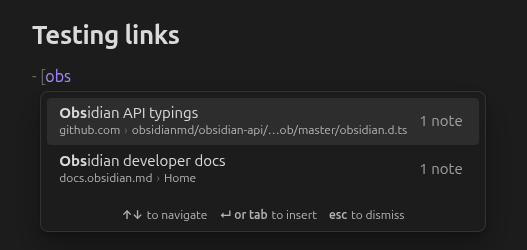
Start a Markdown link with [ and type part of its text. External Link Autocomplete suggests matching links from anywhere in your vault, and accepting one inserts the whole link: type [jira, press Enter, and get [Jira board](https://example.atlassian.net/…).
Features
- Suggestions from your own vault. Every
[text](https://…)link in your notes becomes a suggestion, keyed by its text. - Smart matching. Exact matches come first, then matches at the start of the text (
[jira→ "Jira board"), then at the start of any word ([board→ "Jira board"), then looser matches. Case and accents don't matter:[cafefinds "Café". - Sensible ranking. Among equally good matches, links you use in more notes, and in notes you edited recently, come first.
- Every URL a text has pointed to. If "Docs" has linked to two different sites, you get a row for each, told apart by host and path.
- Native look and feel. The popup matches Obsidian's own suggestions and follows your theme.
- Stays out of your way. No suggestions inside
[[wikilinks,![images,[^footnotes,- [ ]task boxes, code or frontmatter. Links are indexed in the background and kept up to date as you edit, rename and delete notes. - Desktop and mobile. On mobile, tap a suggestion to insert it.
Usage
- In a note, type
[followed by at least two characters of a link text you've used before. - Pick a suggestion with the arrow keys and press Enter or Tab, or click or tap it.
- The full link is inserted, replacing what you typed (including an auto-paired
]), and the cursor moves to just after it.
Press Esc to dismiss the suggestions. They stay closed until you start a new link.
Settings
| Setting | What it does |
|---|---|
| Minimum characters | How many characters after [ before suggestions appear. Default 2. |
| Ranking | Balanced (default), most used, or most recent. |
| When a text has several links | Show all (default), only the most recent, or only the most used. |
| Accept with tab | Tab inserts the selected suggestion, as Enter does. On by default. |
| Show note count | Shows how many notes use each link. |
| Ignored link texts | Texts that are never suggested. Defaults to here, link, this, source and click here. |
| Ignored domains | Domains that are never suggested. * matches anything, as in *.internal.example.com. |
| Excluded folders | Folders whose links are never suggested. |
| Rebuild index | Scans the vault again. Also available as the Rebuild link index command. |
Privacy
Everything stays on your device. The plugin reads your notes to build an in-memory index of the links in them, and makes no network requests: no telemetry, no favicons, no page-title fetching.
Installation
From Obsidian: open Settings → Community plugins → Browse, search for "External Link Autocomplete", then install and enable it.
Manually: download main.js, manifest.json and styles.css from the latest release into <your vault>/.obsidian/plugins/external-link-autocomplete/, then enable the plugin under Settings → Community plugins.
Requires Obsidian 1.13 or later.
Compatibility with other plugins
Obsidian shows one suggestion popup at a time. If another plugin also offers suggestions after a plain [, whichever plugin Obsidian asks first wins. External Link Autocomplete only claims a [ when it has suggestions to show, so it never blocks another plugin otherwise.
Contributing
Bug reports and ideas are welcome in issues. For development, run make to list the commands; docs/design.md describes how the plugin works.
License
For plugin developers
Search results and similarity scores are powered by semantic analysis of your plugin's README. If your plugin isn't appearing for searches you'd expect, try updating your README to clearly describe your plugin's purpose, features, and use cases.