Flow
approvedby tavva
Implements key processes in David Allen's Getting Things Done (GTD) methodology
Flow
GTD-powered task management for Obsidian.
Flow captures everything demanding your attention and helps you focus on what matters. Built on David Allen's Getting Things Done methodology.





The Problem
Your mind is constantly interrupted by things you need to remember: tasks, ideas, commitments, follow-ups. These open loops consume mental energy that should go towards your actual work.
Flow gets everything out of your head and into a trusted system, so you can focus completely on what you're doing right now. It's based on GTD principles but doesn't require you to follow the methodology rigidly.
Features
- Quick Capture — Get thoughts out of your head instantly via command, ribbon icon, or external tools
- Inbox Processing — Intuitive flow to categorise inbox items into projects, actions, reference, or someday/maybe
- Sphere Organisation — Organise life areas (work, personal) with hierarchical projects
- Focus View — Curate a focused list of next actions from across your vault
- Waiting For — Track items you're waiting on others to complete
- Planning Mode — Build your focus list by selecting actions from sphere views
Quick Start

- Install Flow in Obsidian (Settings → Community Plugins)
- Click the inbox ribbon icon and capture something
- Run "Process Inbox" to categorise items
Installing Beta Builds
To try unreleased builds before they reach the stable community plugin listing:
- Install BRAT from Community Plugins
- Open BRAT settings and click "Add Beta plugin"
- Enter
tavva/flowand enable it
BRAT will automatically update to the latest beta when new versions are released. To switch back to stable, remove the plugin from BRAT.
If you use a beta build we'd love to hear from you in the repo Discussions.
How It Works
Capture — When something has your attention, add it to your inbox. Don't organise yet, just get it out of your head.
Process — Review your inbox regularly. For each item you choose:
- What category it belongs to (project, action, reference, someday)
- Which existing project it might fit
- The sphere, and any other metadata required
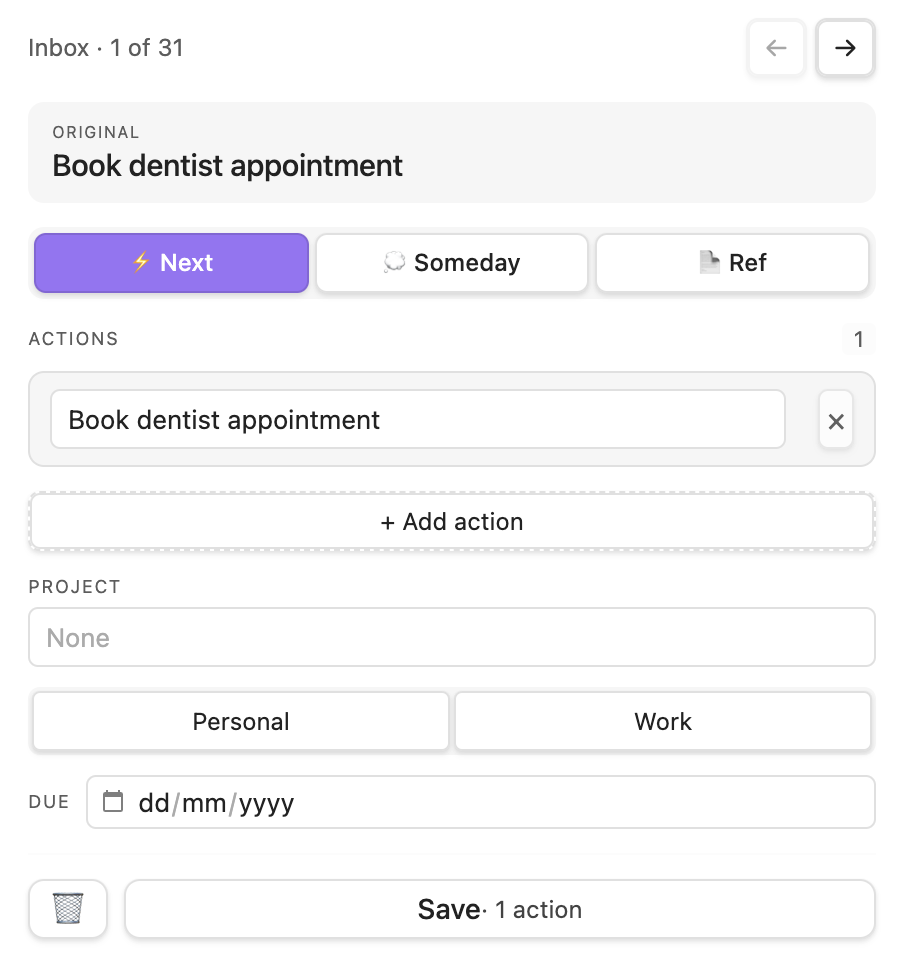
Screenshot from the current inbox processing flow.
Plan — Open a sphere view, enter planning mode, and click actions to add them to your focus. Your focus is your curated list of what to work on.
Do — Work from your focus. When done, mark complete. When blocked, convert to waiting-for.
Focus File Location
Choose Settings → Flow → Output Files & Folders → Focus File to set the vault-relative path for your focus list. The default is flow-focus-data/focus.md; leaving the setting blank uses this default. Click Apply to move your focus file to the new location.
Flow creates missing folders and moves your existing focus file automatically. If the destination already exists, Flow asks whether to use that file instead; neither file is overwritten or merged. Cancelling or a failed move keeps your current location.
Project Structure
Flow projects use YAML frontmatter:
---
priority: 2
tags: project/work
status: live
parent-project: "[[Parent Project]]"
---

# Ship v1.0

## Next actions

- [ ] Write release notes
- [ ] Update documentation
- [w] Waiting for design review from Sarah
Context Tags
Add GTD context tags to your actions to filter by where or how you can do them:
- [ ] Call dentist #context/phone
- [ ] Review budget spreadsheet #context/computer
- [ ] Pick up dry cleaning #context/errands
Context tags appear as filters in sphere and waiting-for views. The prefix is configurable in settings — change context to at, ctx, or whatever suits your workflow.
Cover Image Generation
Flow can generate cover images for projects using AI. Configure an image-capable model via OpenRouter in Settings → Flow (openai/gpt-5-image creates great cover images in our experience).
Documentation
- GTD Guide — Understanding GTD methodology and Flow's implementation
- Project Templates — Customising project templates, including Templater support
- Quick Capture Methods — Tools and workflows for capturing from any device
- Contributing — Development setup, architecture, and how to contribute
Privacy
- AI features are optional and disabled by default — Flow works fully without them
- API keys stored locally in Obsidian settings
- Flow contacts OpenRouter only when AI cover image generation is enabled and you trigger image generation
- Project title, description, and context used for cover generation are sent to your configured OpenRouter-compatible endpoint for that request
- No telemetry or analytics
- Your vault stays under your control
Support
License
GPL-3.0-or-later — see LICENSE for details.
For plugin developers
Search results and similarity scores are powered by semantic analysis of your plugin's README. If your plugin isn't appearing for searches you'd expect, try updating your README to clearly describe your plugin's purpose, features, and use cases.