by GammaFunds
Look up EU law in 24 official languages, plus German, Austrian, Swiss, Spanish, Finnish, Italian and Dutch law. Preview legal text from official sources and insert formatted citations into your notes.
European Law Lookup
European Law Lookup brings legal text from the European Union, Germany, Austria, Switzerland, Spain, Finland, Italy, and the Netherlands into Obsidian.
Look up supported EU regulations, directives, and decisions by human-readable citation or CELEX identifier, choose from the 24 official EU languages, preview the retrieved legal text and source information, and insert the formatted result into your active note only when you explicitly confirm the insertion.
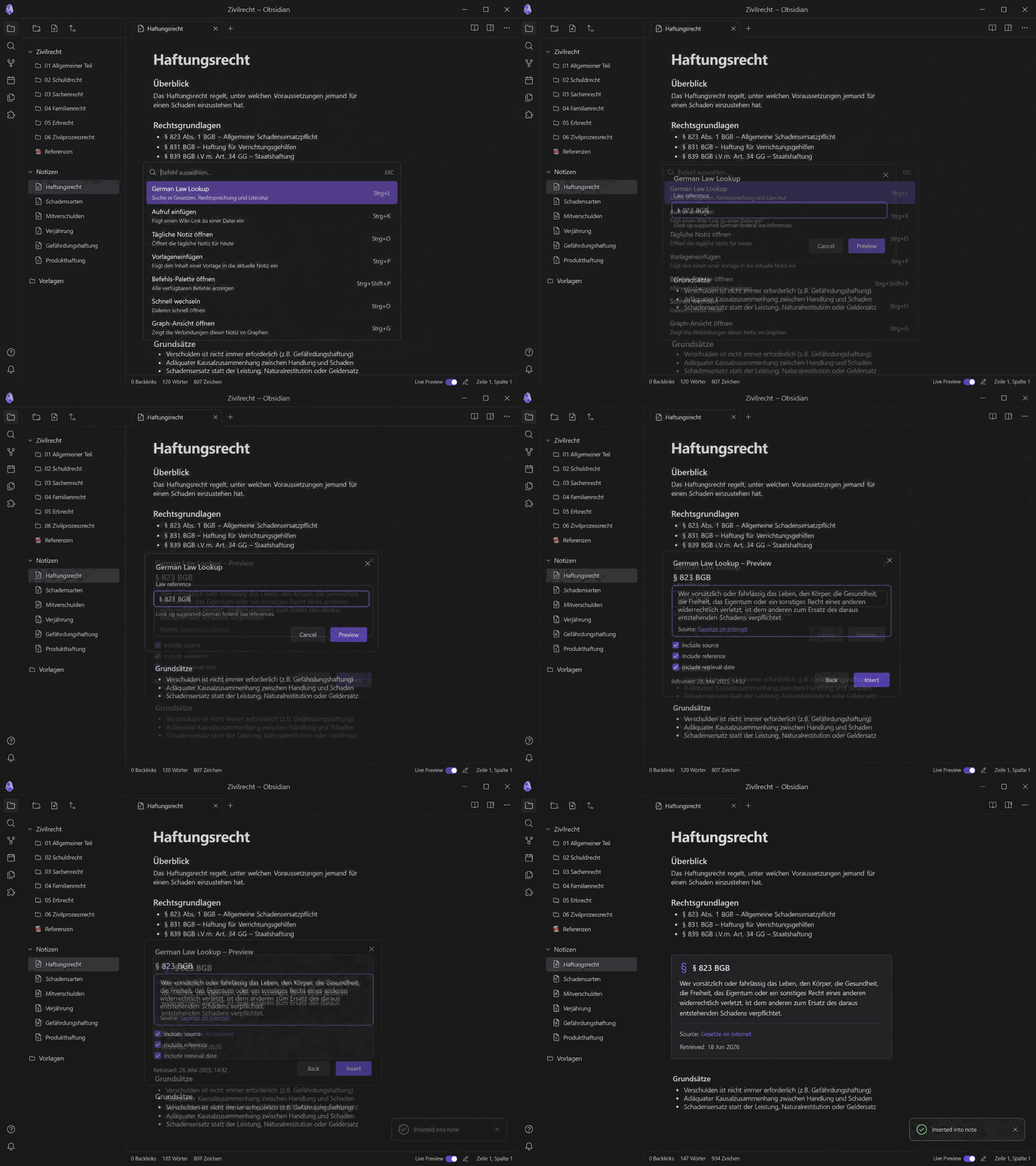
Demo
Highlights
- EU-first legal lookup for supported sector-3 regulations, directives, and decisions.
- Human-readable EU citations such as
Art. 1 Directive 2011/61/EUandArt. 1 Regulation (EU) 2024/3110. - Direct CELEX lookup such as
32016R0679 Art. 1. - 24 official EU languages for official EU legal text when the requested language expression is available.
- Germany, Austria, Switzerland, Spain, Finland, Italy, and the Netherlands are available as additional jurisdictions.
- Official-source retrieval from EUR-Lex / Publications Office CELLAR, Gesetze im Internet, RIS, Fedlex, Spain's BOE, Finland's Finlex, Italy's Normattiva, and the Netherlands' BWB / Wetten.nl.
- Preview before insertion so a lookup never modifies a note without an explicit user action.
- Source-aware metadata for citations, retrieval dates, jurisdiction, language, cache state, and source status where available.
- Configurable lookup workflow with a one-line or two-field input layout, a default jurisdiction, and jurisdiction-specific language preferences where supported.
- Local caching of successful legal-text lookups.
- No AI-generated legal text and no machine-generated translations.
European Union
EU legislation is the primary focus of European Law Lookup.
The local EU metadata index discovers supported sector-3 acts from the Publications Office CELLAR. The index is used to resolve legal-act identity and available official language expressions; legal text is retrieved from the authoritative provider path when you perform a lookup.
Supported EU act families
The generic EU index admits supported sector-3 CELEX acts of these document types:
- Regulations (
R) - Directives (
L) - Decisions (
D)
The current lookup workflow is article-oriented.
EU input examples
Human-readable references:
Art. 1 Directive 2011/61/EUArt. 1 Regulation (EU) 2024/3110Art. 6 GDPR
The act type (Regulation, Directive, or Decision) can be written in any of the EU's 24 official languages.
Direct CELEX references:
32016R0679 Art. 1
Human-readable resolution is intentionally fail-closed where a reference is ambiguous. Direct CELEX input remains available for supported acts.
EU languages
European Law Lookup supports the 24 official EU languages for EU legal text:
Bulgarian, Croatian, Czech, Danish, Dutch, English, Estonian, Finnish, French, German, Greek, Hungarian, Irish, Italian, Latvian, Lithuanian, Maltese, Polish, Portuguese, Romanian, Slovak, Slovenian, Spanish, and Swedish.
The plugin requests official language expressions from EU sources. It does not generate translations. If the requested official expression is unavailable, the provider path follows the plugin's defined language/fallback rules rather than inventing text.
EU metadata refresh
The EU act index is stored locally in dedicated compact index files instead of inside the normal Obsidian plugin settings document.
A stale index may be refreshed in the background when the plugin loads. This refresh contacts the Publications Office CELLAR and can take time because it validates a large public corpus. The last-known-good local index remains the authority until a new candidate index has been completely written and activated.
A metadata refresh is separate from an individual legal-text lookup.
Current EU boundaries
European Law Lookup does not claim generic support for every possible CELEX resource or document component.
The current generic EU workflow is focused on supported sector-3 regulations, directives, and decisions and on article lookup. Recitals, annexes, corrigenda, arbitrary non-R/L/D document families, and other unsupported reference forms remain outside the guaranteed scope unless explicitly added in a future release.
Germany
The German scope covers selected federal laws through the validated Gesetze im Internet provider path.
Examples:
§ 823 BGBBGB 823§ 242 StGBSGB V § 1Art. 1 GGArt. 229 § 6 EGBGB
For configured laws, Germany supports official German text and published English legal text where available. If no supported English source exists, the lookup uses the configured German official-text behavior. The plugin never creates its own translation.
The complete supported-law catalog and example inputs are available in the plugin settings.
Austria
The Austrian scope covers 24 explicitly mapped federal laws through RIS (Rechtsinformationssystem des Bundes).
Examples:
§ 1295 ABGB§ 75 StGBArt. 144 B-VG§ 1 GmbHG§ 35a DSG
German and Austrian laws with the same abbreviation remain isolated by jurisdiction.
RIS consolidated federal-law text is an informational, legally non-binding version and is not presented as an authentic Federal Law Gazette publication.
Austria supports German legal text only, so no language selector is shown for Austrian lookups.
The complete supported-law catalog is available in the plugin settings.
Switzerland
The Swiss scope covers article references for 23 explicitly mapped federal laws through Fedlex.
Examples:
Art. 8 BVArt. 1 ZGBArt. 1 ORArt. 1 DSG
Supported Swiss legal-text languages are:
- German
- French
- Italian
The settings UI also presents the official full titles of the mapped Swiss laws in these languages.
Swiss section-style references, cantonal law, and unlisted federal laws remain outside the current scope.
Spain
Spanish discovery uses the official BOE (Boletín Oficial del Estado) consolidated-legislation service. Search by title or official law number, for example Ley 40/2015 or 40/2015; a result is identified by a BOE ID such as BOE-A-2015-10566.
Article lookup is supported in Spanish, for example Article 1 of a selected BOE act. The provider retrieves consolidated article text and does not mark it as authoritative text; verify legal status against the official publication.
Finland
Finlex supports consolidated statutes identified by number and year, such as 729/2018, with numbered section lookup such as § 1. Discovery accepts a statute identity directly or searches by title.
Finnish and Swedish text are supported. The provider retrieves Finlex consolidated text and does not mark it as authoritative text.
Italy
Normattiva discovery searches act titles, for example Codice civile, and provides the act identity needed for lookup. Article lookup supports positive-numbered articles, including Article 1 of the discovered Codice civile act.
Retrieved text is in Italian. Lookup is limited to articles for acts returned with the metadata required by discovery; the provider does not mark retrieved text as authoritative text.
Netherlands
BWB / Wetten.nl discovery searches by title or BWB identifier, for example Algemene wet bestuursrecht or BWBR0005537. Article lookup supports numbered forms such as Article 1:1 and retrieves Dutch text.
Lookup resolves the BWB state whose validity and visibility periods include the current date. The provider does not mark retrieved text as authoritative text.
How it works
- Open the command palette.
- Run the law lookup command.
- The configured default jurisdiction may already be selected; change it if needed.
- Enter a supported legal reference using the configured one-line input or separate law and reference fields.
- Select the desired legal-text language only where multiple supported choices exist. Austria has no language selector because only German is supported.
- Review the legal text, citation, and source information.
- Insert the result into the active note.
The plugin never inserts or changes note content without an explicit insertion action.
Sources and legal status
European Law Lookup retrieves legal information from public official or governmental legal-information services:
- European Union: Publications Office CELLAR and EUR-Lex.
- Germany: Gesetze im Internet.
- Austria: RIS, Bundesrecht konsolidiert.
- Switzerland: Fedlex.
- Spain: BOE (Boletín Oficial del Estado) consolidated legislation.
- Finland: Finlex.
- Italy: Normattiva.
- Netherlands: BWB / Wetten.nl.
The plugin is a research and productivity tool, not legal advice.
Always verify legal text, version, applicability, consolidation status, and source status against the relevant official publication before relying on it.
Privacy and network access
- Note contents are not sent to legal-information providers.
- The plugin does not use AI services to generate legal text.
- The plugin never generates translations.
- Legal-text network requests occur when you start a lookup that is not satisfied by the configured local cache.
- A stale EU metadata index may trigger a background CELLAR metadata refresh when the plugin loads.
- The EU metadata refresh concerns public act metadata; it does not upload note contents.
- Successful legal-text results may be cached locally according to the plugin settings.
- The EU metadata index is persisted locally in dedicated plugin files.
Installation
Obsidian Community Plugins
Install European Law Lookup from Obsidian's Community Plugins directory and enable it under Settings → Community plugins.
Manual installation
The technical plugin identifier intentionally remains german-law-lookup for compatibility with existing installations.
Create or use:
<your-vault>/.obsidian/plugins/german-law-lookup/
Copy exactly these release assets into it:
manifest.jsonmain.jsstyles.css
Reload Obsidian and enable European Law Lookup.
Compatibility and rename note
Version 0.4.0 introduces the public name European Law Lookup.
The visible plugin name and repository branding change, but the Obsidian plugin ID remains:
german-law-lookup
Keeping the existing ID preserves continuity for current installations and updates.
The GitHub repository is now named european-law-lookup; the Obsidian plugin ID remains german-law-lookup for compatibility with existing installations.
Feedback, bugs, and contributions
Use the GitHub issue tracker for reproducible bugs, feature requests, and other non-security feedback.
For security vulnerabilities, do not post technical details in a public issue. Follow the private reporting process in SECURITY.md.
Contributions are welcome through pull requests. See CONTRIBUTING.md for the development setup, validation commands, contribution process, and scope requirements.
Development
Install the locked dependencies:
npm ci
Run the complete test suite:
npm test
Run lint:
npm run lint
Build the production bundle:
npm run build
Release assets
An Obsidian release contains:
manifest.jsonmain.jsstyles.css
versions.json remains in the repository to map plugin versions to their minimum supported Obsidian version.
Do not include node_modules, test output, source maps, local EU index files, or other development/runtime-local files in release assets.
License
MIT. See LICENSE.
For plugin developers
Search results and similarity scores are powered by semantic analysis of your plugin's README. If your plugin isn't appearing for searches you'd expect, try updating your README to clearly describe your plugin's purpose, features, and use cases.