by yuri55448
Show a customizable month, week, day and year calendar with lunar dates, solar terms, holidays, periodic notes, tasks and recurring items.
Modular Calendar Beta
English | 繁體中文
A calendar for Obsidian: month, week, day and year views plus timelines, with lunar dates, solar terms, holidays, periodic notes, tasks and recurring items — all in one calendar, and you decide what every day cell shows.
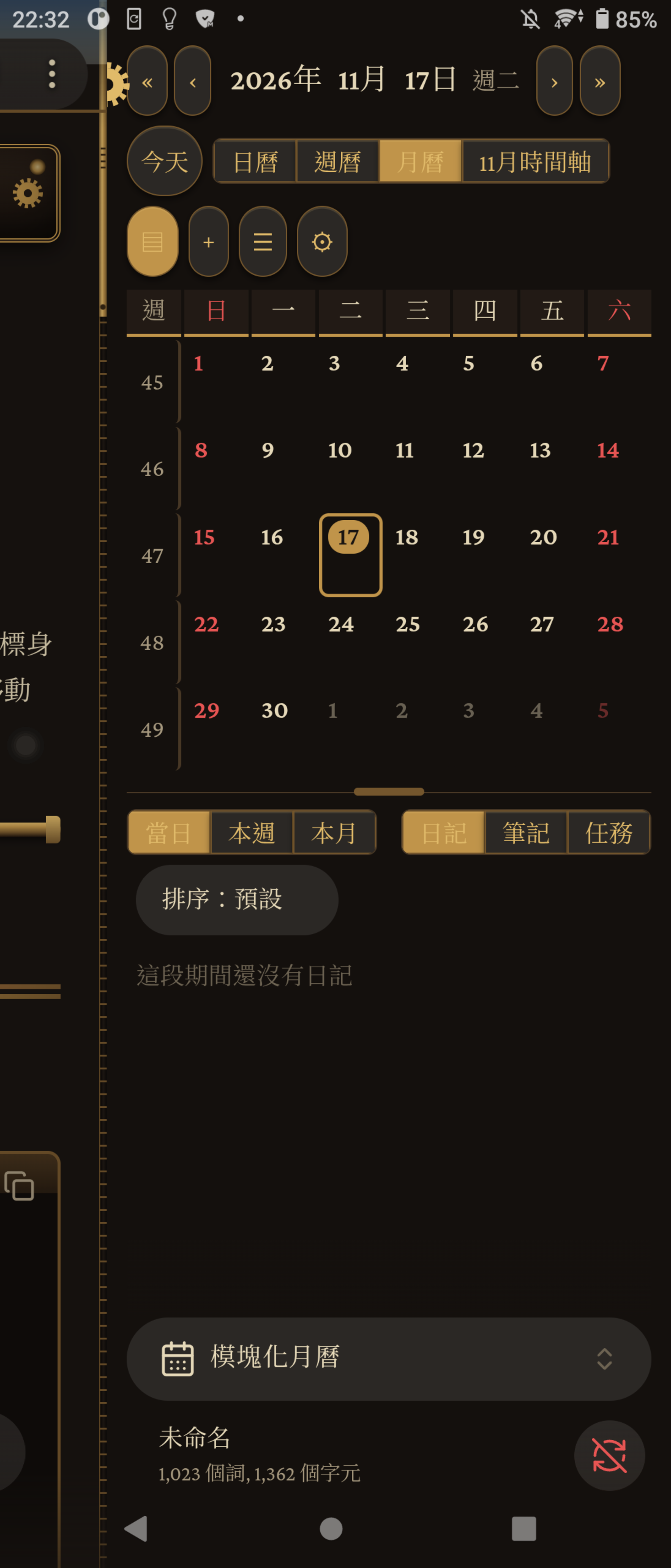
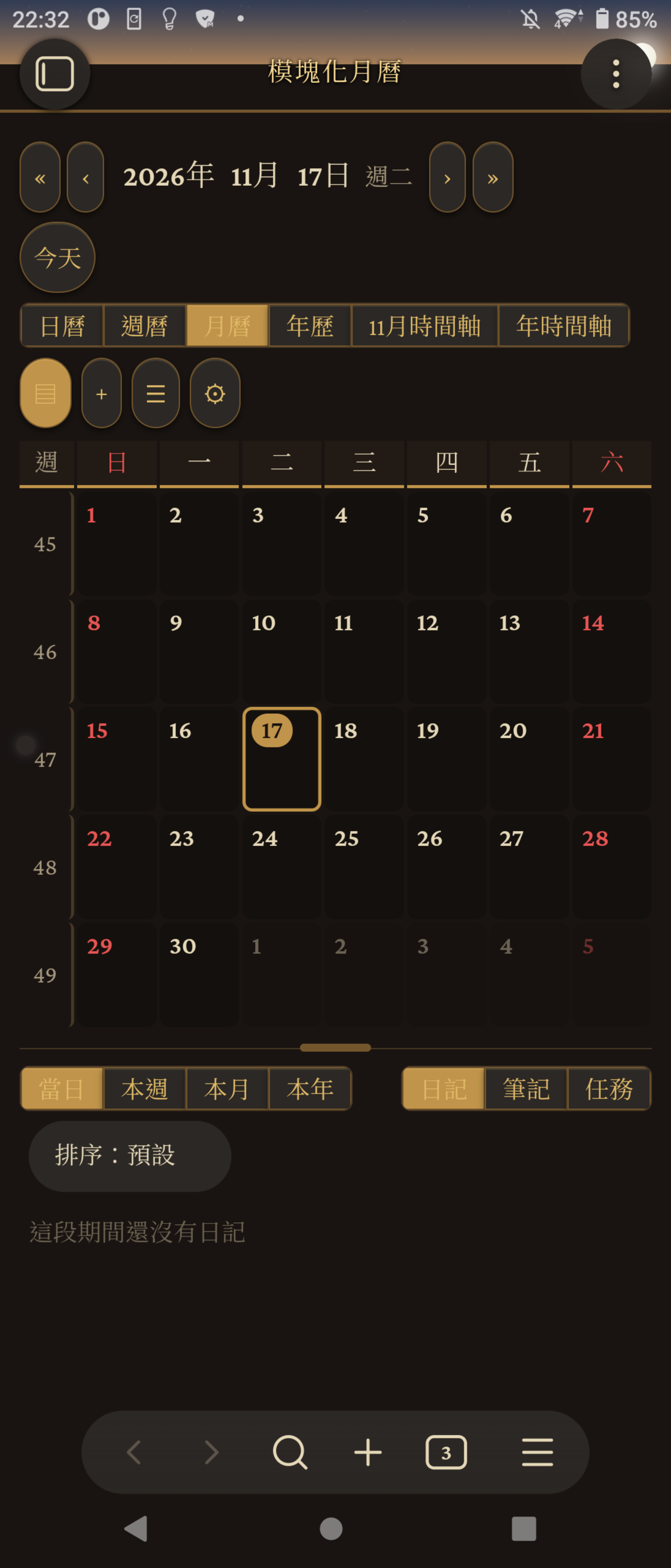
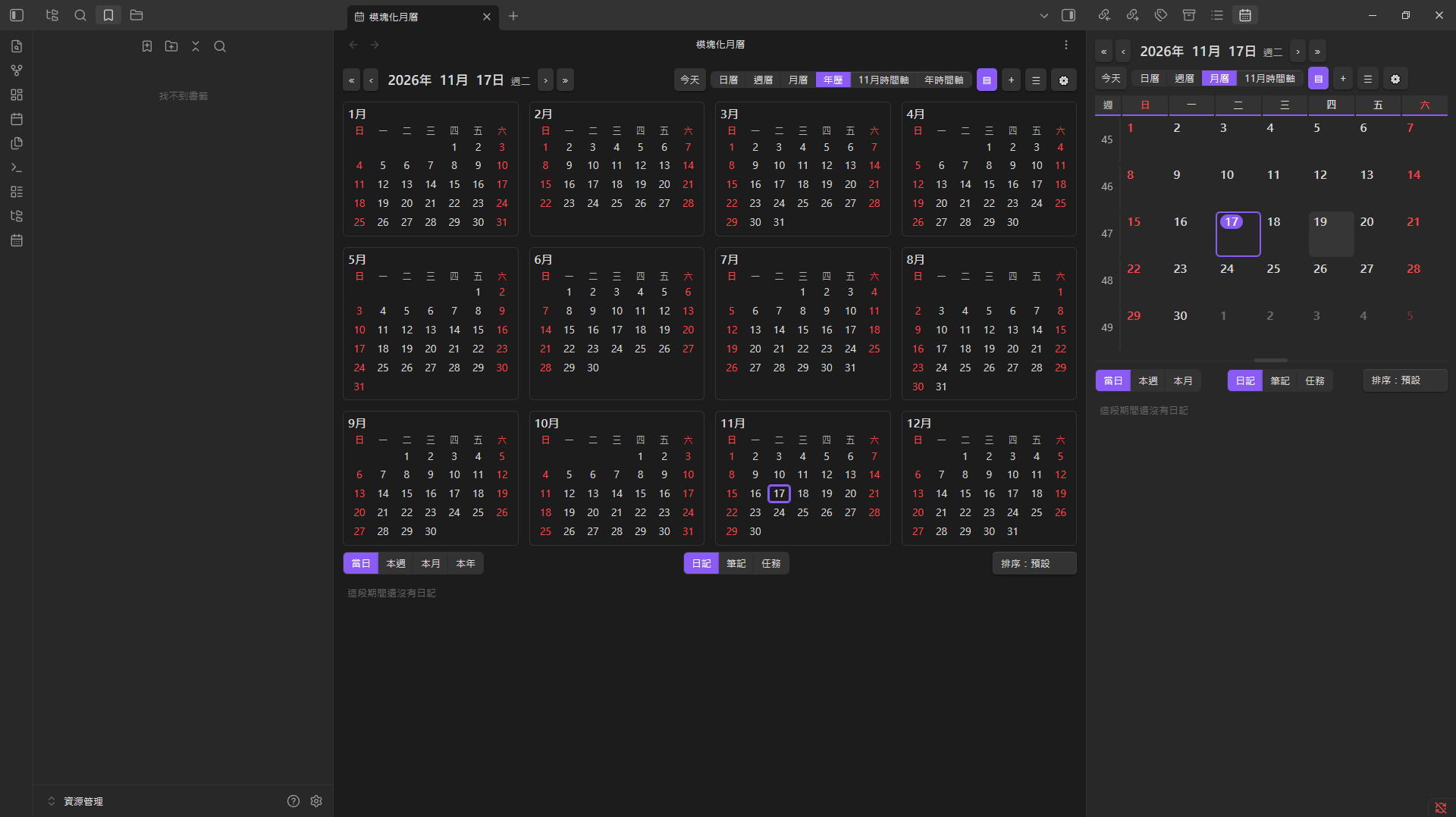
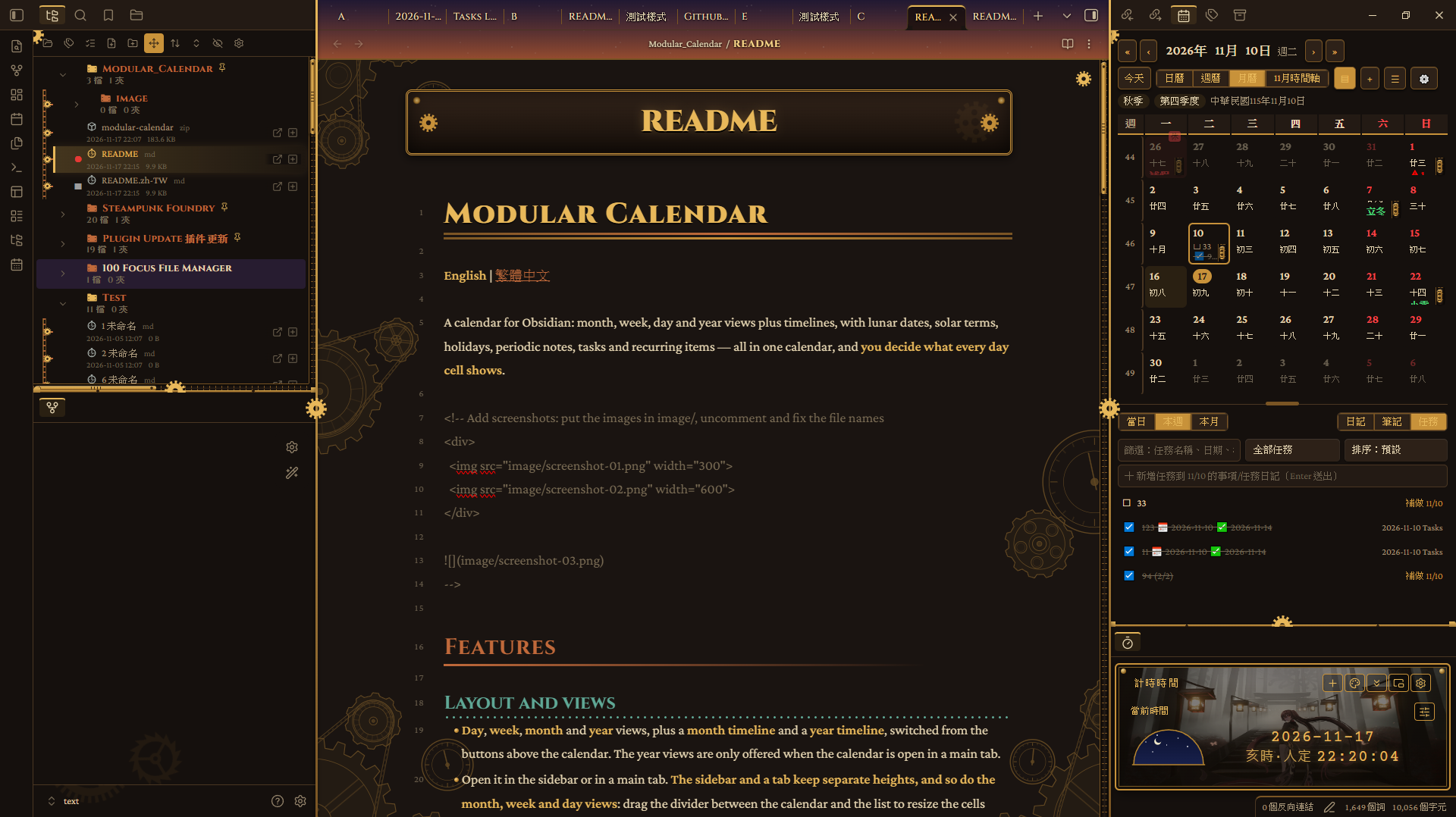
Features
Layout and views
- Day, week, month and year views, plus a month timeline and a year timeline, switched from the buttons above the calendar. The year views are only offered when the calendar is open in a main tab.
- Open it in the sidebar or in a main tab. The sidebar and a tab keep separate heights, and so do the month, week and day views: drag the divider between the calendar and the list to resize the cells (double-click resets); there is no height limit in a tab. When a cell's content is taller than the cell, the cell scrolls.
- The week view has two modes: week number (the week containing the selected day, with its number) and today (today on the left, then the next six days). In a narrow pane it turns into one row per day.
- The header shows "YYYY年 M月 D日", the season and quarter, and the lunar date;
«»jump a year,‹›a month / week / day, click the year or month to jump, "Today" goes back to today. The toolbar wraps when the sidebar is narrow. - Start date: choose the earliest day the calendar can show (optionally plus an elapsed time).
Calendar data
- Lunar date, lunar festivals and solar terms; seasons and quarters with defaults or your own.
- Another date line: a national era (Reiwa, Minguo, Buddhist era), the national lunar date, or a custom one (start date + elapsed time, with a name).
- Japan mode: Japanese weekdays, era names, rokuyō and the old calendar.
Holidays and badges
- Download public holidays for Taiwan, China, Japan, the US and many other countries (see Disclosures), or choose "custom" and import your own JSON.
- Rest / work / custom badges: color, opacity, cell background, position (inside the cell or on its border) and alignment are configurable; the priority of badges and backgrounds can be reordered by dragging. The month and year views use the same colors.
- Custom badges use date rules (each rule needs a year or a count). Right-click → Add custom badge adds an existing or new badge to a day, or choose "None" to cancel that day's custom badges. A custom badge whose label equals the rest / work label is treated as part of the downloaded holidays.
Periodic notes
- Daily, weekly, monthly, quarterly and yearly notes plus an "item/task diary"; folders, year/month sub-folders and file-name formats are configurable.
- Templates support
{{date}},{{date:format}}and{{title}}(daily notes also get lunar, solar term and holiday variables); Templater syntax is processed if Templater is installed. A template can be a file, several files or a folder — with several, a picker appears before creating. - Right-click a day, the week-number column or the header to create day / week / month / quarter / year notes; double-click a day to open or create the daily note; open in the current tab or a new tab.
- A day can have extra daily notes, and "extra sources" assign notes from other folders to a day by a YAML date property.
Day cells
- Built-in modules: solar date, lunar date, lunar festival, solar term, holiday name, rest/work/custom badges, holiday background, note dot, task-list dot, daily content. Each module can be switched on or off and placed in a cell slot.
- Info rows: items under the date get a row each by default; drag an item behind another to share a row, or drag a whole row to reorder.
- ☰ Calendar content (next to the settings gear): tick what every day cell lists — custom items/tasks, tasks, note names, completed tasks. The maximum per day is configurable (automatic by default); beyond it the cell shows "N more…", click to expand and click again to collapse.
- Dots: shape, color, maximum count, automatic switch to a number by cell size; the note dot and the task dot can each read their own files or folders. Pending tasks show "⚠ count" (symbol and color are configurable).
- Hover the date number to list everything about that day (lunar date, solar term, festival, holiday, badges, custom items/tasks, notes and pending tasks).
- Week-number column, week statistics, grid lines, fonts and all colors (theme colors or your own) are adjustable.
- Action modules: choose what a click, a double-click and a right-click do.
List under the calendar
- Scope: day, week, month, year; content: notes, extra notes, tasks.
- Notes can be sorted by name or by the date in the file name; tasks can be filtered (name, date, file name, source) and sorted (name, time, time left, name-time).
- The number of visible rows is fixed or automatic (fills the space below the calendar); the quick-add input lets you pick the heading; the month / year timelines list tasks and sort them by name.
Tasks
- Tasks are written into the day's item/task diary or the daily note, under a heading you pick (several headings can be configured); the diary can use task templates.
- Time status next to a task follows the Tasks plugin's date logic: due (📅), start (🛫), scheduled (⏳) — e.g. "due today", "starts in 12 days", "overdue by 3 days" — with configurable text and colors.
- Optional Tasks plugin integration: right-click → "New task (Tasks style)" opens its "Create or edit task" panel, after letting you pick the location, template and heading; right-click a task in the list or timeline to edit it with the same panel.
Custom items and tasks
- Right-click a day → Create custom item/task opens one form: type (task you can tick / item that is only shown), storage (long-term / same day), repeat (none / daily / weekly / monthly / yearly / custom), strategy (must-do / check-in), every N days / weeks / months / years, weekdays, month days, counting from month end, start date, times, per-time count, per-period count and end (forever / end date / after N cycles). Dates and times can be picked with quick buttons; a live summary is shown below.
- Long-term items are stored where you choose (root folder, year/month sub-folders, file-name format, or a custom path in the form); same-day ones are written into that day's item/task diary and shown in that day's cell.
- Missed must-do tasks stay in the task list (marked "make-up") until done; missed check-in tasks are skipped.
- Ticking a task in the calendar writes the completion back into the note; changing it in the note updates the calendar.
- The form can be saved as a template, applied later, and exported to / imported from a file.
- Right-click → View custom items/tasks (a resizable window) or Open view in a new tab: filter, sort, edit, copy, delete and reorder.
Settings
- Settings are split into categories (a row of buttons at the top) and searchable; settings that must be confirmed (custom badges, the other date line) have a "Save & apply" button with a status; presets are built in (all modules off = a plain standard calendar).
Installation
Manually: download main.js, manifest.json and styles.css from the latest release into <vault>/.obsidian/plugins/modular-calendar/, then enable the plugin in the settings.
BRAT: add this repository's URL in the BRAT plugin.
Community plugin list: once accepted, search for Modular Calendar under Settings → Community plugins → Browse.
Open it from the ribbon icon or the command palette ("Open calendar", "Open calendar in a new tab", "Open custom items/tasks in a new tab").
Disclosures
- No telemetry, no payment. The plugin only uses the network when you choose a holiday source in the settings: it downloads the holiday data for the years you view and caches it in the plugin's data file; choose "custom" to stay offline. Sources: Taiwan ruyut/TaiwanCalendar and China NateScarlet/holiday-cn (both through
cdn.jsdelivr.net), Japan, the US and other countries Nager.Date. - It only reads and writes files inside your vault: periodic notes, long-term custom items/tasks in the "Tasks List" folder (configurable), the template file "自訂事項模板.md" (configurable location), and notes whose tasks you tick or edit. Same-day items/tasks get a hidden
%%cd%%comment at the end of the line so the calendar can find them. - It uses a few undocumented Obsidian internals: detecting and calling the Tasks plugin's API and commands, the Templater plugin, and opening this plugin's settings tab. These may change with Obsidian or those plugins.
- A long-term task's completion log is an indented task line under the item, so Tasks plugin queries may list those lines as ordinary tasks.
- Developed and tested on desktop (Windows). Mobile has not been tested; drag and drop in the settings may not work on touch screens.
Issues and suggestions
If you hit a problem or have a suggestion, please open an issue. Including your Obsidian version, plugin version, theme and steps to reproduce (or a screenshot) makes it much easier to handle. The full history is in CHANGELOG.md.
For plugin developers
Search results and similarity scores are powered by semantic analysis of your plugin's README. If your plugin isn't appearing for searches you'd expect, try updating your README to clearly describe your plugin's purpose, features, and use cases.