Nested Vaults
approvedby Real-Fruit-Snacks
Scope your vault to a specific folder, effectively treating it as a nested sub-vault. - This plugin has not been manually reviewed by Obsidian staff.
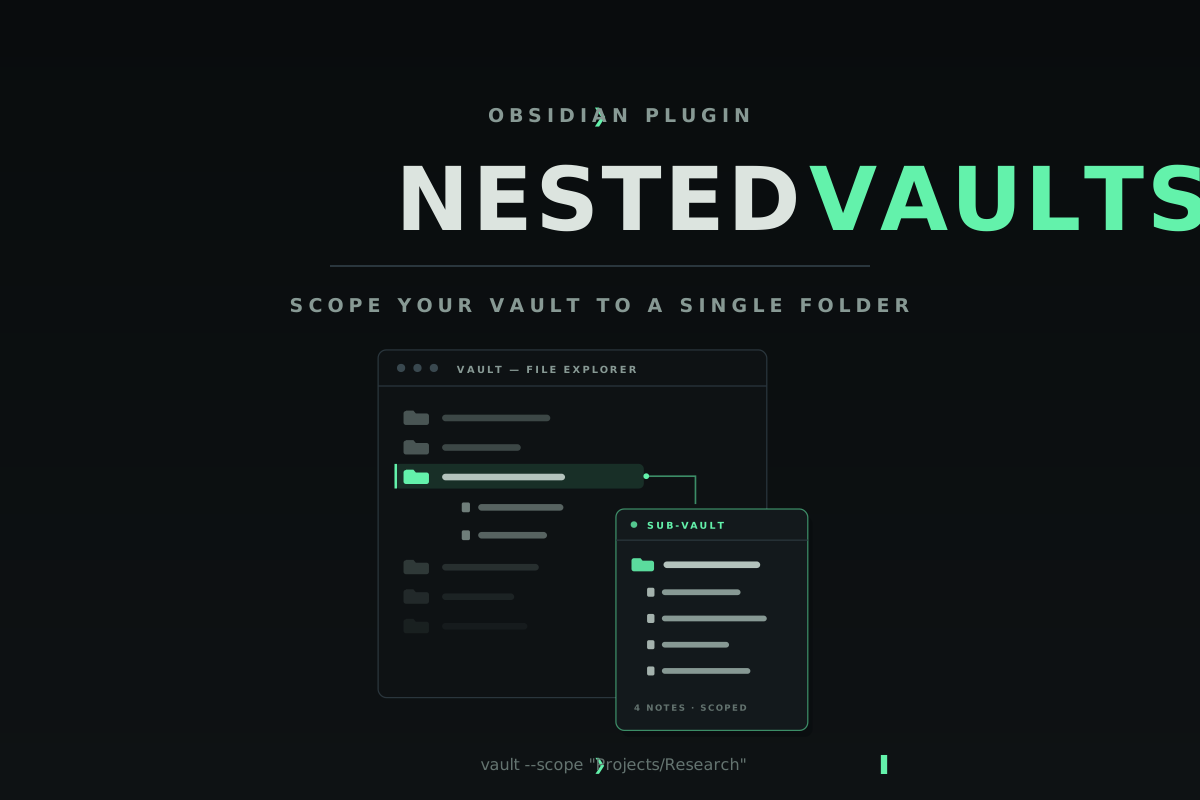
Scope your entire Obsidian vault down to a single folder — file explorer, search, graph, tags, and backlinks all respect the boundary.



Overview
A big master vault is great — until you need to spend the afternoon inside one project. Nested Vaults lets you pick any folder and treat it as a temporary vault of its own, without opening a second vault window or losing your plugins, themes, and settings.
While a Sub-Vault is active, the file explorer shows only that folder (plus anything you whitelist), core Search and the Graph views carry a path: filter for it, the tag pane shows only tags used inside it, backlinks from outside it are hidden, and opening an outside file is blocked with a notice. Leave the Sub-Vault from the status bar or ribbon and everything returns instantly — nothing about your files is ever changed to make the scoping happen.
Features
- File explorer scoping — folders and files outside the active Sub-Vault are hidden. Parents of the Sub-Vault and of allowed folders stay visible so everything remains reachable.
- Search and Graph scoping — a
path:"<sub-vault>"filter is added to core Search, Graph, and local graph queries, and cleanly removed when you leave. Your own query text is left untouched. Toggleable in settings. - Tag pane filtering — only tags used by notes inside the Sub-Vault are shown, with nested tags (
#project/idea) matched by their full path. - Backlink filtering — backlinks from notes outside the Sub-Vault are hidden, both in the backlinks pane and in the linked-mentions section at the bottom of notes.
- Open blocking — following a link to a file outside the Sub-Vault shows a notice and turns the tab into an empty tab instead of opening the file.
- Global allowed folders — whitelist folders like
AttachmentsorTemplatesthat stay visible and accessible in every Sub-Vault, so embeds and templates never break. - Scoped quick switcher — a quick switcher that searches only inside the active Sub-Vault, with paths shown relative to it.
- Auto-move new notes (opt-in) — notes created outside the Sub-Vault are moved into it automatically, with links to the moved note updated.
- Status bar and ribbon — the status bar shows the active Sub-Vault (click it to leave), and a ribbon action leaves it too. Renaming the scoped folder follows along; deleting it clears the scope.
Installation
Requires Obsidian 1.4.10 or newer.
Community plugins (recommended)
- Open Settings → Community plugins → Browse.
- Search for Nested Vaults, then Install and Enable.
BRAT (for the latest pre-release)
Install BRAT, then add Real-Fruit-Snacks/obsidian-nested-vaults as a beta plugin.
Manual
Download main.js, manifest.json, and styles.css from the latest release into <your-vault>/.obsidian/plugins/nested-vaults/, then enable Nested Vaults under Settings → Community plugins.
Getting started
- Enter a Sub-Vault — right-click any folder in the file explorer and choose Set as Active Sub-Vault, or run Set Active Sub-Vault from the command palette.
- Work — the explorer, search, graph, tags, and backlinks are now scoped to that folder.
- Leave — click the Sub-Vault name in the status bar, or the Leave Active Sub-Vault ribbon icon, and the whole vault comes back.
Commands
| Command | Description |
|---|---|
| Set Active Sub-Vault | Pick a folder to scope the vault to |
| Clear Active Sub-Vault | Return to the full vault |
| Open Scoped Quick Switcher | Quick switcher limited to the active Sub-Vault |
Settings
| Setting | Default | Description |
|---|---|---|
| Active Sub-Vault | (empty) | The folder currently scoped to; supports autocomplete |
| Auto-move new notes into the Sub-Vault | Off | Move notes created outside the Sub-Vault into it, updating links |
| Scope Search and Graph to the Sub-Vault | On | Add and maintain the path: filter in Search and Graph queries |
| Global allowed folders | Attachments, Templates | Folders that stay visible and accessible in every Sub-Vault |
How the scoping works
Nested Vaults never moves, locks, or rewrites your files to create the boundary. The file explorer, tag pane, and backlinks are scoped by tagging out-of-scope items with a CSS class that hides them; Search and Graph are scoped by inserting a path: token into their query inputs; and out-of-scope files are kept out of view by intercepting file-open events. Disable the plugin (or leave the Sub-Vault) and your vault is exactly as it always was.
Because the boundary is a view-level convenience rather than a permission system, other plugins that read the vault directly can still see the whole vault.
Architecture
nested-vaults/
├── manifest.json    Plugin metadata
├── versions.json    Plugin version → minimum Obsidian version map
├── main.js          Plugin code (single-file CommonJS, no build step)
├── styles.css       One rule: hide elements marked out-of-scope
└── docs/            Documentation site and artwork
- No build step — a single hand-maintained CommonJS
main.js, with no framework or bundler. - Event-driven — scoping refreshes on vault, metadata, and layout events plus targeted pane observers, debounced so rapid changes coalesce into one pass.
- Safe writes — the only file operation the plugin can perform is the opt-in auto-move, which uses
fileManager.renameFileso links to the moved note are updated. - No network, no telemetry — the plugin never talks to the network.
License
Released under the MIT License.
For plugin developers
Search results and similarity scores are powered by semantic analysis of your plugin's README. If your plugin isn't appearing for searches you'd expect, try updating your README to clearly describe your plugin's purpose, features, and use cases.