Relative Dates
pendingby Munckenh
Relative, color-coded dates.
Relative Dates
A simple plugin for Obsidian that transforms date references in your task lists into color-coded elements that show relative dates.
Features
- Converts date references in the format
@ YYYY-MM-DD(with optional timeHH:MM) into relative dates - Supports changing the default
@prefix through the plugin settings - Works in both Reading mode and Live Preview mode
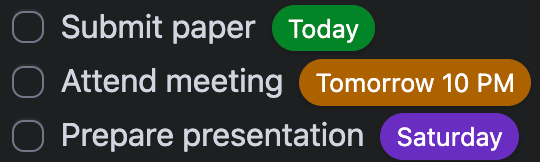
- Color-coded elements based on date proximity (overdue, today, tomorrow, this week, future)
- Customizable colors through the plugin settings
Usage
Add dates in your task lists using the format:
@ 2025-08-12for dates@ 2025-08-12 14:30for dates with time
The plugin will automatically convert these into easy-to-read elements such as:
Installation
- Clone the repository to
.obsidian/plugins/:git clone https://github.com/Munckenh/obsidian-relative-dates.git - Install the dependencies and compile:
npm install npm run build - Enable the plugin in Obsidian
Release
To release a new version of the plugin:
- Update
manifest.jsonwith the new version number, such as1.0.1, and the minimum Obsidian version required for the latest release. - Run
npm version patch,npm version minor, ornpm version major. - Create new GitHub release using the new version number as the "Tag version". Use the exact version number, don't include a prefix
v. See here for an example: https://github.com/obsidianmd/obsidian-sample-plugin/releases - Upload the files
manifest.json,main.js,styles.cssas binary attachments. Note: The manifest.json file must be in two places, first the root path of the repository and also in the release. - Publish the release.
Scripts
To manage the plugin, you can use the following scripts:
- Build the plugin by running
npm run buildor with live reload by runningnpm run dev - Improve code quality (optional) by running
npm run lint
For plugin developers
Search results and similarity scores are powered by semantic analysis of your plugin's README. If your plugin isn't appearing for searches you'd expect, try updating your README to clearly describe your plugin's purpose, features, and use cases.