TubeSage
approvedby rmccorkl
Create comprehensive notes from YouTube transcripts using LLMs. - This plugin has not been manually reviewed by Obsidian staff.
TubeSage
TubeSage is an Obsidian plugin that converts YouTube videos into structured notes using large language models. It extracts transcripts, generates summaries, and can add timestamped links back to specific moments in the video.
Demo — click the image to watch the walkthrough video:
Quick Start
Installation
Community Plugins: Install through Obsidian's Settings → Community plugins browser once TubeSage is listed in the directory.
Manual install from a GitHub release:
- Open the latest release page.
- From the Assets section, download
main.js,manifest.json, andstyles.css. Do not download "Source code (zip)" or "Source code (tar.gz)" — those are source archives and will not load as a plugin. - In your vault, create the folder
.obsidian/plugins/tubesage/. - Move the three downloaded files into that
tubesage/folder. - In Obsidian, go to Settings → Community plugins, toggle off "Restricted mode" if needed, refresh the installed-plugins list, and enable TubeSage.
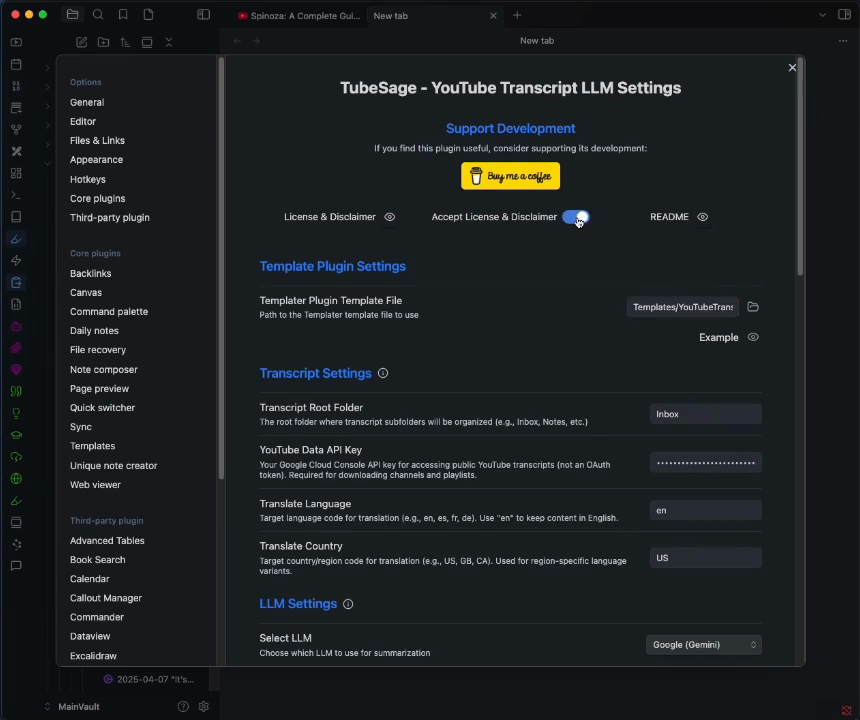
- Accept the license terms in TubeSage's settings panel.
- Configure API keys for your preferred LLM provider.
- (For YouTube notes) Install the Templater plugin for template-driven formatting.
Requirements
- Obsidian v1.11.4+ (TubeSage stores cloud API keys using Obsidian's secret storage, which was introduced in 1.11.4)
- Templater plugin (required for template functionality)
- An API key for at least one LLM provider:
- OpenAI
- Anthropic
- Google (Gemini)
- OpenRouter
- Ollama (local models)
- A YouTube Data API key (optional — required only for channel/playlist processing)
Features
- Transcript extraction from YouTube videos with fallback methods
- Summary generation using a configurable LLM provider
- Optional timestamp links added to section headings, linking to the moment in the video
- Works on desktop and mobile Obsidian
- Batch processing of YouTube channels and playlists
- Multi-provider support: OpenAI, Anthropic, Google Gemini, OpenRouter, and Ollama
- A cross-platform fetch shim so all providers work on mobile without Node.js dependencies
Configuration
1. License acceptance
Accept the MIT license terms in the settings panel before using the plugin. Use the "View License" button to read the full text.
2. LLM provider setup
Choose and configure a provider in settings:
- OpenAI — models such as GPT-4o, GPT-4, GPT-3.5-Turbo.
- Anthropic — Claude 3 family models.
- Google Gemini — Gemini Pro models.
- OpenRouter — gateway access to models from multiple vendors.
- Ollama — local open-source models; runs offline, requires Ollama installed and running.
Where API keys are stored: cloud-provider keys (OpenAI, Anthropic, Google, OpenRouter) are saved in Obsidian's native secret storage, not in the plugin's data.json. Type a key into its provider field and it is written to the secret store automatically — there is no separate setting to enable this, and it is not optional. The Ollama field holds a server URL rather than a secret, so it remains in plugin data.
3. Other settings
- Summary modes: Fast (brief) or Extensive (detailed).
- Timestamp processing: enable or disable automatic timestamp links.
- Batch processing: sequential or parallel processing for collections.
- Performance monitoring: optional logging of processing times.
Usage
Basic workflow
- Click the YouTube icon in the ribbon, or use the Command Palette.
- Paste a YouTube video URL.
- Choose a summary mode and folder location.
- Run processing.
- The resulting note appears in the chosen folder.
Batch processing (channels/playlists)
- Configure a YouTube Data API key in settings.
- Paste a channel or playlist URL.
- Set the number of videos to process.
- Choose sequential or parallel processing.
Timestamp navigation
When enabled, each section heading includes a link that opens the YouTube video at the corresponding moment.
Technical Architecture
- Main plugin (
main.ts): coordinator and UI. - Transcript extractor (
src/youtube-transcript.ts): multi-method extraction with mobile fallbacks. - LLM factory (
src/llm/llm-factory.ts): constructs the provider client. - Transcript summarizer (
src/llm/transcript-summarizer.ts): orchestrates summarization. - LangChain client (
src/llm/langchain-client.ts): unified interface for cloud providers. - Fetch shim (
src/utils/fetch-shim.ts): cross-platform HTTP via Obsidian'srequestUrl. - Timestamp processor (
src/utils/timestamp-utils.ts): timestamp link generation. - Error utilities (
src/utils/error-utils.ts): error categorization and retry logic.
Architecture diagrams are in the docs/ directory:
Privacy & Security
API keys
Cloud-provider API keys (OpenAI, Anthropic, Google, OpenRouter) are stored in Obsidian's native secret storage, never written to the plugin's data.json. Keys saved by versions older than 1.3.0 are migrated into secret storage automatically the first time you open the plugin after upgrading.
Network requests
All requests use HTTPS. TubeSage contacts:
- YouTube, to fetch video metadata and transcripts.
- Your configured LLM provider (OpenAI, Anthropic, Google, or OpenRouter), to generate summaries. If you use Ollama, requests go only to your local Ollama server and nothing leaves your machine.
- ScrapeCreators (
api.scrapecreators.com) and Supadata (api.supadata.ai) — contacted only if you choose to configure an API key for one of them. These are optional paid transcript services used as alternatives or fallbacks to direct YouTube extraction; with no key set, neither is contacted.
That is the complete list. LangChain's bundled tiktoken helper, which would otherwise fetch tokenizer data from a third-party CDN, is replaced with a network-free stub at build time, so TubeSage contacts no other hosts.
No user data is stored on servers operated by the plugin author.
The plugin also bundles langsmith as a transitive dependency of @langchain/core. langsmith is LangChain's optional tracing library and contains a background cache-refresh timer. TubeSage never enables LangSmith tracing and never sets a LangSmith API key, so this code stays dormant and performs no background network transmission.
Static analysis of the bundled main.js shows a few atob()/btoa() (base64) calls. These all originate in bundled libraries, not in TubeSage's own code, and are all routine: decoding embedding vectors and image data URLs, reading a JWT header, and encoding Mermaid diagram syntax for rendering. None of them obscure code, API keys, or URLs.
Vault and system access
- Vault files: TubeSage lists the folders and Markdown files in your vault so you can choose where notes are saved and pick template files. It reads and writes only the note and template files involved in processing.
- Clipboard: write-only. The "Copy template" button in the template viewer writes template text from within Obsidian to your system clipboard. TubeSage never reads the clipboard, so it cannot access or expose anything copied from outside Obsidian.
Troubleshooting
- API key errors: verify keys are configured correctly in settings.
- Mobile processing issues: ensure a stable connection, or use Ollama for offline processing.
- Timestamp link failures: check video availability and URL format.
- Batch processing limits: monitor YouTube API quota usage.
License
This project is licensed under the MIT License — see the LICENSE file. A YouTube content-usage disclaimer is included in MIT-license-tubesage.md.
Support & Contribution
- GitHub Issues: bug reports and feature requests.
- Code contributions: fork the repository and open a pull request.
GitHub Repository: https://github.com/rmccorkl/TubeSage
For plugin developers
Search results and similarity scores are powered by semantic analysis of your plugin's README. If your plugin isn't appearing for searches you'd expect, try updating your README to clearly describe your plugin's purpose, features, and use cases.