Lightweight HTML Reader
unlistedby Autonomous Work
Read HTM and HTML files natively within the Editor.
Lightweight HTML Reader
An Obsidian plugin that lets you read .htm, .html, .jsx, and .tsx files directly in your vaults.
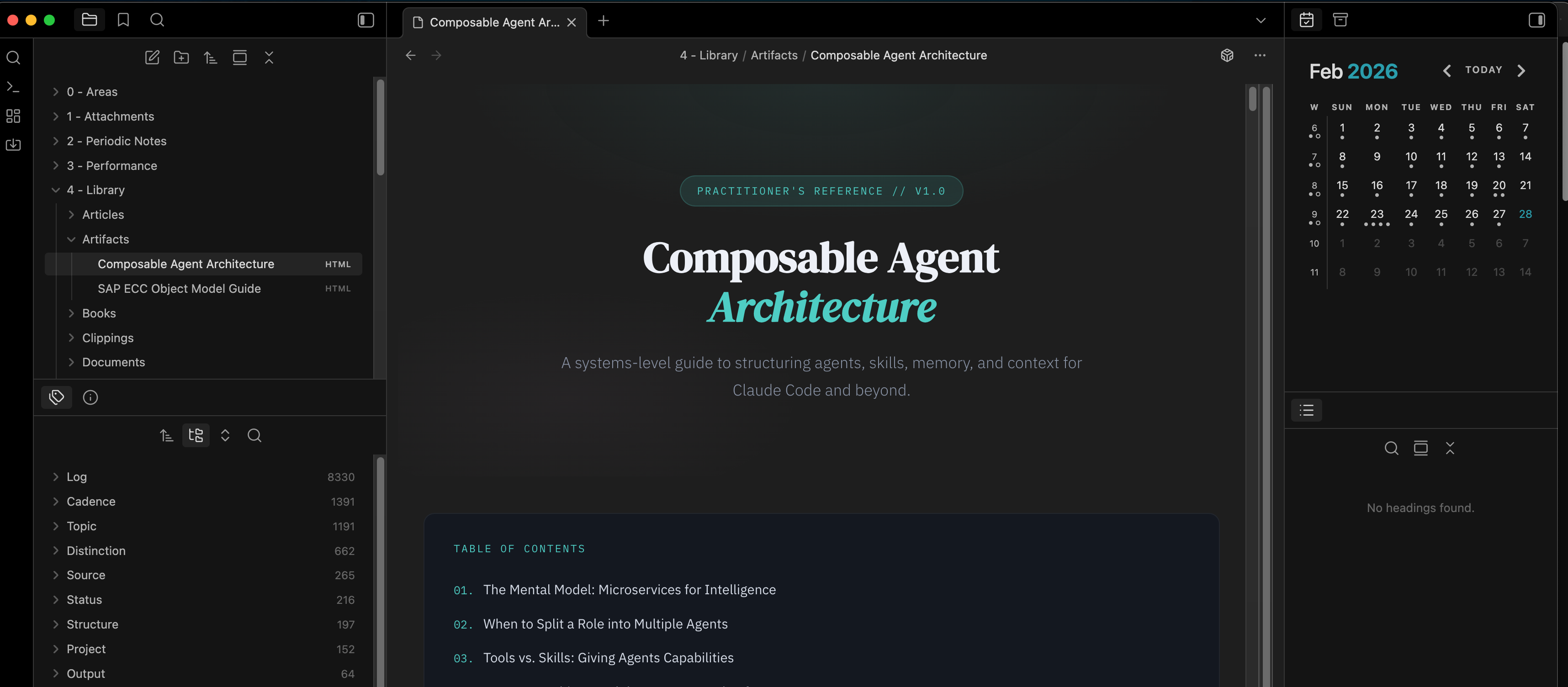
Features
- Native HTML rendering — open HTM/HTML files as a tab. No external dependencies
- Standalone React component rendering — open JSX and TSX files that export a React component or React element and render them locally inside Obsidian.
- Configurable security modes — choose how aggressively content is sanitized:
- Restricted — strips scripts, styles, forms, iframes, and inline event handlers.
- Balanced (default) — strips scripts and dangerous elements but preserves CSS styles.
- Unrestricted — renders HTML as-is with no sanitization.
- Optional script execution — in unrestricted mode, you can allow JavaScript to run for sandboxed HTML rendering and standalone JSX/TSX components.
- Local-only JSX runtime — bundles a React-compatible runtime and a small JSX transformer so standalone component files render without a remote service or external build step.
- Dark mode support — automatically injects dark-mode-friendly styles so HTML pages look comfortable in dark themes.
- Cross-platform — HTML uses a sandboxed
<iframe>on desktop and a Shadow DOM renderer on mobile, while JSX and TSX files render through a local React root.
Setup
Before using the plugin, Obsidian needs to be configured to detect and display non-markdown file types.
1. Enable file detection
Go to Settings → Files and links → Show all file types. Turn this on so Obsidian recognizes .htm, .html, .jsx, and .tsx files in your vault.
2. Sync supported files (Obsidian Sync users)
If you use Obsidian Sync, go to Settings → Sync → Selective sync and enable Sync all other types. This ensures your HTML and JSX files are synced across devices.
Installation
From community plugins
Search for Lightweight HTML Reader in Settings → Community plugins → Browse and install.
Manual
- Build the plugin (see below) or download
main.js,manifest.json, andstyles.cssfrom a release. - Copy those files into your vault at
<Vault>/.obsidian/plugins/lightweight-html-reader/. - Reload Obsidian and enable the plugin in Settings → Community plugins.
Development
Requires Node.js 18+.
npm install
npm run dev      # watch mode
npm run build    # production build
Settings
| Setting | Description | Default |
|---|---|---|
| Security mode | Controls HTML sanitization level (Restricted / Balanced / Unrestricted) | Balanced |
| Allow scripts | Allow JS execution for unrestricted HTML files and standalone JSX/TSX component files | Off |
| Dark mode support | Inject dark mode styles into rendered HTML | On |
JSX and TSX files
Standalone JSX and TSX files are rendered locally with a React-compatible runtime when they export a component or a React element. To run them:
- Set Security mode to Unrestricted.
- Turn on Allow scripts.
- Open a
.jsxor.tsxfile from the vault.
Current JSX support is intentionally small and local-first:
- Files should be self-contained and export a default component,
App, or a React element. - Imports are limited to
react. - No remote bundling, CDN imports, or extra build step is required.
Example:
import {useState} from "react";

export default function Counter() {
	const [count, setCount] = useState(0);

	return (
		<main style={{padding: 24}}>
			<h1>Hello from Obsidian</h1>
			<button onClick={() => setCount(count + 1)}>
				Clicked {count} times
			</button>
		</main>
	);
}
License
For plugin developers
Search results and similarity scores are powered by semantic analysis of your plugin's README. If your plugin isn't appearing for searches you'd expect, try updating your README to clearly describe your plugin's purpose, features, and use cases.