by Eren Can
Run AI coding agents like Claude Code and Codex or etc. in your Obsidian sidebar.
ecu-ai
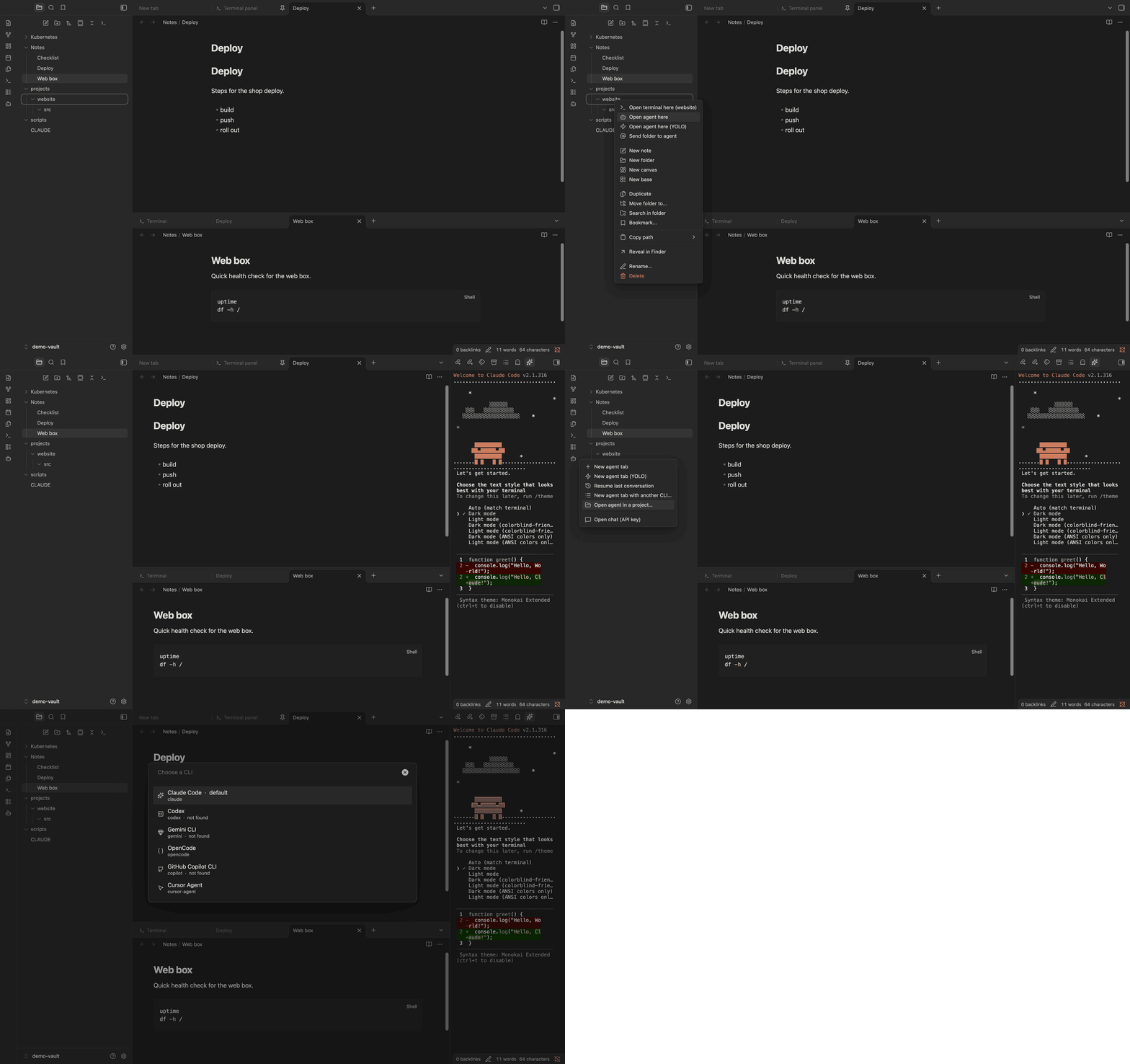
Run AI coding agents in your Obsidian sidebar. Click the ribbon button and Claude Code starts in a real terminal next to your notes, in your vault folder. Open more tabs, switch to Codex, Gemini CLI or another CLI, or start an agent in any folder on your computer.
No agent installed? The chat panel talks to the Claude API with your own API key, and works on mobile too.
Features
- Starts right away: the ribbon button opens your default CLI in the right sidebar. Click it again to come back to the same tab.
- Multiple tabs: run several agents side by side. New tabs open next to the last one.
- Folder menu: right-click a folder for Open agent here or Open agent here (YOLO).
- Send notes to the agent: right-click a file, a folder or a selection (or use the commands) to
type a reference such as
@Notes/Deploy.md (lines 3-8)into the agent's prompt. You add the question. Open notes are saved first, so the agent reads your latest text. You can also drag files from the file explorer or your desktop into the terminal. - Projects outside the vault: Open agent in a project… opens any folder. Browse… adds it to a list that's kept for next time. Pick the project, then the CLI, with the default on top. If only one CLI is installed, it starts right away.
- Many CLIs: Claude Code, Codex, Gemini CLI, OpenCode, GitHub Copilot CLI and Cursor Agent are built in. Add any other CLI or wrapper script under Additional CLIs.
- YOLO mode starts the agent without approval prompts (
--dangerously-skip-permissionsfor Claude Code, the matching flag for the others). It asks for confirmation first, unless you turn that off. - Conversations continue: tabs reopened after Obsidian restarts continue their last conversation. Resume last conversation does the same on demand.
- Install help: if a CLI isn't installed, the tab shows its install commands with a copy button.
- Safe typing: if the agent is showing a question (first-run setup, "trust this folder", a permission prompt), nothing is typed into it; the reference goes to the clipboard instead.
- Shift+Enter adds a new line in the agent's prompt.
Commands
| Command | What it does |
|---|---|
| Open agent | Brings back the last agent tab, or opens one |
| New agent tab | Opens the default CLI in a new tab |
| New agent tab with another CLI… | Opens another CLI once, without changing the default |
| New agent tab (YOLO) | Opens the default CLI without approval prompts |
| Resume last conversation | Continues the last conversation in a new tab |
| Open agent in a project… | Opens an agent in a folder outside the vault |
| Switch default CLI… | Picks the CLI used by default |
| Toggle focus: editor ↔ agent | Jumps between the note and the agent |
| Close agent tab | Closes the current agent tab |
| Run agent in this note's folder | Starts an agent in the active note's folder |
| Send this file to the agent | Types a reference to the active note |
| Send the selection to the agent | Types a reference to the selected lines |
| Prepare this vault for AI agents | Adds AGENTS.md, CLAUDE.md and GEMINI.md (see below) |
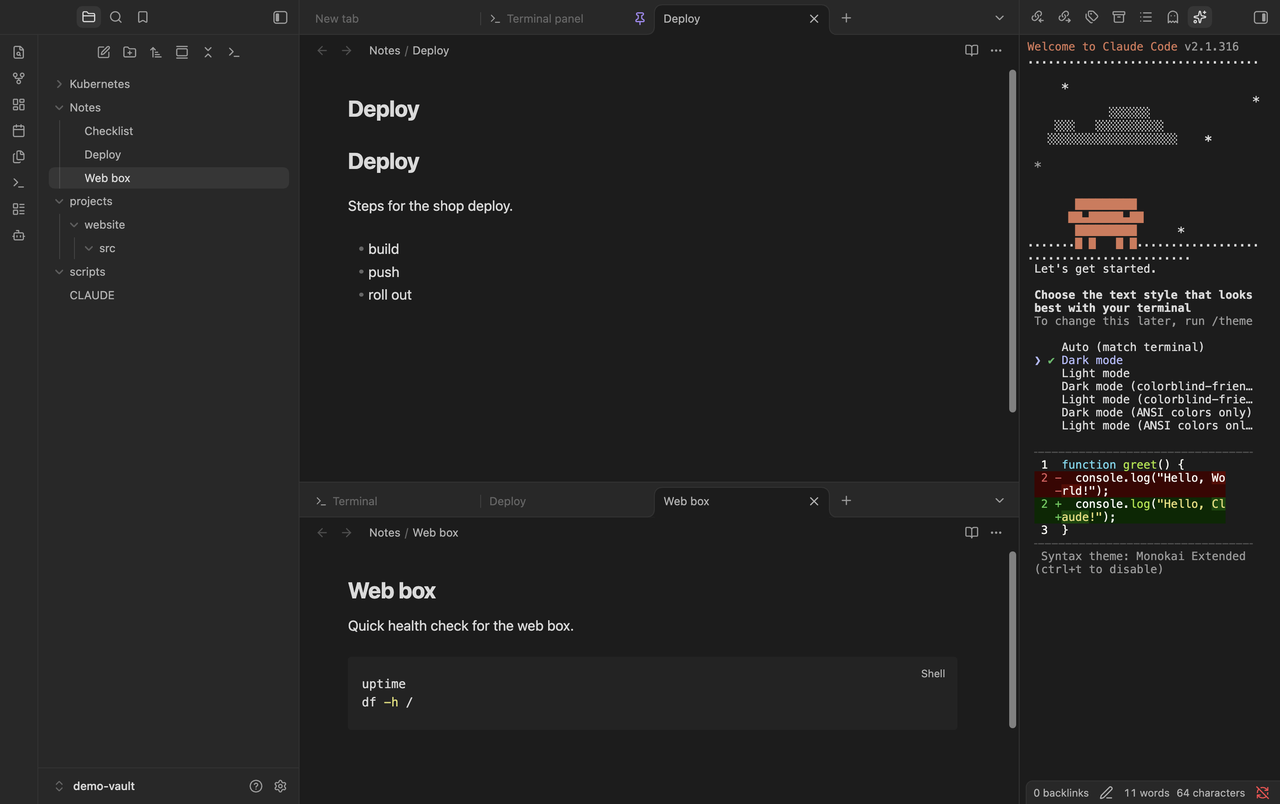
No hotkeys are set by default; add your own under Settings > Hotkeys. Right-click the ribbon button for the most common ones.
Supported CLIs
| CLI | Command | YOLO flag | Resume |
|---|---|---|---|
| Claude Code (default) | claude | --dangerously-skip-permissions | --continue |
| Codex | codex | --dangerously-bypass-approvals-and-sandbox | resume --last |
| Gemini CLI | gemini | --approval-mode=yolo | --resume latest |
| OpenCode | opencode | (none) | --continue |
| GitHub Copilot CLI | copilot | --allow-all | --continue |
| Cursor Agent | cursor-agent | --force | resume |
Each one can use a different command (a full path, for example) and extra arguments such as
--model sonnet. Install the CLI you want and sign in to it once; ecu-ai starts it the same way
your own terminal would.
Chat with an API key
- Add your key from platform.claude.com under Chat with an API key. The key is kept in Obsidian's keychain, not in the vault, so it doesn't travel with sync. Usage is billed to your Anthropic account; the panel shows the tokens each reply used.
- Claude can list, search and read notes, and create, edit and append to notes. Every change is shown first (what's removed, what's added) and only happens when you click Allow, unless you turn "Ask before changes" off or choose "Allow all in this chat".
- Edits replace one exact passage that must appear once in the note, so Claude can't accidentally
rewrite the wrong part. Paths are checked to stay inside the vault, and
.obsidian/is off limits. - Ask in chat about this note attaches the note (and the selected lines) to your next message.
- Every reply has Copy and Insert into note buttons.
- Models: Claude Opus 5.5 (default), Claude Sonnet 5.5 or Claude Haiku 5.5, with a low / medium / high effort setting.
Prepare the vault
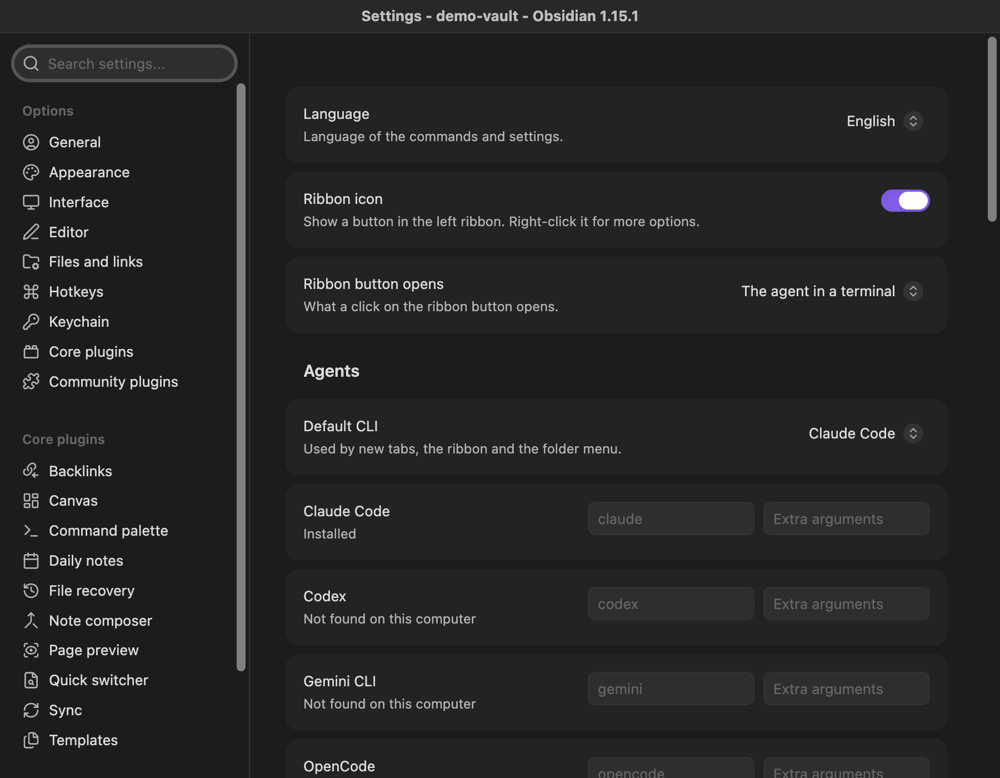
Prepare this vault for AI agents adds:
AGENTS.mdwith the vault's conventions: wikilinks, frontmatter, code blocks with a language, edit in place, write in the note's language, leave.obsidian/alone. Codex, OpenCode, Copilot and Cursor read it directly.CLAUDE.mdandGEMINI.md, which importAGENTS.mdfor Claude Code and Gemini CLI..claude/settings.jsonwith a rule that stops Claude Code from editing.obsidian/.
Existing files are never overwritten.
How it works
- The terminal is xterm.js with node-pty. node-pty is a small native module, so it isn't bundled: the first time you open an agent, ecu-ai downloads the build for your platform from this repository's releases and checks its SHA-256. If ecu-terminal is installed, its copy is reused and nothing is downloaded.
- On macOS and Linux the agent starts through your login shell, so it gets the same
PATHas your terminal. On Windows it starts throughcmd.exe, or through WSL if you choose that in the settings; paths sent to an agent in WSL are converted to Linux paths. - Supported: macOS, Linux and Windows (x64 and arm64). On mobile only the chat panel is available.
Privacy
- In agent tabs ecu-ai makes no network requests itself, apart from the one-time node-pty download. The CLI you run talks to its own service.
- The chat panel sends your messages, and the notes you attach or Claude reads, to the Claude API at api.anthropic.com.
- To find installed CLIs, ecu-ai runs
command -vfor each built-in command in your shell (where.exeon Windows).
Claude Code is a product of Anthropic, Codex of OpenAI, Gemini CLI of Google, OpenCode of SST, GitHub Copilot CLI of GitHub and Cursor Agent of Anysphere. This plugin isn't affiliated with any of them.
Install
-
From the latest release, download
main.js,manifest.jsonandstyles.cssinto<your vault>/.obsidian/plugins/ecu-claude/. (The plugin started out as ecu-claude, and Obsidian keeps a plugin's ID for good, so the folder keeps that name.) -
Enable ecu-ai under Settings > Community plugins.
-
Install at least one agent CLI, for example Claude Code:
curl -fsSL https://claude.ai/install.sh | bash
The interface is in English and Turkish and follows Obsidian's language by default.
License
MIT, see LICENSE.
For plugin developers
Search results and similarity scores are powered by semantic analysis of your plugin's README. If your plugin isn't appearing for searches you'd expect, try updating your README to clearly describe your plugin's purpose, features, and use cases.