TikZJax
approvedby artisticat
Render LaTeX and TikZ diagrams in your notes.
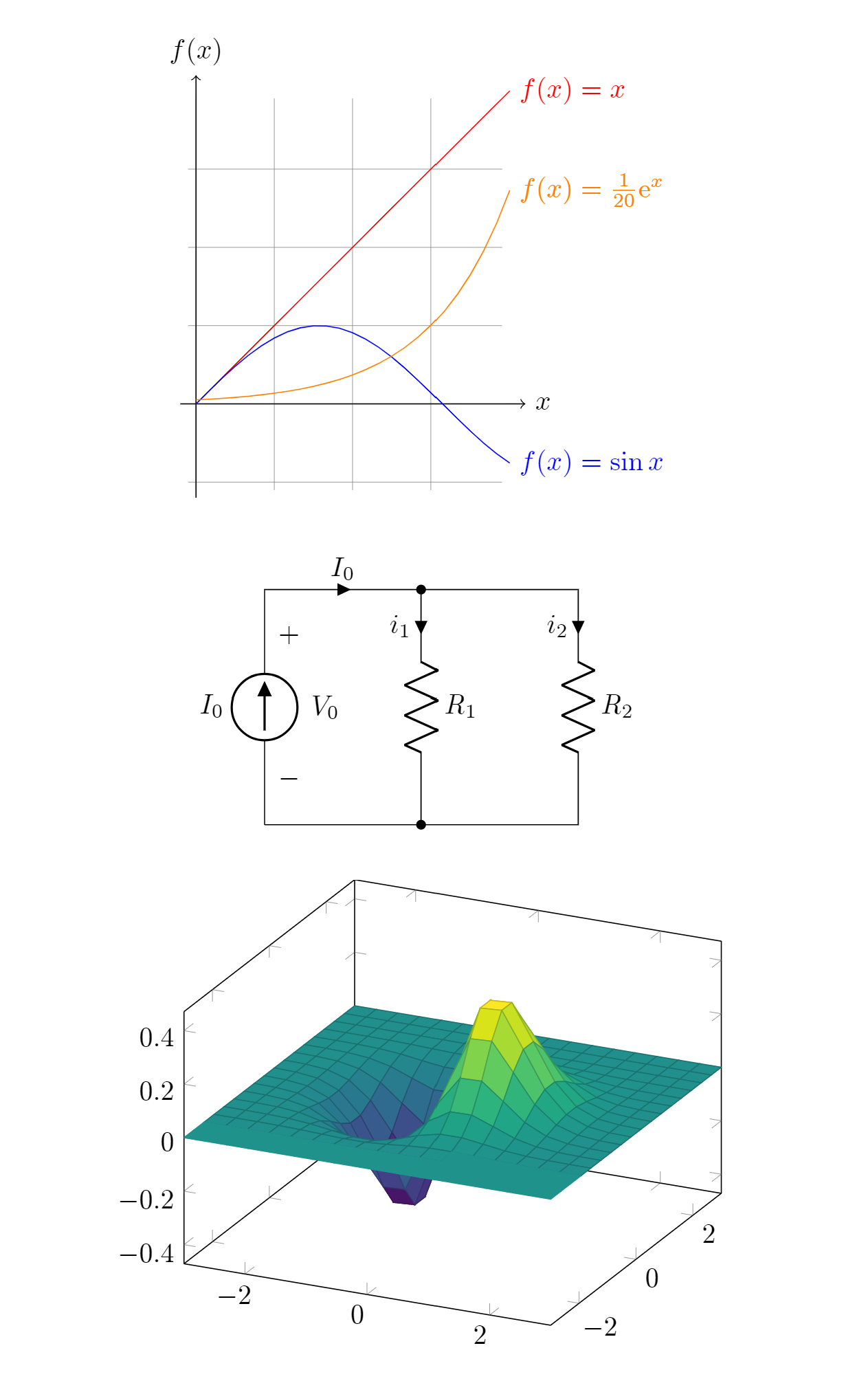
Obsidian TikZJax
A plugin for Obsidian that lets you render LaTeX and TikZ diagrams in your notes.
You can render graphs, figures, circuits, chemical diagrams, commutative diagrams, and more.
The following packages are available in \usepackage{}:
- chemfig
- tikz-cd
- circuitikz
- pgfplots
- array
- amsmath
- amstext
- amsfonts
- amssymb
- tikz-3dplot
Usage
Content inside of tikz code blocks will be rendered by TikZJax.
-
Remember to load any packages you need with
\usepackage{}, and include\begin{document}and\end{document}. -
The standalone document class is used (
\documentclass{standalone}).
Examples
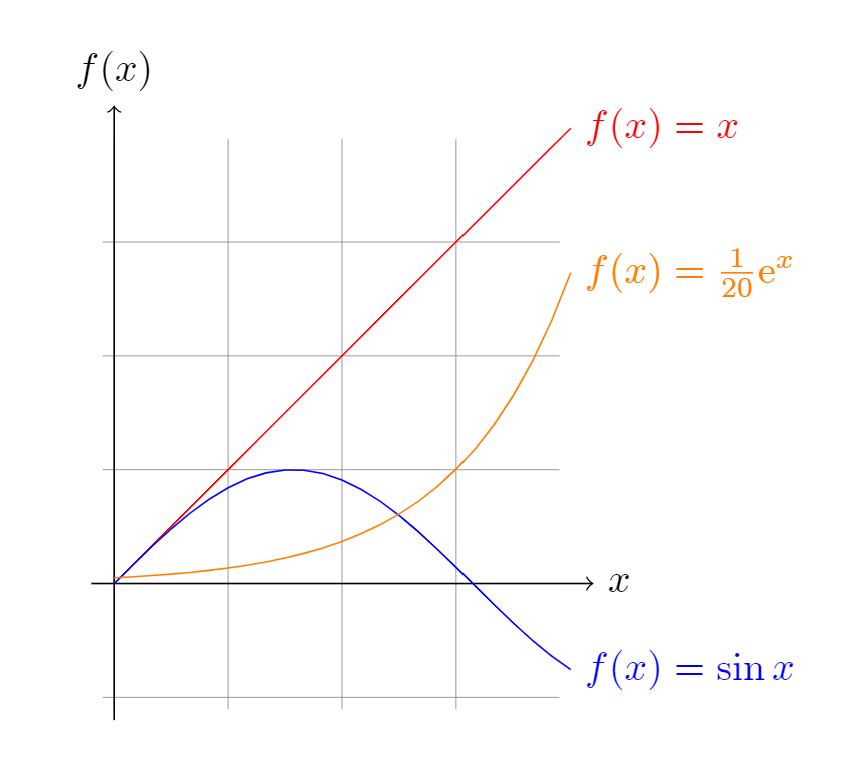
```tikz
\begin{document}
  \begin{tikzpicture}[domain=0:4]
    \draw[very thin,color=gray] (-0.1,-1.1) grid (3.9,3.9);
    \draw[->] (-0.2,0) -- (4.2,0) node[right] {$x$};
    \draw[->] (0,-1.2) -- (0,4.2) node[above] {$f(x)$};
    \draw[color=red]    plot (\x,\x)             node[right] {$f(x) =x$};
    \draw[color=blue]   plot (\x,{sin(\x r)})    node[right] {$f(x) = \sin x$};
    \draw[color=orange] plot (\x,{0.05*exp(\x)}) node[right] {$f(x) = \frac{1}{20} \mathrm e^x$};
  \end{tikzpicture}
\end{document}
```
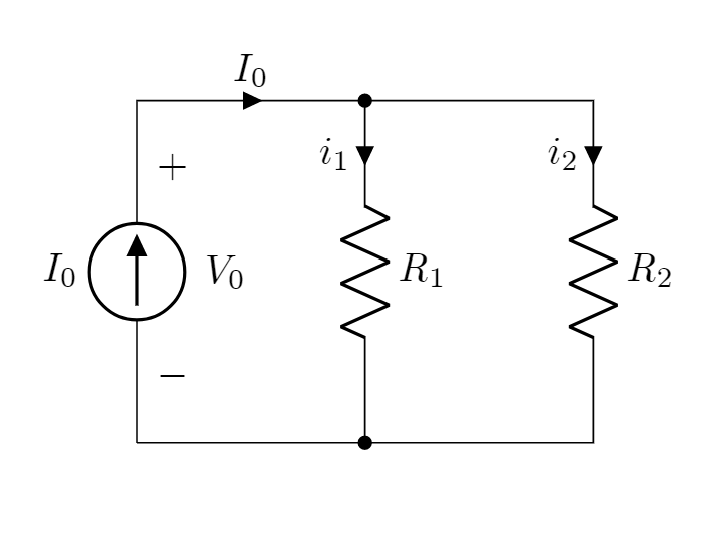
```tikz
\usepackage{circuitikz}
\begin{document}

\begin{circuitikz}[american, voltage shift=0.5]
\draw (0,0)
to[isource, l=$I_0$, v=$V_0$] (0,3)
to[short, -*, i=$I_0$] (2,3)
to[R=$R_1$, i>_=$i_1$] (2,0) -- (0,0);
\draw (2,3) -- (4,3)
to[R=$R_2$, i>_=$i_2$]
(4,0) to[short, -*] (2,0);
\end{circuitikz}

\end{document}
```
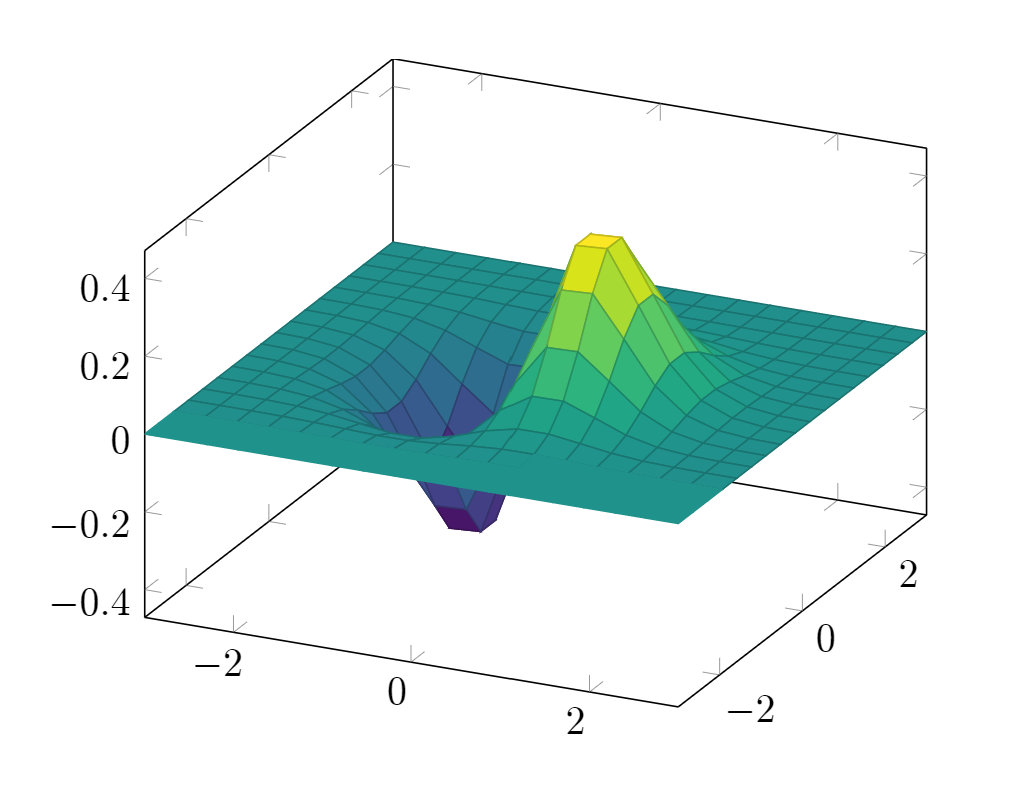
```tikz
\usepackage{pgfplots}
\pgfplotsset{compat=1.16}

\begin{document}

\begin{tikzpicture}
\begin{axis}[colormap/viridis]
\addplot3[
	surf,
	samples=18,
	domain=-3:3
]
{exp(-x^2-y^2)*x};
\end{axis}
\end{tikzpicture}

\end{document}
```
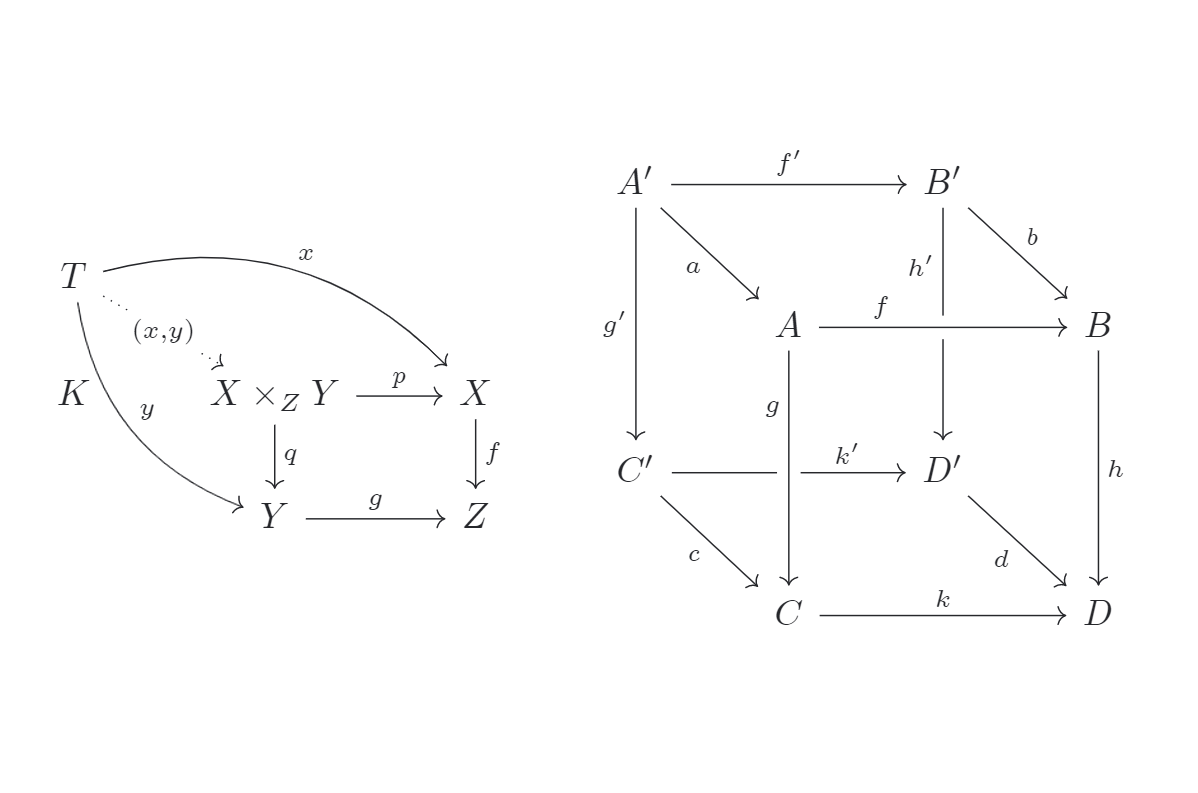
```tikz
\usepackage{tikz-cd}

\begin{document}
\begin{tikzcd}

    T
    \arrow[drr, bend left, "x"]
    \arrow[ddr, bend right, "y"]
    \arrow[dr, dotted, "{(x,y)}" description] & & \\
    K & X \times_Z Y \arrow[r, "p"] \arrow[d, "q"]
    & X \arrow[d, "f"] \\
    & Y \arrow[r, "g"]
    & Z

\end{tikzcd}

\quad \quad

\begin{tikzcd}[row sep=2.5em]

A' \arrow[rr,"f'"] \arrow[dr,swap,"a"] \arrow[dd,swap,"g'"] &&
  B' \arrow[dd,swap,"h'" near start] \arrow[dr,"b"] \\
& A \arrow[rr,crossing over,"f" near start] &&
  B \arrow[dd,"h"] \\
C' \arrow[rr,"k'" near end] \arrow[dr,swap,"c"] && D' \arrow[dr,swap,"d"] \\
& C \arrow[rr,"k"] \arrow[uu,<-,crossing over,"g" near end]&& D

\end{tikzcd}

\end{document}
```
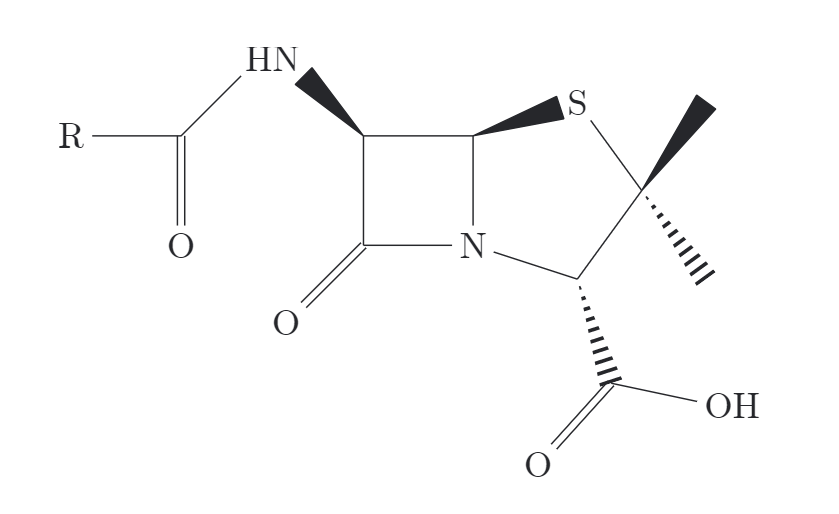
```tikz
\usepackage{chemfig}
\begin{document}

\chemfig{[:-90]HN(-[::-45](-[::-45]R)=[::+45]O)>[::+45]*4(-(=O)-N*5(-(<:(=[::-60]O)-[::+60]OH)-(<[::+0])(<:[::-108])-S>)--)}

\end{document}
```
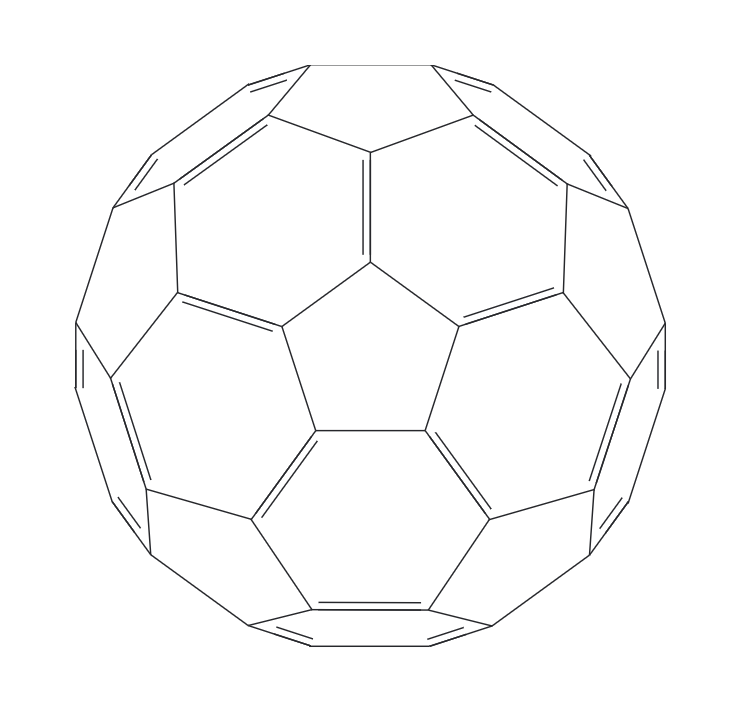
```tikz
\usepackage{chemfig}
\begin{document}

\definesubmol\fragment1{

    (-[:#1,0.85,,,draw=none]
    -[::126]-[::-54](=_#(2pt,2pt)[::180])
    -[::-70](-[::-56.2,1.07]=^#(2pt,2pt)[::180,1.07])
    -[::110,0.6](-[::-148,0.60](=^[::180,0.35])-[::-18,1.1])
    -[::50,1.1](-[::18,0.60]=_[::180,0.35])
    -[::50,0.6]
    -[::110])
    }

\chemfig{
!\fragment{18}
!\fragment{90}
!\fragment{162}
!\fragment{234}
!\fragment{306}
}

\end{document}
```
Contributing
Contributions are welcome! For information on building Tikzjax, have a look at the contributing guide, courtesy of @thecodechemist99.
Acknowledgements
This plugin would not be possible without TikZJax by @kisonecat! In particular, it uses @drgrice1's fork that adds some additional features.
For plugin developers
Search results and similarity scores are powered by semantic analysis of your plugin's README. If your plugin isn't appearing for searches you'd expect, try updating your README to clearly describe your plugin's purpose, features, and use cases.