Syncer
unlistedby Daniel Simpson
Sync references/links to Google Tasks, Gmail Starred, Microsoft To Do, Outlook flagged mail, Azure DevOps work items, Firefox Bookmarks, and Todoist into your vault.



Obsidian plugin to sync references/links to Google Tasks, Gmail Starred, Microsoft To Do, Microsoft Outlook, Azure DevOps, Firefox Bookmarks, and Todoist into your vault.
Site: obsidiansyncer.com · Privacy Policy · Terms of Service
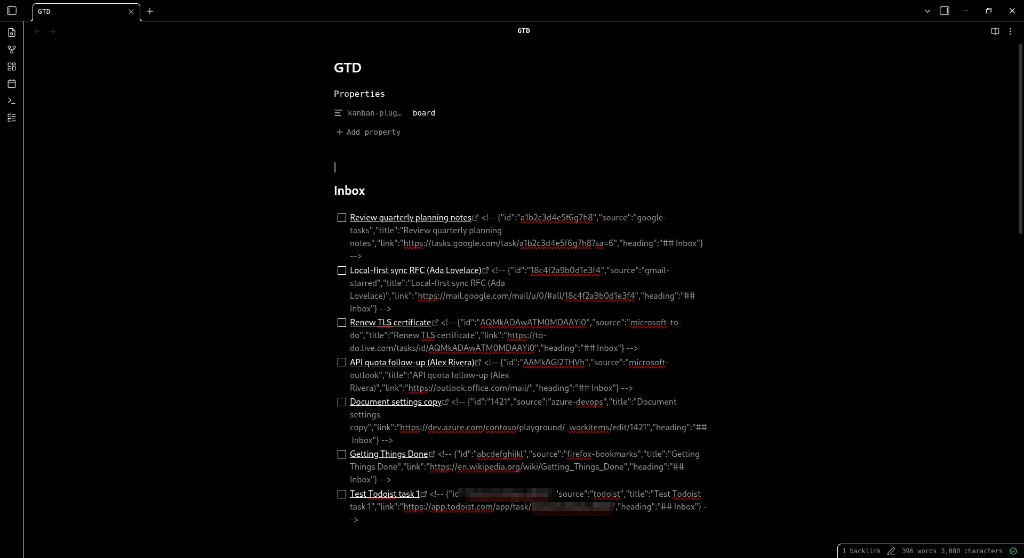
This plugin fetches data from external sources and syncs references/links to them into a target Markdown document under a configurable heading. Supported sources are Google Tasks, Gmail Starred, Microsoft To Do, Microsoft Outlook (flagged mail), Azure DevOps (assigned work items), Firefox Bookmarks (desktop), and Todoist. Inspired by Getting Things Done (GTD), but equally suited to any workflow based on to-do lists or Kanban boards. Designed to integrate well with the Obsidian Kanban plugin and the Obsidian Tasks plugin.

Features
- Scheduled background sync on a configurable interval (minutes)
- Manual sync command from the Command Palette
- Configurable target Markdown file to write to
- Configurable target heading under which items will be inserted
- Optional sync of completion status from Obsidian back to connected sources (off by default)
- Google Tasks integration:
- OAuth 2.0 (Authorization Code)
- Select which task lists to sync
- Only incomplete Google Tasks are synced into Obsidian; when you complete a task in Google it drops out of the incoming feed and the corresponding line is removed from the items under the target heading in the Obsidian note on the next sync
- Optional deletion sync (off by default): deleting a synced Google task in Obsidian can also delete it in Google Tasks (with optional confirmation)
- Gmail Starred integration:
- OAuth 2.0 (Authorization Code)
- Syncs starred Gmail messages into Obsidian
- Configurable maximum number of starred messages to sync per run
- When completion status sync is enabled, checking/unchecking synced items in Obsidian updates the Gmail star state on the next sync
- Microsoft Outlook integration:
- OAuth 2.0 (Authorization Code with PKCE) via Microsoft identity platform
- Syncs messages with an Outlook follow-up flag set to flagged
- Personal (Outlook.com / Hotmail / Live) or work/school accounts (optional Entra tenant ID)
- When completion status sync is enabled, checking/unchecking items in Obsidian updates the Outlook flag on the next sync
- Microsoft To Do integration:
- Separate OAuth consent from Outlook (Tasks scopes on the same Entra app — add delegated Tasks.ReadWrite)
- Select which To Do lists to sync
- Incomplete tasks only; completing in To Do removes the Obsidian line (checkbox is not auto-checked)
- When completion status sync is enabled, checking/unchecking in Obsidian updates task status in To Do on the next sync
- Todoist integration:
- OAuth 2.0 (Authorization Code with PKCE) via a Todoist public client (Dynamic Client Registration)
- Select which projects to sync
- Incomplete tasks only; completing in Todoist removes the Obsidian line (checkbox is not auto-checked)
- When completion status sync is enabled, checking/unchecking in Obsidian closes/reopens tasks in Todoist on the next sync
- Requires a maintainer Todoist app; production builds use the committed client ID in
oauth-clients.prod.json
- Azure DevOps integration:
- Personal Access Token (PAT) authentication
- One organisation + one project per settings profile
- Syncs work items assigned to the connected user with clickable links to the work item in the browser
- One-way sync only; checking items in Obsidian does not update work item state in Azure DevOps
- Firefox Bookmarks integration (desktop only):
- Sync bookmarks from a local Firefox profile into your vault
- Auto-detect default profile or set a manual profile path
- Search and select bookmark folders (subfolders included recursively)
- One-way sync: Firefox → Obsidian only; checking items in Obsidian does not change Firefox
- Works while Firefox is open when
sqlite3or Python is available to merge the places WAL; otherwise close Firefox briefly and sync again
Requirements
- Node.js >= 22.15 (for builds and tests)
- Obsidian Desktop
- (Optional) Obsidian Kanban plugin for task board views
- (Optional) Obsidian Tasks plugin for enhanced task management
Installation
Install Syncer from Obsidian’s Community plugins browser, or from the Community directory.
Beta testers (BRAT)
Use BRAT in a dedicated vault (not one with Community Plugin Syncer already enabled — same plugin id). Add desimpson/syncer in latest mode; BRAT installs the highest semver release including prereleases (e.g. 0.5.0-beta.1), not GitHub’s “Latest” stable badge.
From source
- Build the plugin (see Development below)
- Copy these files to your vault:
Vault/.obsidian/plugins/syncer/manifest.jsonmain.jsstyles.css
- Enable Syncer in Obsidian → Settings → Community plugins
Configuration
Open Obsidian settings and navigate to Community plugins → Syncer.
GTD tip: The plugin ships with sensible defaults for a GTD-style setup—GTD.md as the target file and ## Inbox as the heading. You can keep these for a classic capture inbox, or change them to suit your workflow.
General
- Sync interval (minutes): How often background sync runs
- Sync markdown file path: Target note for synced items (sync saves the note if needed, then reads the on-disk file)
- Sync heading: H2 heading under which new items are inserted (input is normalised to
## …) - Sync completion status: When enabled, completing or uncompleting synced items in Obsidian updates Google Tasks, Gmail stars, Microsoft To Do, Microsoft Outlook (email flags), and Todoist on the next sync. With Kanban boards that move cards to a Done column, enable this if you want local
[x]to write back before Syncer reconciles against the incomplete remote feed (otherwise a still-open remote task can uncheck the card in place).
Google Tasks
- Connect your Google account using the Connect button in the plugin's settings tab
- Select task lists to sync via the multi-select input
- Sync task deletions is off by default; enable it (and optional confirmation) if you want deleting a Google Tasks item in Obsidian to also delete it in Google Tasks
Gmail Starred
- Connect your Google account using the Connect button in the plugin's settings tab
- Set Gmail Starred max items to control how many starred messages are synced each run
- Starred messages are synced into the target note under the sync heading
Microsoft Outlook
- Choose Outlook account type (personal or work/school); for work/school you may optionally set a Directory (tenant) ID
- Connect your Microsoft account using the Connect button (requires the plugin to be built with a Microsoft application client ID)
- Flagged messages are synced into the target note under the sync heading
- Connect / disconnect Outlook independently of Microsoft To Do
Microsoft To Do
- Connect after adding Tasks.ReadWrite (delegated) to your existing Syncer Entra app (same client ID as Outlook)
- Select one or more To Do lists to sync; account type / tenant fields above apply to the next Connect only
- Incomplete tasks from selected lists sync under the sync heading
- Disconnect clears To Do credentials only — Outlook and existing note lines are unaffected
Todoist
- Connect using Connect (production builds include the committed Todoist client ID; local
build:devneedsoauth-clients.dev.json) - Select one or more projects to sync
- Incomplete tasks from selected projects sync under the sync heading
- Disconnect clears Todoist credentials; existing Todoist lines remain in your sync note until you remove them or deselect their projects
OAuth app setup (maintainers)
- Register a public client with
POST https://api.todoist.com/oauth/register(token_endpoint_auth_method: none, scopedata:read_write, grant typesauthorization_code+refresh_token). Includelogo_uri(https://obsidiansyncer.com/logo.png) andclient_uri(https://obsidiansyncer.com). The App Management Console only creates confidential clients, which require aclient_secretSyncer cannot ship, and it cannot brand DCR clients. - Use redirect URIs:
http://localhost:27855/,http://localhost:27856/,http://localhost:27857/ - Put the production
tdd_…client ID inoauth-clients.prod.json. Useoauth-clients.dev.json(copied fromoauth-clients.dev.json.example) for localbuild:devonly. After changing a client ID, Disconnect and Connect again. - Todoist does not document a DCR update API. To change the consent icon or name, re-register with the same metadata plus the new
logo_uri, then swap the client ID. There is no Todoist CLI for this.
OAuth app icon (maintainers)
One mark, reused on every consent screen. Do not invent a second logo.
| File | Size | Use |
|---|---|---|
site/favicon.svg | vector | Source / tab icon |
site/logo.png | 512×512 | Google OAuth consent (120×120 minimum), Microsoft Entra branding, and Todoist logo_uri (https://obsidiansyncer.com/logo.png) |
docs/branding/logo-300.png | 300×300 | Local 300² export if a console asks for that size |
Azure DevOps
- Enter your Organisation name (the URL segment from
https://dev.azure.com/your-org, or paste the full URL and Syncer will extract the name) - Enter Project name
- Enter Personal access token (PAT) with Work Items (Read) scope
- Run Manual sync — Syncer fetches work items assigned to your account in the configured project
PAT setup (Azure DevOps)
- Open Azure DevOps user settings → Personal access tokens
- Create a token with scope Work Items (Read) (optionally Project and Team (Read))
- Copy the token and paste it into Syncer’s Personal access token (PAT) field
Firefox Bookmarks (desktop only)
- Enable Firefox Bookmarks in the plugin settings
- Optionally set a Firefox profile path; leave empty to auto-detect the default profile from
profiles.ini(this reads files outside the vault — see Privacy and disclosures) - Click Refresh folders, then search by folder name and select parents to include (subfolders are synced recursively — nested matches under a hit are hidden in search)
- Typical profile locations:
- Linux:
~/.mozilla/firefox/<profile>/or~/.config/mozilla/firefox/<profile>/ - macOS:
~/Library/Application Support/Firefox/Profiles/<profile>/ - Windows:
%APPDATA%\Mozilla\Firefox\Profiles\<profile>\
- Linux:
- If newest bookmarks are missing while Firefox is open, close Firefox briefly and sync again (or install the
sqlite3CLI so the plugin can merge the live database)
Commands
Manual sync: Triggers a once-off sync and restarts the schedulerOpen sync document: Opens the configured sync note, revealing an existing pane if it is already open
Development
Contributor/agent notes for architecture and sync rules live in docs/kb/.
For contribution guidelines, see CONTRIBUTING.md.
Install dependencies, then build with esbuild.
npm clean-install
npm run build:dev
Build scripts set BUILD_ENV automatically (dev, staging, prod). If you invoke esbuild.config.mjs directly, set BUILD_ENV explicitly.
Set OAuth client IDs for local build:dev to enable Connect. build:dev now requires a local oauth-clients.dev.json; copy oauth-clients.dev.json.example → oauth-clients.dev.json first (empty IDs are allowed and simply disable matching Connect actions). Google Connect needs your own Desktop client (ID and secret) — dev creds are never committed; obsidiansyncer-dev is the maintainer’s personal project (see docs/kb/gotchas.md). After changing Google client ID or secret, Disconnect and Connect again.
Run tests with coverage (floor + report): npm run test:coverage.
Sync to your vault with:
npm run sync
You will need to create a dev Obsidian vault and set the OBSIDIAN_VAULT_PLUGIN_DIR_DEV variable in a .envrc file to use the sync script. See .envrc.example for an example.
It is also recommended to install the Hot-Reload plugin for automatic reloads.
Privacy and disclosures
This section is for Obsidian developer policy review and for users who want to know what the plugin contacts before installing.
Hosted copies used for Google OAuth verification: homepage, Privacy Policy, and Terms of Service.
Syncer is a local plugin: it does not run a Syncer backend, proxy, or hosted API. Data access is limited to the integrations you enable:
- Account requirement: cloud sync features need a corresponding Google account (Tasks / Gmail), Microsoft account (Outlook / To Do), Todoist account, and/or Azure DevOps account. Firefox Bookmarks sync is local and does not require a cloud account.
- Credentials / API keys: Google, Microsoft, and Todoist use OAuth 2.0 (tokens stored in plugin settings). Azure DevOps uses a Personal Access Token (PAT) you paste in settings. OAuth tokens and PATs are sent only to the matching provider endpoints below — never to a Syncer service.
- Network use: when an integration is connected and sync runs, Syncer calls that provider to read/update items. Typical hosts include:
- Google:
accounts.google.com,oauth2.googleapis.com,www.googleapis.com,tasks.googleapis.com,gmail.googleapis.com - Microsoft:
login.microsoftonline.com,graph.microsoft.com - Todoist:
app.todoist.com,api.todoist.com - Azure DevOps:
dev.azure.com
- Google:
[!WARNING] Outside-vault filesystem access (Firefox Bookmarks). Community plugins are expected to stay inside the vault. Firefox stores bookmarks in the browser profile, so this desktop integration must read
profiles.ini,places.sqlite, and WAL sidecars outside the vault: the selected path, or auto-detect under~/.mozilla/firefox,~/.config/mozilla/firefox, Snap, Flatpak, and the macOS/Windows folders listed in Firefox Bookmarks. Copies go to a temporary directory only. Syncer does not write back to the live Firefox database. See SECURITY.md for details.
- Telemetry / ads: Syncer does not include client-side telemetry, analytics SDKs, or ads.
Attribution
No third-party UI components are currently bundled in the settings tab.
Releasing
Release tags match [0-9]* (no v prefix), e.g. 0.2.1 or 0.5.0-beta.1.
Stable release (x.y.z): prod build (oauth-clients.prod.json), GitHub Environment prod approval gate, non-prerelease publish.
Staging prerelease (tag contains -beta., e.g. 0.5.0-beta.1): staging build (oauth-clients.staging.json), no prod gate, GitHub prerelease flag.
Do not tag stable 0.5.0 until #121 approves Google OAuth verification. An accidental stable outranks staging betas in BRAT latest; tell testers to switch to frozen at the last good beta until the mistake is fixed.
- Bump version with
npm version patch|minor|major(ornpm version x.y.z/npm version x.y.z-beta.n). This updatespackage.json/manifest.json/versions.json, commits, and creates an annotated git tag (required). Do not usegit tag x.y.zwithout-a—git push --follow-tagsonly pushes annotated tags. - Build locally before push: stable →
npm run build(prod); beta →npm run build:staging - Verify:
npm run release:check(fails if the version tag exists but is lightweight) - Confirm the tag is annotated:
git cat-file -t x.y.zmust printtag(notcommit). If you ever need a manual tag:git tag -a x.y.z -m "x.y.z". - Push commit and tag:
git push --follow-tags. If--follow-tagsskips the tag, push it explicitly:git push origin x.y.z. - Verify the GitHub release contains
main.js,manifest.json,styles.css, and the generated attestation bundle - Stable releases only: submit the new plugin version through Obsidian Community directory, following Submit your plugin, then monitor automated review results
For plugin developers
Search results and similarity scores are powered by semantic analysis of your plugin's README. If your plugin isn't appearing for searches you'd expect, try updating your README to clearly describe your plugin's purpose, features, and use cases.