Dashboard
approvedby Sean
An interactive home dashboard for Todo, a 3D knowledge graph, plugin shortcuts, vault health, and writing activity. - This plugin has not been manually reviewed by Obsidian staff.
Dashboard
A calm, interactive home dashboard for Obsidian. Dashboard turns the current vault into a practical overview of tasks, knowledge connections, writing activity, note health, installed plugins, recent notes, and top-level folders.
The interface is written in Chinese and uses a Nord-inspired visual language. All analysis runs locally inside Obsidian.
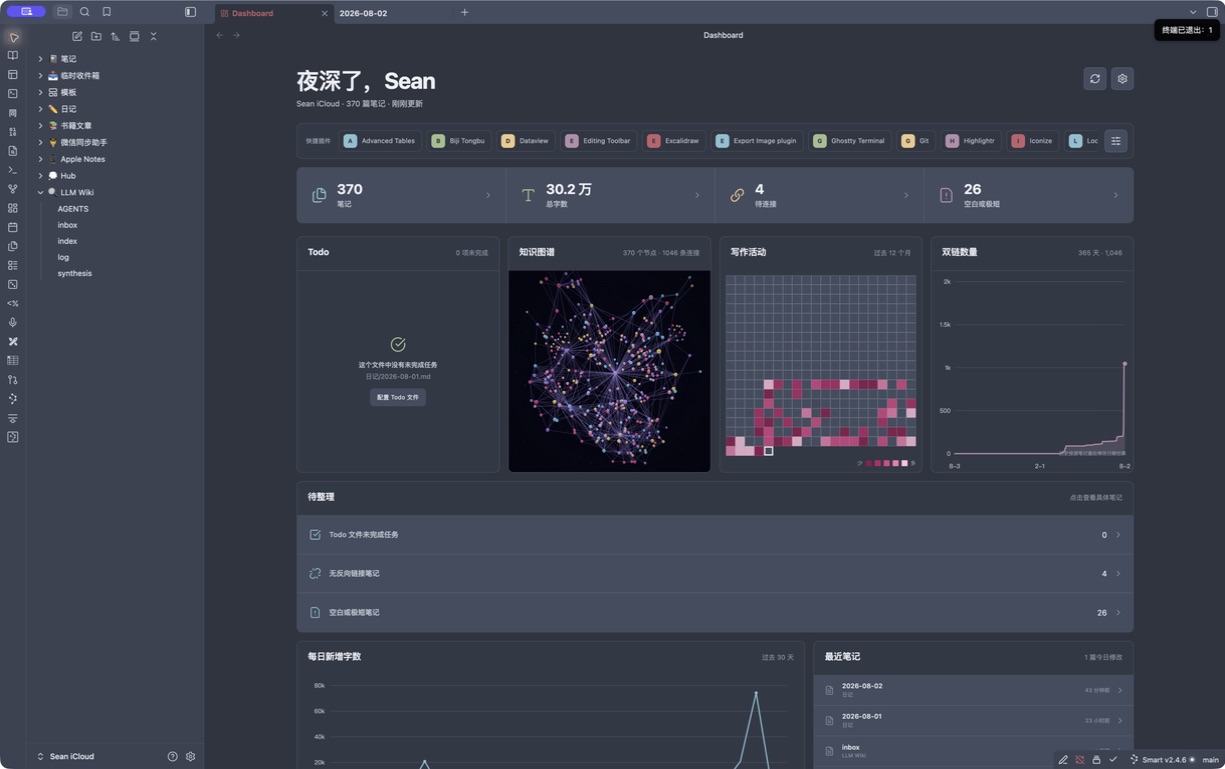
What it shows
- Total Markdown notes and total readable word count.
- Isolated notes with neither outgoing note links nor resolved backlinks.
- Empty or very short notes, with a configurable word threshold.
- An editable Todo list sourced only from one explicitly configured Markdown file. It is empty by default.
- An animated perspective-projected 3D galaxy knowledge graph rendered on an isolated 2D canvas, with orbit controls, moving link particles, tooltips, and clickable notes.
- A horizontally scrollable, manually ordered list of installed plugin shortcuts.
- A 365-day writing activity heatmap.
- An interactive 365-day cumulative resolved-link line-area chart.
- A 30-day added-word trend.
- Recently modified notes.
- Note and word totals for each top-level folder.
- Clickable details for every headline metric, issue, date, and folder.
Dashboard opens automatically when the workspace is ready. You can choose whether it replaces the active tab or opens in a new tab.
Metric definitions
| Metric | Definition |
|---|---|
| Notes | Included .md files in the current vault. |
| Total words | Readable CJK characters plus non-CJK word groups after common Markdown syntax, frontmatter, code fences, and comments are removed. |
| Isolated notes | Included notes that contain no outgoing note links and are not targeted by any resolved link in Obsidian's metadata cache. |
| Empty or very short | Notes whose readable word count is at or below the configured threshold. The default is 10. |
| Open tasks | Unchecked Markdown task items matching - [ ] in the configured Todo file only. No task file is read until a path is configured. |
| Added words | Positive word-count deltas observed after the plugin starts tracking. Deletions do not reduce a day's total. |
| Cumulative links | Current resolved metadata-cache links, recorded as an exact daily snapshot after tracking starts. Earlier dates are estimated from each source note's creation date. |
Obsidian files do not contain an exact historical “words added per day” ledger. For dates before installation, Dashboard can estimate activity by grouping each note's current word count under its creation date. Estimated cells use a subtle opacity difference and can be disabled in settings.
Privacy and safety
- No analytics, network calls, accounts, or cloud service.
- Statistics and activity history stay in
.obsidian/plugins/aurora-dashboard/data.json. - Daily resolved-link snapshots stay in the same local plugin data file.
- The Todo module reads only the explicitly configured Markdown file and edits it only when you change or complete one of its tasks.
- Excluded folders and their descendants are omitted from every metric.
Install
Manual installation
- Create
.obsidian/plugins/aurora-dashboard/inside your vault. - Copy
main.js,manifest.json, andstyles.cssinto that folder. - Reload Obsidian.
- Enable Dashboard under Settings → Community plugins.
Community plugin directory
Install Dashboard from Settings → Community plugins → Browse, or open its Obsidian Community listing and choose Add to Obsidian.
Commands
- Dashboard: 打开首页看板
- Dashboard: 重新扫描首页统计
The ribbon dashboard icon also opens the view.
The shortcut strip reads installed plugin manifests from the current vault.
Use its manage button to reorder, remove, or add entries. Selecting a shortcut
opens that plugin's Obsidian detail page through the official show-plugin URI.
The knowledge graph uses an isolated Canvas 2D perspective renderer so it does not compete with Obsidian's built-in graph for a WebGL context. Reduced-motion system preferences disable continuous star and link particle animation.
Settings
- Optional greeting name.
- Open on startup.
- Replace the active tab or open a new tab.
- Todo Markdown file path (empty by default).
- Empty/short-note threshold.
- Excluded folders.
- Show or hide estimated pre-install history.
- Activity calendar range: 90, 180, or 365 days.
Development
Requirements: Node.js 22 and npm.
npm install
npm run dev
Run the complete verification suite:
npm run check
This runs ESLint, Vitest, TypeScript type-checking, and the production esbuild bundle.
Release
- Update
manifest.json,package.json,versions.json, andCHANGELOG.md. - Run
npm run check. - Commit the source and metadata changes.
main.jsis generated during the release workflow and is intentionally ignored by Git. - Push a Git tag exactly equal to the manifest version, without a
vprefix. - The included GitHub Action publishes
main.js,manifest.json, andstyles.cssas release assets. - Submit the repository through the Obsidian Community plugin submission process.
Repository: tianxiangyu0717-hub/obsidian-aurora-dashboard
Compatibility
minAppVersion is 1.8.7. The plugin does not use Node or Electron APIs and
includes narrow-view responsive styles. Hands-on QA currently covers Obsidian
1.13.4 on macOS.
Design reference
The color system and restrained dark surfaces are inspired by insanum/obsidian_nord. Dashboard is an independent plugin and does not include code or assets from that theme.
License
For plugin developers
Search results and similarity scores are powered by semantic analysis of your plugin's README. If your plugin isn't appearing for searches you'd expect, try updating your README to clearly describe your plugin's purpose, features, and use cases.