by dhenyson
Link cards with a Canvas linker. Create hook shortcuts, copy card links, and jump to destinations across canvases in the same vault using native zoom to selection.
Canvas Card Hook
A Canvas card linker for Obsidian: create hook shortcuts, copy card links, and jump straight to the card you need.
Canvas Card Hook adds small, clickable navigation cards to Obsidian Canvas. Link to a destination in the same Canvas or another Canvas in your vault. Click the arrow and Obsidian uses its native Zoom to selection to focus the destination.
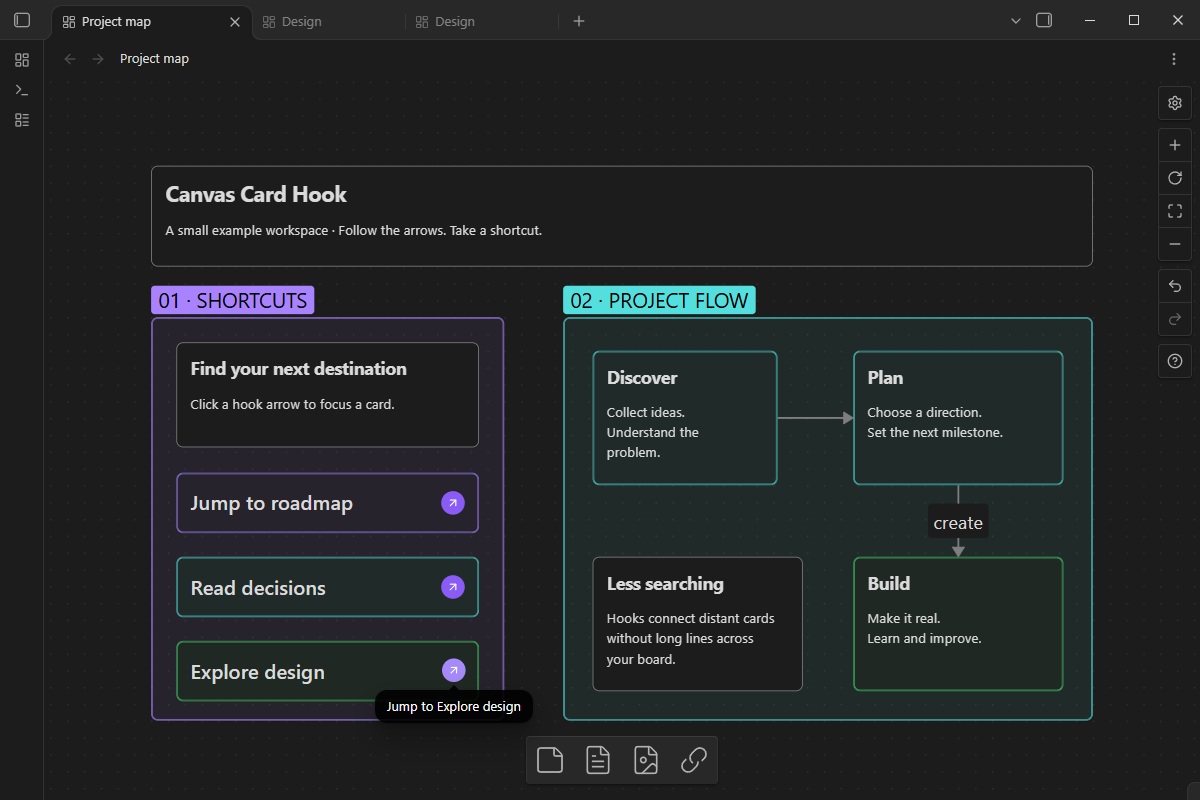
Watch a hook jump to a distant card in the same Canvas, then open a specific card in another Canvas in the same vault. The animated pointer and click highlights make each action visible.
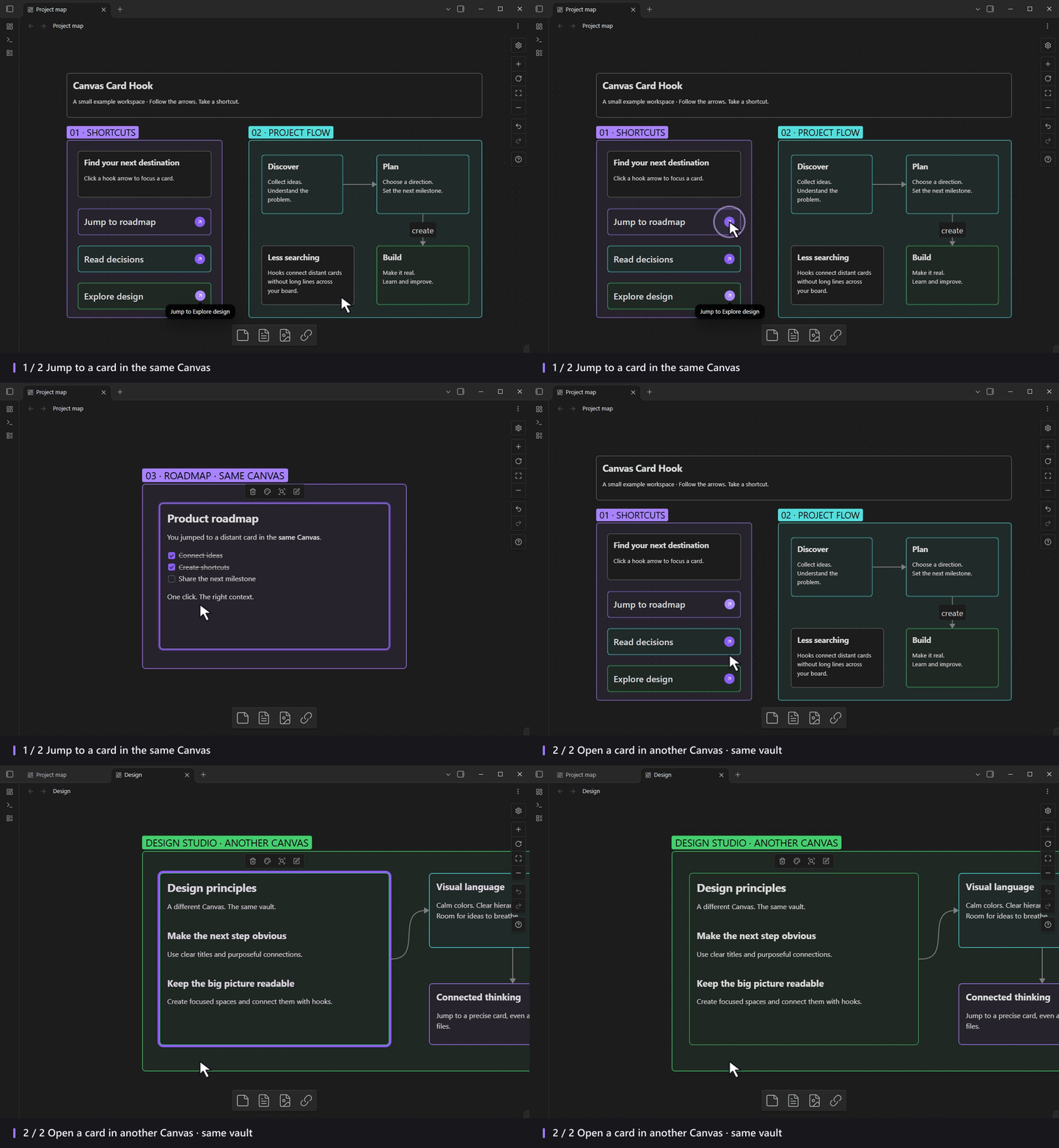
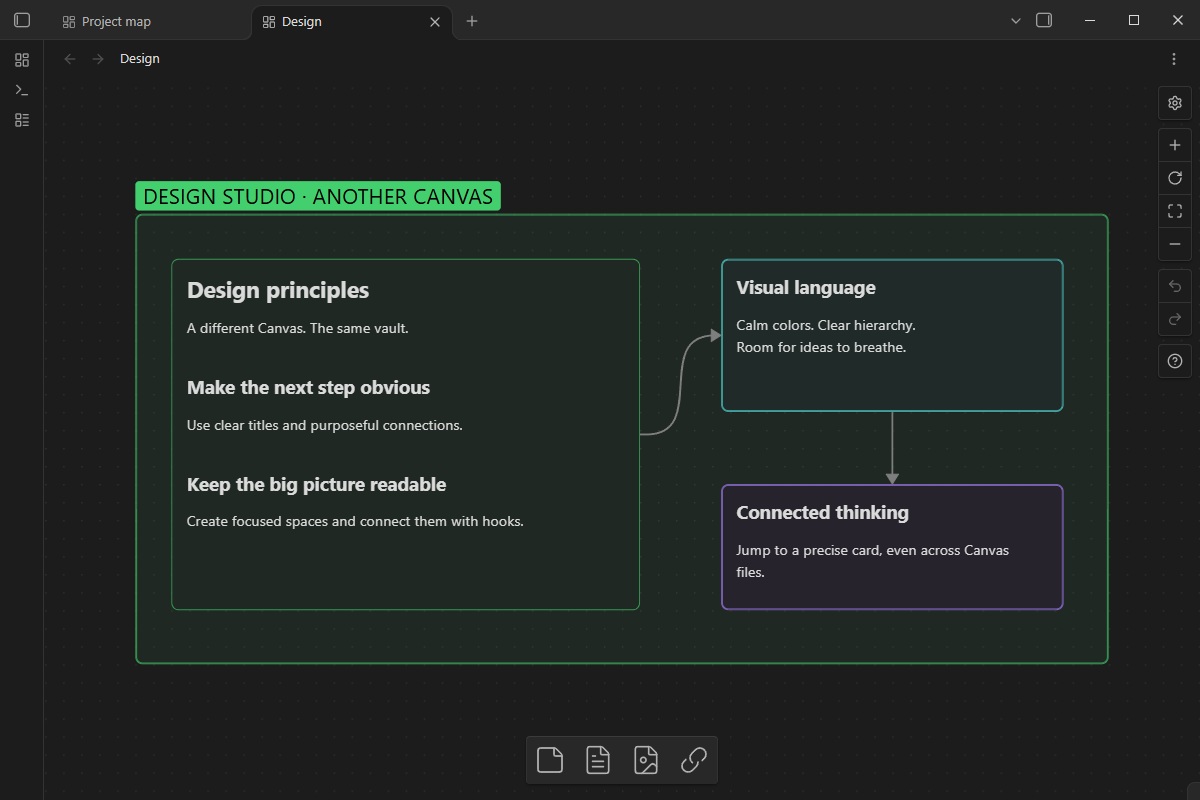
The screenshots and animation use a fictional example workspace with groups, connections, and three hook shortcuts.
Features
- Add hook in the native card context menu.
- Copy card link for any destination card.
- Two inline fields: Title and Card link or ID.
- Click the arrow to jump; click the body to select or move the hook.
- Links within a Canvas and between canvases in the same vault.
- Native card movement, resizing, colors, connections, duplication, undo, and redo.
- A centered arrow on compact cards.
- A comfortable temporary editor size that restores your chosen card size afterward.
- Offline storage inside standard
.canvasfiles, with a readable Markdown fallback.
Installation
Find the plugin in the official Obsidian Community directory, or install it from the app:
- Open Settings → Community plugins → Browse.
- Search for Canvas Card Hook.
- Select Install, then Enable.
Publishing a GitHub release alone does not make the plugin searchable in Obsidian. Directory availability depends on the official review and publication process.
For manual installation, download main.js, manifest.json, and styles.css from the latest release. Place them in your vault's configuration directory under plugins/canvas-card-hook/, then reload Obsidian and enable the plugin. The default configuration directory is .obsidian.
Create a card link
- Right-click the destination card and choose Copy card link, or select one card and press Ctrl+C.
- Right-click a card near where you want the shortcut and choose Add hook.
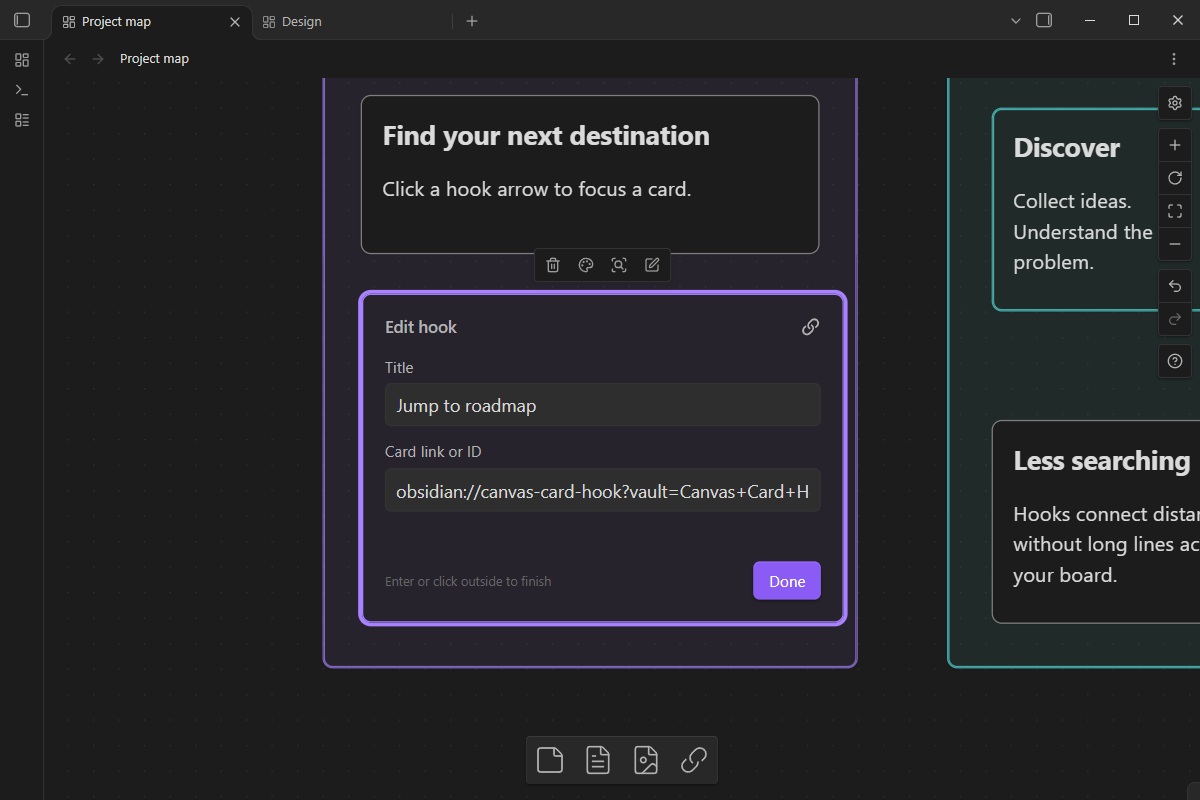
- Enter a title and paste the copied reference into Card link or ID.
- Click Done, press Enter, or click outside the card.
- Click the arrow to jump to the destination.
The card on which you choose Add hook is only the placement anchor. It is not replaced, and it does not determine the destination.
Double-click the hook body or use the native Edit action to change its title or destination. Changes save as you type. Escape finishes editing; it does not discard changes.
Jump between canvases
Copy the destination card link from Canvas B, then paste it into a hook in Canvas A. Both canvases must belong to the same vault. Clicking the hook opens or reveals Canvas B, selects the correct card, and applies native zoom to selection. An already-open destination Canvas is reused.
For cross-canvas links, use Copy card link or Ctrl+C, rather than a bare card ID. A raw 16-character card ID is resolved only within the hook's own Canvas. Cross-vault navigation is not supported.
Compact cards and comfortable editing
Resize a hook to suit your layout. Its arrow stays centered even on short cards.
While editing, the card temporarily becomes 380 × 260, the same size as a new hook. Done, Enter, Escape, or clicking outside restores its exact previous width and height. Saves, clipboard data, and history retain the chosen preview dimensions while the editor is expanded.
Copy and paste behavior
| Action | Result |
|---|---|
| Ctrl+C on one selected card | Copies native Canvas data and the original card link |
| Ctrl+V on the Canvas | Duplicates the card normally, with a new ID |
| Ctrl+V in a hook's target input | Inserts the original card reference |
| Copy card link | Copies a link without the native duplication payload |
| Copy several selected cards | Keeps normal multi-card copy without choosing an ambiguous target |
Two commands are also available from the command palette: Copy selected card link and Add hook beside selected card.
Storage, renaming, and compatibility
Hook data is stored in the native text card's text field as a versioned JSON HTML comment followed by readable Markdown. There is no separate database. When the plugin is disabled, the title and destination link remain readable as ordinary Markdown.
Renaming a Canvas file or folder inside Obsidian while the plugin is enabled updates matching hook references in this vault. Files renamed externally, cards moved between canvases, renamed vaults, and deleted or recreated cards may require a new destination link. Links already copied to the system clipboard cannot be rewritten after a rename.
Read-only canvases permit navigation but prevent editing. Convert to file retains the title and destination link as Markdown; the result becomes an ordinary file card.
Supported platform: Obsidian Desktop 1.14.4 or later. Tested on Windows with Obsidian Desktop 1.14.4. Mobile and interactions with other Canvas plugins have not been verified.
Canvas rendering and viewport methods use internal Obsidian interfaces. Future Obsidian updates may require compatibility changes. The plugin reuses native zoom and restores its instance wrappers when unloaded.
Privacy and access
- No network requests, telemetry, advertising, payment, or external service.
- No account or API key is required by the plugin.
- Clipboard data is written when you copy a card or choose Copy card link, and read from paste events inside the target input.
- Hook configuration is saved within Canvas files in the current vault. Rename handling updates affected hook links in that vault.
- No files outside the vault are accessed by the runtime plugin.
Development and support
The project is written in JavaScript with a deterministic, dependency-free runtime build. Development linting uses the official Obsidian ESLint rules. See CONTRIBUTING.md for setup and testing.
pnpm install --frozen-lockfile
pnpm lint
pnpm test
pnpm build
The build produces main.js in the repository root and installable runtime files in dist/canvas-card-hook/. A Git tag matching the manifest version publishes the three installation assets through GitHub Actions after validation.
The local test suite contains four unit tests and 42 integration checks in the real Obsidian app. See TEST-RESULTS.json for the tested behaviors and application version. These checks are evidence of the tested release, not a promise that all themes or Canvas plugins are compatible.
Report reproducible problems in GitHub Issues. See the changelog for release history.
Related terms: Canvas linker, card links, hook cards, jump shortcuts, Canvas navigation, and zoom to selection.
License
MIT. An independent community plugin, not an official Obsidian product.
For plugin developers
Search results and similarity scores are powered by semantic analysis of your plugin's README. If your plugin isn't appearing for searches you'd expect, try updating your README to clearly describe your plugin's purpose, features, and use cases.