LexiNote
approvedby alucpro
Highlight difficult English words and learn vocabulary while writing. - This plugin has not been manually reviewed by Obsidian staff.
LexiNote
中文 README | 用户使用手册 | User Guide
Learn vocabulary while writing in Obsidian.
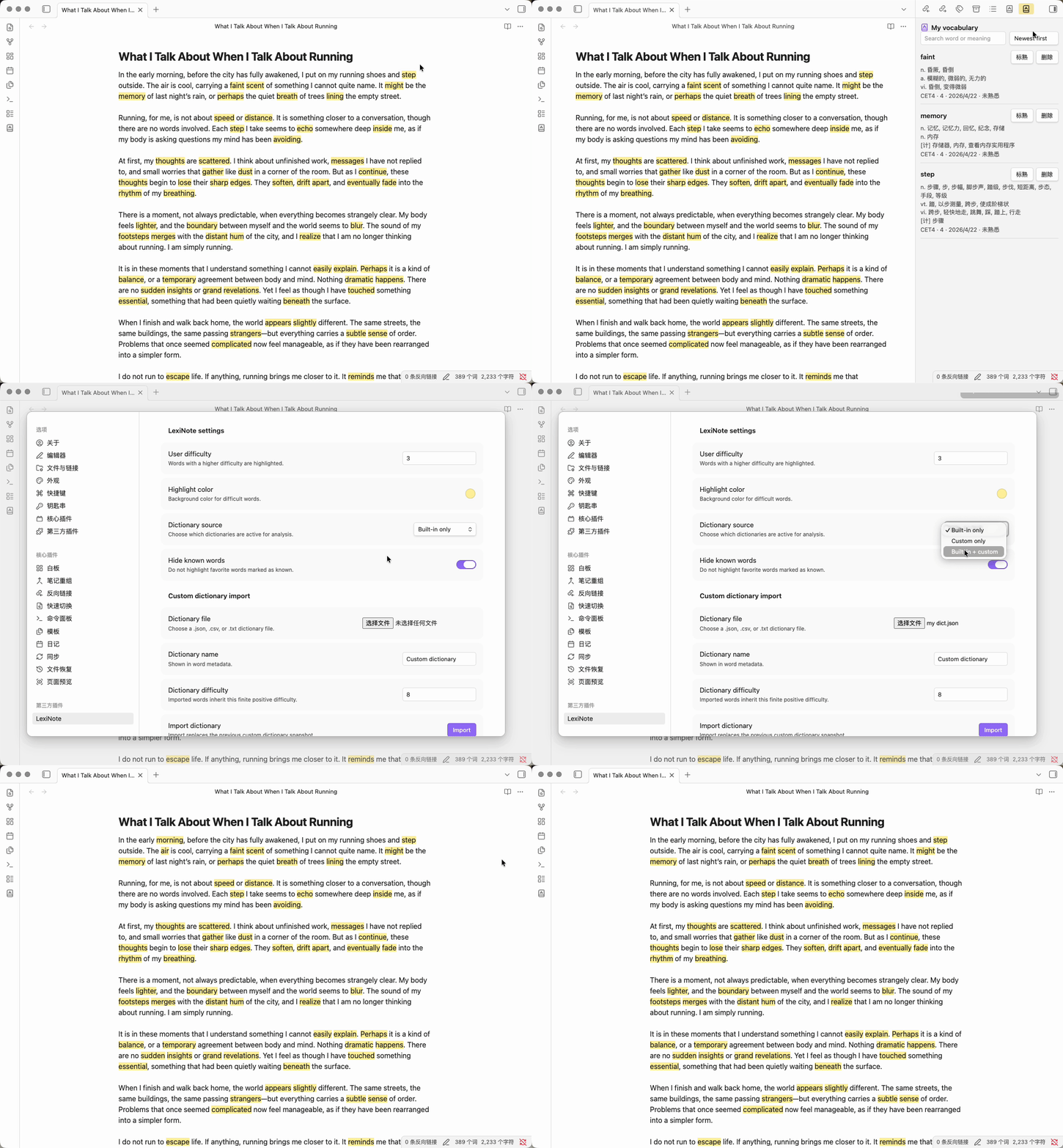
LexiNote is an Obsidian plugin that automatically highlights difficult English words in your notes, shows meanings on hover, and helps you build a personal vocabulary list without interrupting your writing flow.
Best for:
- English learners using Obsidian
- People who read or write English notes
- CET-4 / CET-6 learners
- Users who want vocabulary learning inside their PKM workflow
Why LexiNote
I often write and read English notes in Obsidian, but traditional vocabulary apps are separated from my real reading and writing context.
LexiNote was built for a simple idea:
Vocabulary learning should happen where words naturally appear.
Features
- Real-time highlighting for difficult English words in Markdown notes.
- Background or underline highlighting, including straight and wavy underline styles.
- Hover cards with local meanings and dictionary metadata.
- A current-document word list that summarizes the difficult words in the active note.
- One-click saving to a personal Vocabulary Library.
- Vocabulary Library search, sorting, known-word markers, deletion, and export.
- Built-in CET4 / CET6 dictionaries derived from ECDICT.
- Multiple custom dictionary imports from
JSON,CSV, andTXTfiles. - A dictionary table for enabling, disabling, reordering, editing, and deleting imported dictionaries.
- Configurable user difficulty from
1to30, highlight color, and known-word hiding. - Vocabulary export as LexiNote JSON or Anki-compatible TSV.
- English and Chinese UI text that follows the Obsidian app language.
- Markdown-aware analysis that skips inline code, fenced code blocks, URLs, and wikilinks.
Requirements
- Obsidian
1.8.7or newer.
Install From Obsidian Community Plugins
- Open Obsidian.
- Go to
Settings -> Community plugins. - Turn off
Restricted modeif Obsidian asks you to do so. - Click
Browseto open the Community plugins marketplace. - Search for
LexiNote. - Click
Install. - After installation, click
Enable.
After enabling LexiNote, a book icon appears in the left ribbon. Click it to open the current document word list. You can also run these commands from the command palette:
LexiNote: Reanalyze active documentLexiNote: Open current document word listLexiNote: Open vocabulary library
Quick Start
- Open an English note in Obsidian.
- Write or paste a few English paragraphs.
- LexiNote highlights words that are above your configured difficulty.
- Hover a highlighted word to see its meaning.
- Click the LexiNote ribbon icon to review all difficult words found in the current note.
- Save useful words to
My vocabulary, then mark familiar words as known when you no longer need them highlighted.
You can adjust LexiNote in Settings -> Community plugins -> LexiNote.
Custom Dictionary Import
LexiNote can import multiple custom dictionaries from JSON, CSV, and TXT files. Imported entries are stored locally in your Obsidian plugin data. The import UI asks for a dictionary name and difficulty, and every imported word inherits those values.
Custom dictionaries are language-flexible. LexiNote only needs the source word to be English, while meaning can be Chinese, Japanese, Korean, French, or any other target language you want to review. For example, the same English word can be imported as English -> Chinese or English -> Japanese by changing only the meaning text.
Imported dictionaries appear in the dictionary table together with the built-in CET4 / CET6 dictionaries. Built-in dictionaries are read-only. Imported dictionaries can be enabled or disabled, reordered, renamed, assigned a new difficulty, or deleted.
Dictionary names must be unique. If the same word appears in multiple enabled dictionaries, LexiNote keeps all matching entries and shows them in dictionary order. A word is highlighted when any matching entry has a difficulty higher than your user difficulty.
JSON
Use an array of objects with word and optional meaning fields:
[
  {
    "word": "meticulous",
    "meaning": "非常细致的;一丝不苟的"
  },
  {
    "word": "resilient",
    "meaning": "回復力のある;しなやかな"
  }
]
CSV
Use a header row with word,meaning:
word,meaning
nuance,细微差别
cohesive,まとまりのある;結束した
elaborate,详细说明;精心制作的
TXT
Use one English word per line:
meticulous
resilient
scrutiny
TXT imports do not include local meanings, so hover cards and lists show No local meaning. in English UI or 暂无本地释义 in Chinese UI.
Vocabulary Export
Open My vocabulary and use:
Export JSONto export a LexiNote JSON dictionary. This file can be imported again through the custom dictionary importer.Export Anki TSVto export a simple UTF-8 tab-separated file with two columns:wordandmeaning.
The Anki TSV export is intentionally minimal. It does not generate .apkg files, card templates, pronunciation, tags, or AnkiConnect sync.
Development
Requirements
- Node.js 18 or newer
- npm
- Obsidian Desktop 1.8.7 or newer
- A local Obsidian vault for testing
Commands
Install dependencies:
npm install
Run unit tests:
npm test
Run type checking:
npm run typecheck
Build the plugin:
npm run build
Development build:
npm run dev
Install Into A Local Vault
Replace /path/to/TestVault with your local Obsidian vault path:
mkdir -p "/path/to/TestVault/.obsidian/plugins/lexinote"
cp manifest.json main.js styles.css "/path/to/TestVault/.obsidian/plugins/lexinote/"
The plugin directory should contain:
/path/to/TestVault/.obsidian/plugins/lexinote/
  manifest.json
  main.js
  styles.css
Enable In Obsidian
- Open the test vault in Obsidian.
- Go to
Settings -> Community plugins. - Turn off
Restricted modeif needed. - Refresh the installed plugins list.
- Enable
LexiNote.
After enabling, the left ribbon should show the LexiNote book icon.
Local Acceptance Path
Use this quick note to verify the happy route:
Today I encountered a peculiar problem.

This robust tool provides a comprehensive workflow.

`peculiar should not be highlighted inside inline code`

```text
robust should not be highlighted inside fenced code
```

Visit https://example.com/peculiar and check [[robust link target]].
Expected behavior:
peculiar,robust, andcomprehensiveare highlighted in normal prose.- Inline code, fenced code, URLs, and wikilinks are excluded.
- Hovering a highlighted word shows its meaning.
- The LexiNote ribbon icon opens the current document word list.
- The current document word list has a
My vocabularybutton for opening Vocabulary Library.
Test Fixtures
Sample files for local custom dictionary import testing are available in:
tests/fixtures/imports/custom-academic.json
tests/fixtures/imports/custom-writing.csv
tests/fixtures/imports/custom-txt-words.txt
tests/test-dictionary/v2-test-novel.md
tests/test-dictionary/v2-academic.json
tests/test-dictionary/v2-sensory.csv
tests/test-dictionary/v2-plain.txt
You can also view and use the test dictionary files directly on GitHub:
TXT imports do not include local meanings, so they are useful for validating the no-local-meaning display.
Release
Example: release version 0.1.5 to GitHub.
gh release create 0.1.5 main.js manifest.json styles.css -t "0.1.5"
License
MIT
For plugin developers
Search results and similarity scores are powered by semantic analysis of your plugin's README. If your plugin isn't appearing for searches you'd expect, try updating your README to clearly describe your plugin's purpose, features, and use cases.