Study Familiar
approvedby Heidi Andersén
A small owl that lives in your vault: tracks what needs studying, lets you rate concepts in one keystroke, and cheers for the work rather than for the score. - This plugin has not been manually reviewed by Obsidian staff.
🦉 Study Familiar
An Obsidian study companion that rewards the act of studying and never the rating you give yourself.
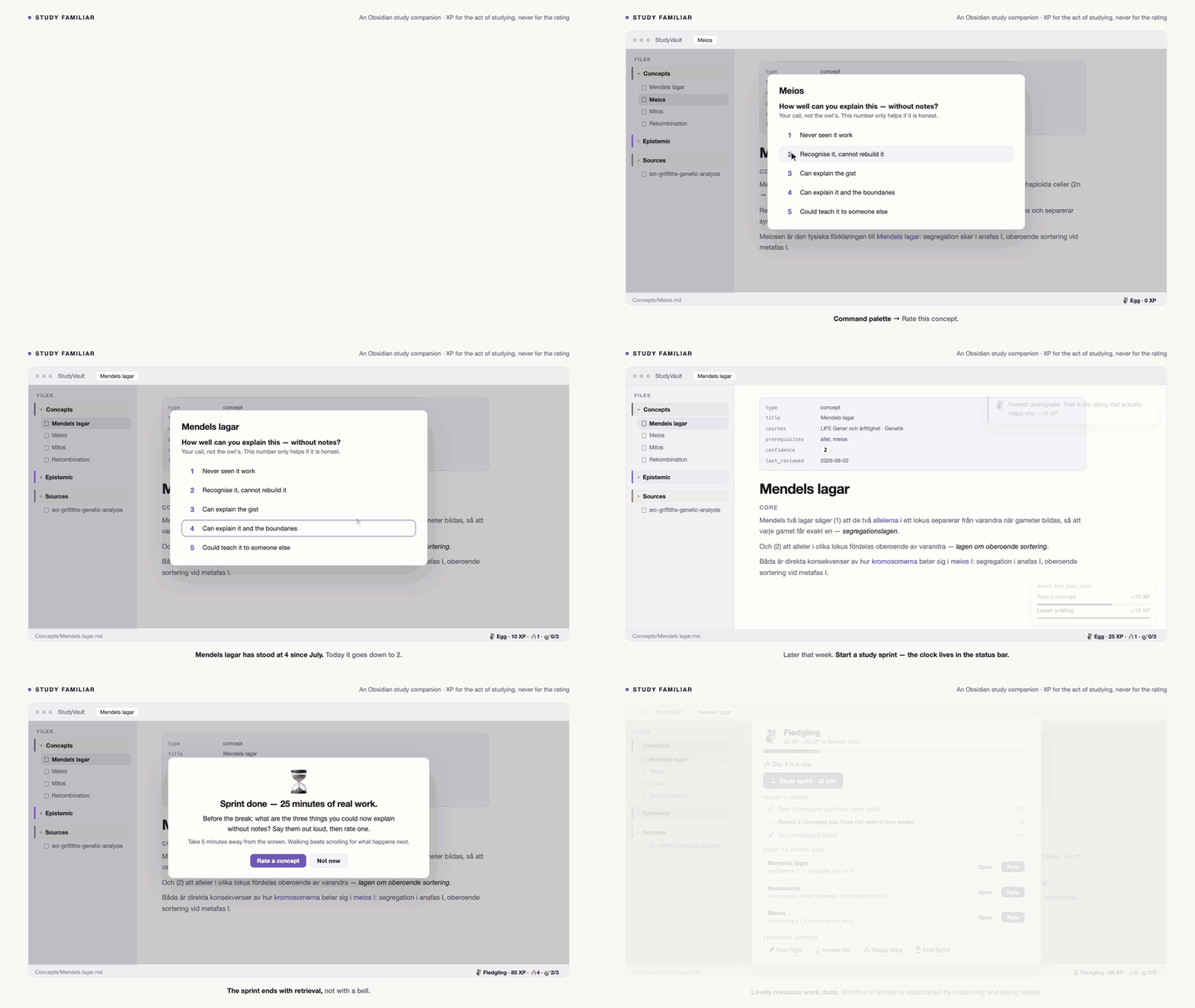
Most study gamification has an obvious failure mode: rate everything 5, feel great, learn nothing. This one pays the same XP for rating a concept 2 as for rating it 5, pays more for lowering a rating than for raising one, and has a badge for the first downgrade: Honest Owl ⚖️. No popup ever tells you that you know something. Levels measure work done; whether the work landed is established elsewhere, by explaining and by being tested.
Status: personal plugin, not (yet) in the community catalogue
Read this before installing. Study Familiar reads a specific note schema: concept notes carrying
type: concept in their frontmatter, with confidence, last_reviewed and optionally courses
and prerequisites; source notes carrying type: source and status. The folders are
configurable (and can be the whole vault), but the frontmatter keys are not. In a vault that does
not use them, the dashboard will be empty and the plugin will do nothing.
Install with BRAT: add
heidihelena/obsidian-study-familiar as a beta plugin. Or copy main.js, manifest.json and
styles.css into <vault>/.obsidian/plugins/study-familiar/ and enable it in
Settings → Community plugins.
Commands
| Command | What it does |
|---|---|
| Open the familiar | Dashboard: level, XP bar, streak, today's quest, what to study now, badges |
| Rate this concept | Five-button scale with real descriptions; writes confidence + last_reviewed |
| What should I study now? | Ranked from live frontmatter: unrated, weak, stale, and how many concepts depend on it |
| Start a study sprint / Stop the sprint | Timer in the status bar that ends with a recall prompt, not a bell |
| Today's quest | Three small tasks built from the vault's actual state; one is always a sprint |
| Suggest links for this note | Finds concepts mentioned in prose but not linked; you tick which are real references |
| Add Zotero link to this source | Turns a Better BibTeX citekey: into a clickable zotero://select/items/@key |
| Feathers earned | Eleven badges, each tied to a real study behaviour |
Settings
| Setting | Default | What it does |
|---|---|---|
| Concepts folder | Concepts | Where concept notes live. Empty means the whole vault; type: concept still does the real filtering. |
| Sources folder | Sources | Where source notes live, for the unconfirmed-source quest. |
| Language | English | English or Swedish interface. |
| Daily goal | 3 | How many concepts a quest asks for. Lower it before raising it. |
| Sprint / break length | 25 / 5 min | Focused block, then time away from the screen. |
| Status bar, Celebrations | on | Turn celebrations off during exam week if popups break concentration. |
The design rules
- XP is paid for the act, never for the rating. A 2 pays what a 5 pays. Lowering pays 15 where a re-rate pays 12. Enforced by the smoke test, not merely intended.
- Nothing claims you know anything. A 4 or 5 gets "Noted, we will test that rather than take your word for it." Also enforced by the smoke test.
- A broken streak is a welcome, not a scolding. "Streak restarts today, nothing is lost that matters." Streak systems that punish absence make people abandon the tool instead of returning, and returning is the whole point.
- It writes two frontmatter fields,
confidenceandlast_reviewed, plus links you explicitly tick andzotero:when you ask. It never moves, renames or reorganises a note. - It reads every markdown file's frontmatter to rank what to study next, since that ranking is a question about the whole set. The folder settings limit the scan. Nothing but frontmatter is read, and nothing leaves the vault.
- No network, no account, no telemetry. Everything is computed from your own notes, locally.
Progress lives in the plugin's own
data.json, so the notes stay clean.
Sprints end with retrieval
When the timer runs out the card asks: what are the three things you could now explain without notes? Say them out loud, then rate one. Those last two minutes are where a timed block becomes learning. A bell on its own only measures sitting. Stopping early gives no XP and no guilt.
Development
TypeScript, bundled with esbuild. main.js is a build artifact but is committed, because BRAT and
manual installs read it straight from the repository root.
npm install
npm run build      # typecheck, then bundle src/main.ts to main.js
npm run dev        # watch mode
npm test           # build, then run the contract tests
Source layout: src/main.ts (plugin and commands), src/views.ts (modals), src/settings.ts,
src/constants.ts (XP table, levels, badges), src/i18n.ts (English and Swedish strings),
src/util.ts, src/types.ts.
The smoke test loads the built bundle against a stubbed Obsidian API and asserts the two honesty rules, sprint behaviour, atomic link writing, and manifest correctness, so a release cannot ship a broken listing, or a plugin that has quietly started rewarding self-flattery.
Licence
Apache-2.0.
For plugin developers
Search results and similarity scores are powered by semantic analysis of your plugin's README. If your plugin isn't appearing for searches you'd expect, try updating your README to clearly describe your plugin's purpose, features, and use cases.