by muzaijian
Render chat logs into bubble-style cards from chat code blocks. Paste raw chat exports and they become chat cards in reading view.
Chat Log Render
Render chat logs into chat-bubble cards inside your Obsidian notes. Paste a raw chat export (WeChat, QQ, or any name + time + message text) into a ```chat code block and it becomes a clean chat UI in reading view.
在 Obsidian 笔记里把聊天记录渲染成聊天气泡卡片。把微信、QQ 或任意「昵称 + 时间 + 消息」格式的原始聊天记录粘贴进 ```chat 代码块,阅读视图自动变成干净的聊天界面。
| Paste raw export → rendered card(写代码块 → 得到聊天卡片) | Media, system lines & right-side bubbles(媒体消息、系统提示与右侧绿气泡) |
|---|---|
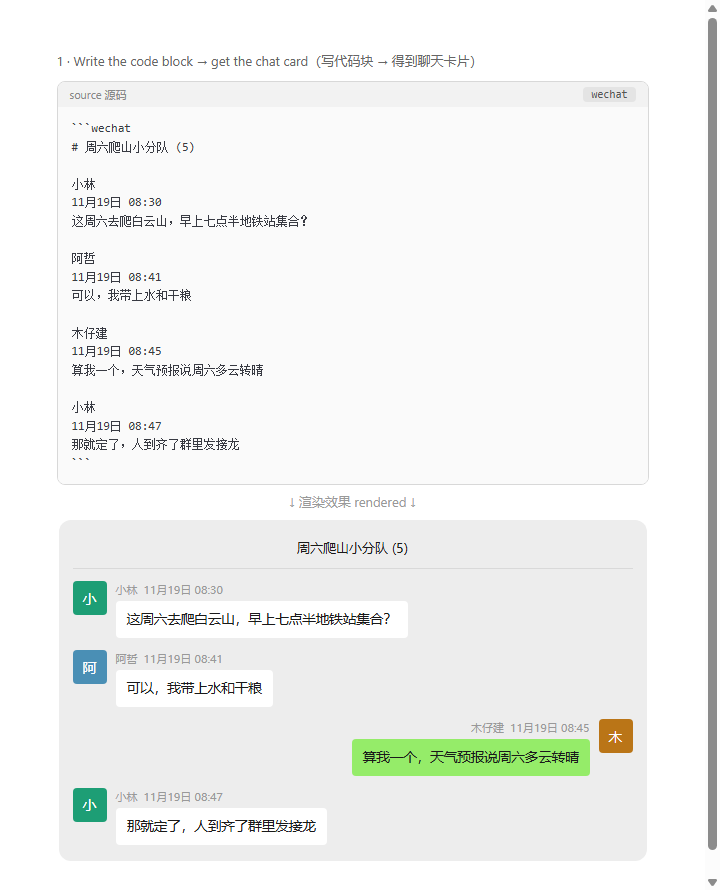 | 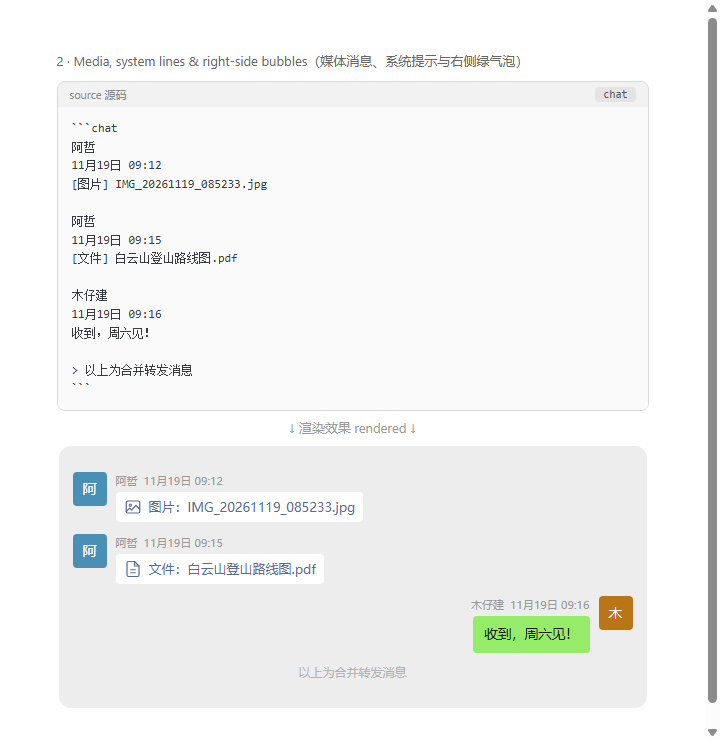 |
Each screenshot shows the source code block above and the rendered result below (all data in the screenshots is fictional). 截图为「源码块在上、渲染结果在下」的对照图(图中数据均为虚构)。
Features 功能
- Paste and go(粘贴即用) — no rigid schema. Paste chat text straight from WeChat mobile multi-select, PC exports, or handwritten notes. 无需固定模板,手机多选复制、PC 导出、手写文本都能解析。
- Three header formats(三种消息头格式) auto-detected(自动识别):
-
Name line followed by a time line(昵称行 + 时间行,微信手机端导出):
Alice 2026/11/19 9:31 Good morning! -
Name and datetime on one line(昵称 + 时间同行,PC 端导出):
Alice 2026/11/19 9:31:02 Good morning! -
Bracket style(方括号格式):
[2026/11/19 9:31:02] Alice: Good morning!
-
- Smart parsing(智能防误判) — data timestamps inside message bodies (e.g.
2026-10-17 13:34:02pasted as part of a debug log) are kept as body text, not misread as new messages. 消息正文里的数据时间戳不会被误拆成新消息。 - Images inside bubbles(气泡内图片) — standard Markdown
, relative paths (../../../附件/img.png), and Obsidian embeds![[img.png]]all render as real images inside the bubble. Path resolution tries vault-relative → note-relative → filename lookup. 气泡内的 Markdown 图片、相对路径、Obsidian 嵌入语法都会显示为真实图片(按 库内路径 → 笔记相对路径 → 文件名 三级解析)。 - Media lines(媒体消息) —
[image]、[file]、[voice]、[video]([图片]、[文件]、[语音]、[视频])and similar lines render as media cards with icons. 带图标的媒体卡片。 - System lines(系统提示) — a line starting with
>renders as a centered grey system notice (e.g. "Merged forwarded messages" / 「以上为合并转发消息」). - Date dividers(日期分隔线) — inserted automatically when the date changes. 日期变化时自动插入。
- Avatars(头像) — deterministic colors from the sender name hash; first character as the avatar letter. 按昵称稳定取色,首字符作头像。
- Title(标题) — a
# headingon the first line becomes the chat window title (group name). 首行# 标题渲染为顶部群名。
Usage 用法
```chat
# Project Team

Alice
2026/11/19 9:31
Which API was it?

Bob
2026/11/19 9:46
Project ID: bf5ad9cf
API: POST /project/update
- When was it changed
2026-10-17 13:34:02
```
Accepted code block languages: chat, chatlog, wechat, 微信.
支持的代码块语言:chat、chatlog、wechat、微信。
Settings 设置
| Setting 设置 | Description 说明 |
|---|---|
| Right-side name 靠右显示的昵称 | Your own nickname in the chat. Messages from this sender render as green bubbles on the right (like WeChat). Empty = all left. 填你在聊天中的昵称,该昵称消息以绿色气泡靠右显示;留空则全部靠左。 |
| Show avatars 显示头像 | Toggle avatar blocks on/off. 开关头像块。 |
Manual install 手动安装
- Download
main.js,manifest.json,styles.cssfrom the latest release. 从最新 Release 下载三个文件。 - Put them in
<vault>/.obsidian/plugins/obsidian-chat-log-render/. 放入库的.obsidian/plugins/obsidian-chat-log-render/目录。 - Enable "Chat Log Render" in Settings → Community plugins. 在 设置 → 第三方插件 里启用。
How parsing works 解析原理
The parser scans the block twice: first it classifies every line (time header / nick line / body / system / media), then it groups lines into messages. A standalone time line right after body text is treated as data inside the message (common when pasting debug logs); only time lines preceded by a blank line or another message start a new message.
解析器两遍扫描:第一遍给每行分类(时间头 / 昵称行 / 正文 / 系统行 / 媒体行),第二遍按类组装消息。紧跟在正文后面的独立时间行视为消息内的数据(粘贴排障日志时常见);只有前面是空行或另一条消息的时间行才开启新消息。
Compatibility 兼容性
- Requires Obsidian 1.0.0 or later. 需要 Obsidian 1.0.0 及以上。
- Works on desktop and mobile (pure JS, no build step). 桌面端、移动端均可用(纯 JS,免构建)。
License
For plugin developers
Search results and similarity scores are powered by semantic analysis of your plugin's README. If your plugin isn't appearing for searches you'd expect, try updating your README to clearly describe your plugin's purpose, features, and use cases.