by march
A compact scrollspy for long notes: track headings and reading progress, preview sections, and jump between them.
Margin Rail
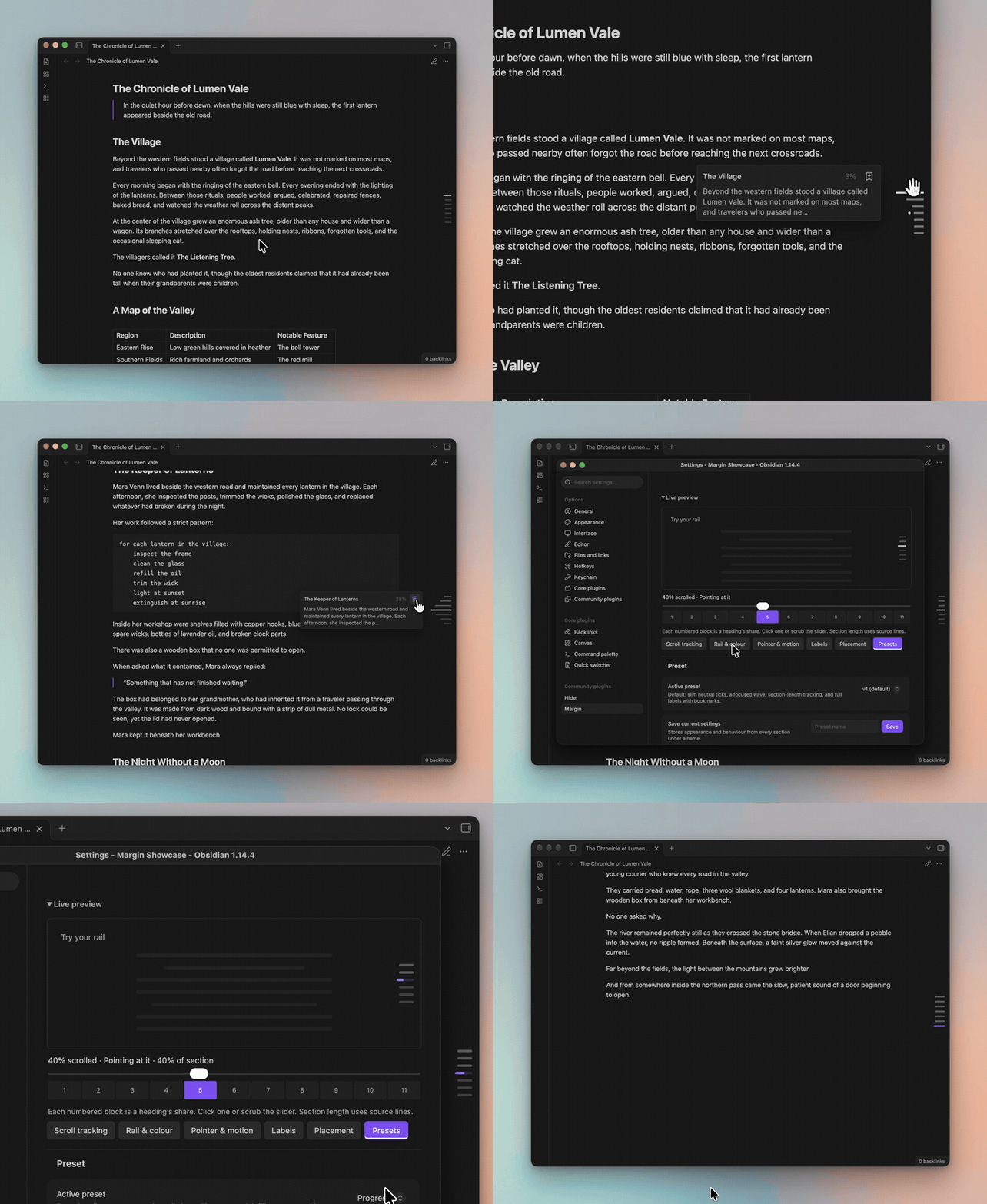
Find your place in a long note without opening a sidebar. Margin Rail is a scrollspy: a slim set of heading markers along the edge of your note. Hover for a preview, click to jump, or drag to scroll. Works while reading and editing.
Install
In Obsidian, open Settings → Community plugins → Browse, search for Margin Rail, then install and enable it. You can also find it on the community plugins page.
Requires Obsidian 1.2.7 or later. Compatibility details below.
Install manually
Download main.js, manifest.json, and styles.css from the
latest release.
Inside your vault’s .obsidian/plugins/ folder, create a folder with the name
shown in the id field of manifest.json. Put the three files there, restart
Obsidian, and enable Margin Rail in Community plugins.
Using the rail
Open a note with a few headings. Each small bar represents a heading, and the highlighted bar shows where you are.
- Hover over a bar to see its heading. Labels can also show a short text preview and how far down the note the heading is.
- Click to navigate to that mark using your selected tracking rule.
- Drag up or down along the rail to scroll through the note.
- Scroll or swipe over the rail to browse headings when the outline is taller than the pane.
- Keyboard: Tab to the rail, use Up/Down or Home/End to select any heading, including nested headings, then Enter to jump. Escape dismisses the label.
- Bookmark a heading with the button on its label. Click it again to remove the bookmark. Saved headings have a dot beside their bar.
Bookmarks use Obsidian’s Bookmarks core plugin, so it needs to be enabled. You can show or hide the bookmark button under Settings → Margin Rail → Labels.
Make it yours
Open Settings → Margin Rail to adjust the look and behaviour. Changes appear immediately in the live preview and your open notes. Start with a preset:
| Preset | What it looks and feels like |
|---|---|
| v2 · default | Slim bars that grow near your pointer, with heading previews and a bookmark button. |
| Absolutely | Claude-inspired styling: fine, widely spaced marks on the left with simple labels. |
| Quiet | A subtle rail with simple heading labels. |
| Outline | Indented bars and heading-level labels to show your note’s structure. |
| Progress | Equal scroll shares, square marks with a hover swell, and section progress filling from right to left. |
Use Normal for named choices for mark shape, length, spacing, emphasis, hover, labels, and placement. Advanced exposes individual sliders and exact numeric inputs. Both edit the same values: Normal shows a matching choice automatically, or Custom when the values do not match. Switching modes preserves your setup.
Hover options include Still, Swell, Heading badge, Focus (frame the pointed mark and dim its neighbours), and Dot (morph the mark into a circle). Advanced lets you tune the badge and dot sizes. Labels have separate Show and hide (None, Fade, Slide) and Between marks (None, Slide) animations, with speed choices in Normal and exact durations in Advanced. Label animations respect reduced motion. Absolutely uses Slide for both; Progress keeps both off.
Align marks to the left, centre, right, or the rail’s side. Section progress can fill from left to right, right to left, or outward from the centre.
Use Save as… to name a new preset. The preset options menu holds reset and delete actions. Changes to a preset show as Custom (unsaved) until you save them. Update appears after edits and saves over the preset you started from; use its dropdown to choose another saved preset. Updating a built-in creates a local copy. If the starting preset is unknown or was deleted, choose a destination before updating. Your phone visibility choice stays the same when switching presets.
How headings follow your scrolling
Choose a rule under Behaviour → Scroll tracking and try it with the preview’s scroll slider.
| Setting | What happens |
|---|---|
| Follow the note | A heading becomes current when it reaches the top of the note area. |
| By section length | Longer sections stay current for more of your scrolling. Every heading gets a turn. |
| Equal shares | Every heading stays current for the same amount of scrolling. |
| No tracking | Use the rail to navigate without highlighting a current heading. |
With By section length, navigation places the heading 24px below the top of the note area when space allows. That same landing position starts its tracking range, which continues to the next heading’s landing position. Ranges follow the rendered layout, including wrapped text and images. Near the bottom, where a heading cannot reach the top, trailing ranges use the remaining scroll space. Short or empty sections borrow some scroll space from the preceding section, while keeping their headings visible. Their headings may therefore land lower. Very short notes may not have enough scroll space for distinct ranges.
Equal shares keeps equal portions of the scroll range for each heading; navigation prefers showing the heading within its assigned portion. Opening a heading bookmark from Obsidian or following a heading link uses the same landing rule as clicking a mark. Follow the note and No tracking keep Obsidian’s exact heading jumps.
Under Behaviour → Heading navigation, you can enable Place cursor at heading for editing mode and Briefly highlight heading for a fading destination highlight in either mode. Both are off by default and are independent of presets.
On Mac, Haptic ticks while dragging adds subtle trackpad feedback when a rail
drag crosses a section boundary. It is off by default, stays independent of
presets, and adds no feedback to clicks or ordinary scrolling. Requires a
compatible Force Touch or Magic Trackpad with system haptics enabled. A small
helper uses macOS’s built-in osascript and AppKit only during a drag; no extra
binary or installation is required. Fast crossings are rate limited rather than
queued. This option does not change phone behaviour.
While dragging with section-length or equal-share tracking, each mark’s pointer area maps to that heading’s scroll range. The label follows the selected section without animation lag, and each crossing has a brief landing detent and a small mark pulse. Fast dragging smoothly reduces the heading holds, pulses and haptic ticks; slowing down restores them without pulling the note backwards. Speed is measured in marks per second so rail spacing does not change the feel. Dense outlines bring the selected mark beneath the cursor; folded headings remain reachable during the drag. Reduced motion disables the pulse.
On touchscreens, taps select the mark originally pressed and long outlines scroll with a native swipe. Rail gestures do not trigger Obsidian’s pull-down command. Touch labels omit the quick bookmark button; using a mouse, trackpad, or keyboard restores it, including on iPad. Heading navigation uses precise pixel landings so closely spaced headings activate their own marks.
By section length is the default for new installations. Existing saved choices are preserved. Nested headings each start their own range.
Finish on the last heading highlights the final heading when you reach the bottom of a scrollable note. It works with any rule, including No tracking if you only want a highlight at the very end.
You can also highlight other headings that are on screen, fade sections you’ve passed, or let the current bar fill as you move through its section.
On your phone
The rail is hidden on phones by default. To enable it, go to Settings → Margin Rail → Placement → On phones and choose Landscape only or Show on phones. The settings preview is always available.
If the rail doesn’t appear
Check Placement: the rail can hide on notes with too few headings, narrow desktop or tablet panes, or phones. Run Margin Rail: Refresh rail and show status from the command palette to refresh it and see what might be keeping it hidden.
Still having trouble? Open an issue with your Obsidian version, device, whether you were reading or editing, and what happened.
Compatibility and privacy
Margin Rail works locally. It doesn’t send network requests or collect usage data.
Desktop testing includes Obsidian 1.12.7 and 1.14.4, and the plugin has also been tested on iPhone. Support back to 1.2.7 is based on checking that version’s code and APIs; it hasn’t been tested by hand on that version. Reports from older versions, Android devices, and tablets are welcome.
Scrolling and bookmarks rely on some parts of Obsidian that aren’t official plugin APIs. Those can change when Obsidian updates, so an update could affect these features.
For developers
Plain JavaScript and CSS; no build step. Run node scripts/verify.cjs for all
checks. Optional browser layout and interaction checks use Playwright with an
installed Chromium: node tests/browser/navigation.cjs. Set PLAYWRIGHT_MODULE
to its module path if it is not installed locally. Touch regressions run in Chromium
and WebKit with node tests/browser/touch.cjs (install both Playwright browsers).
To release, commit on the branch tracking origin/main, then run
node scripts/release.cjs <next-version>. GitHub Actions checks, attests, and
publishes the plugin files.
License
MIT — you’re welcome to use, modify, and share it under that license.
Maintained by Mars-den.
Developed using AI assistance.
For plugin developers
Search results and similarity scores are powered by semantic analysis of your plugin's README. If your plugin isn't appearing for searches you'd expect, try updating your README to clearly describe your plugin's purpose, features, and use cases.