Wardley Map Simple
unlistedby BlockSecCA
Render Wardley Maps from inline code blocks using declarative syntax
Wardley Map Simple - Obsidian Plugin





Create Wardley Maps in Obsidian using declarative syntax. No coordinates, no manual positioning: describe your components and dependencies, and the plugin handles the layout.
Installation
- Download the latest release ZIP from GitHub
- Extract
main.js,manifest.json, andstyles.cssinto your vault at.obsidian/plugins/wardley-map-simple/ - In Obsidian: Settings > Community Plugins > Reload > Enable "Wardley Map Simple"
Quick Start
Create a fenced code block with language wardley:
```wardley
title My Map

anchor User Need [custom]
component Our App [product]
component Cloud Platform [commodity]

User Need -> Our App -> Cloud Platform
```
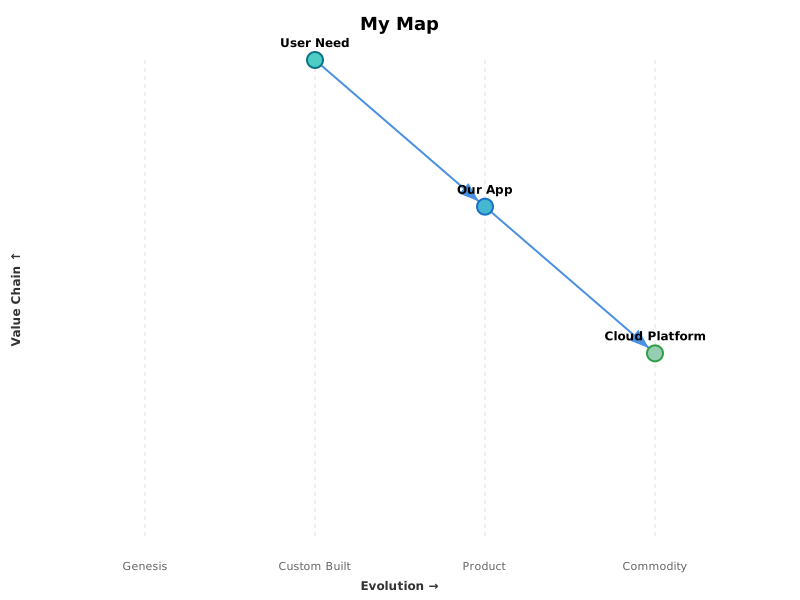
The plugin renders the map automatically. Components are positioned by evolution stage (X-axis) and dependency depth (Y-axis).
Syntax Reference
Components and Anchors
component Name [stage]              # regular component
component Name [stage] (strategy)   # with source strategy
anchor User Need [stage]            # user need (always at top)
Evolution stages (X-axis, left to right):
genesis-- novel, uncertain (red)custom-- custom-built (teal)product-- standardized (blue)commodity-- utility (green)
Source strategies (optional): build, buy, outsource, market
Dependencies
A -> B                  # A depends on B
A -> B -> C -> D        # chain notation
A -> B; some label      # with annotation
Evolution
evolve Old -> New [product]     # component-to-component (dashed purple arrow)
evolve Component [product]      # evolve to stage (rightward arrow at same Y)
Inertia
inertia ComponentName # vertical bar indicating resistance to change
Flow Arrows
Flow arrows are distinct from dependencies (rendered in orange):
A +> B                  # forward flow
A +< B                  # backward flow
A +<> B                 # bidirectional flow
A +> B; label           # with annotation
Pipelines
A component containing sub-components at different evolution stages, rendered as a horizontal box:
component Database [product]

pipeline Database
  component File Storage [genesis]
  component SQL DB [custom]
  component NoSQL [product]
  component Cloud DB [commodity]
Sub-components must be indented (2 spaces or tab). The pipeline block ends at the next non-indented or empty line.
Metadata
title Map Title                 # optional title
annotation 1 Some insight       # numbered annotation (bottom of map)
note General observation        # note text
# this is a comment             # comments are ignored
Examples
Tea Shop (Classic Wardley Map)
```wardley
title Tea Shop

anchor Business [custom]
anchor Public [commodity]

component Cup of Tea [product]
component Cup [commodity]
component Tea [commodity]
component Hot Water [commodity]
component Water [commodity]
component Kettle [custom]
component Electric Kettle [product]
component Power [commodity]

Business -> Cup of Tea
Public -> Cup of Tea
Cup of Tea -> Cup
Cup of Tea -> Tea
Cup of Tea -> Hot Water
Hot Water -> Water
Hot Water -> Kettle
Kettle -> Power

evolve Kettle -> Electric Kettle [product]
```
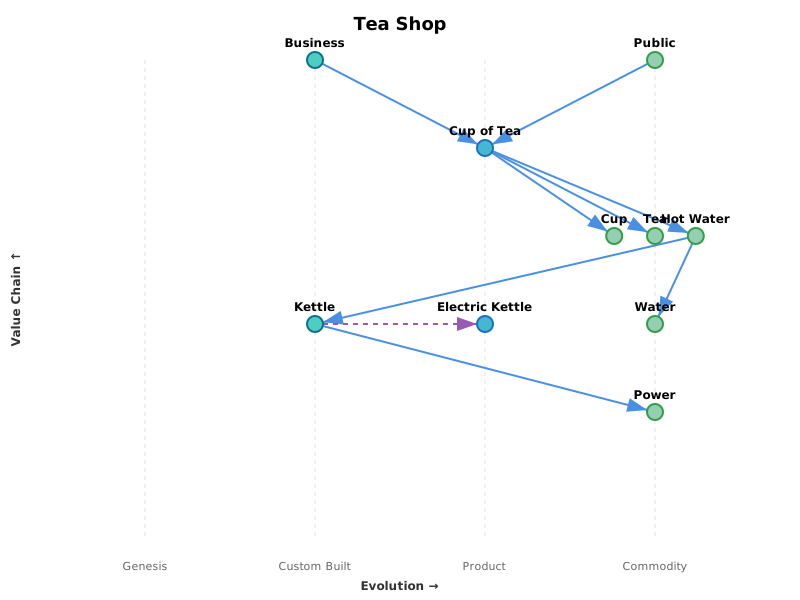
User needs (Business, Public) at the top, value chain flowing downward to infrastructure (Power), components color-coded by evolution stage, evolution arrow from Kettle to Electric Kettle.
Database Pipeline
```wardley
title Database Evolution

anchor Business [custom]
component Service [product]
component Database [product]

pipeline Database
  component File Storage [genesis]
  component SQL DB [custom]
  component NoSQL [product]
  component Cloud DB [commodity]

Business -> Service
Service -> Database
```
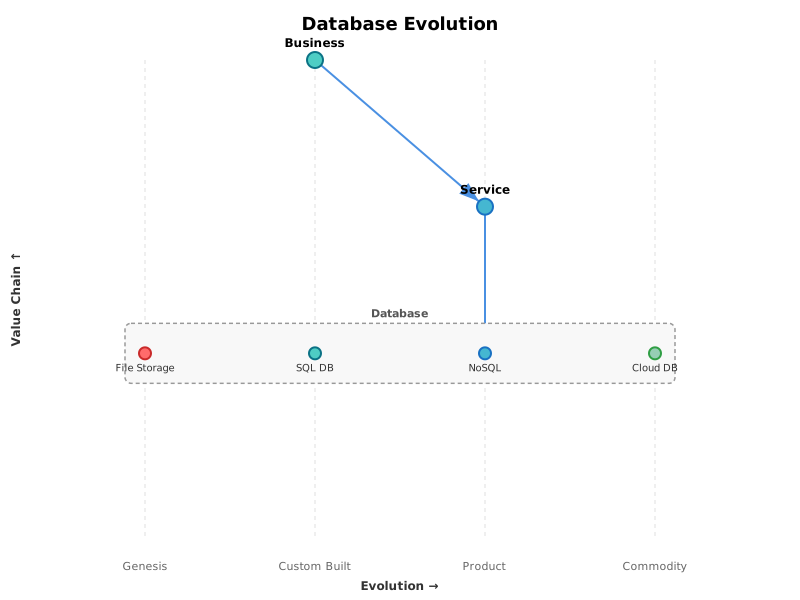
The pipeline box shows Database existing across multiple evolution stages simultaneously, from File Storage (genesis) through to Cloud DB (commodity).
More examples in the examples/ folder.
How the Layout Works
- X-axis (Evolution): Components are placed in their stage band (genesis, custom, product, commodity)
- Y-axis (Value Chain): Computed from dependency depth. Anchors at the top, deepest dependencies at the bottom. No manual coordinates needed.
- Overlap prevention: Components at the same depth and stage are spread horizontally, ordered by their connections to reduce edge crossings
Theming
The plugin uses CSS custom properties. Override them in an Obsidian CSS snippet:
.wardley-map-container {
  --wardley-genesis-fill: #FF6B6B;
  --wardley-custom-fill: #4ECDC4;
  --wardley-product-fill: #45B7D1;
  --wardley-commodity-fill: #96CEB4;
  --wardley-bg: white;
}
All SVG elements have semantic CSS classes (wardley-node, wardley-edge, wardley-pipeline, etc.) for fine-grained styling.
Development
npm install
npm run build       # type-check + bundle
npm test            # 65 tests (parser, layout, renderer, backward compat)
npm run dev         # watch mode
Project structure:
src/-- TypeScript source (parser, renderer, types, plugin entry)examples/-- sample Wardley Map definitions with SVG outputtools/-- standalone SVG generator and validatorstest.mts-- test suite (Node built-in test runner)
Syntax and OWM
This plugin's syntax is inspired by OnlineWardleyMaps (OWM) and supports the same Wardley elements (components, anchors, pipelines, inertia, flows, evolution). However, it deliberately uses named evolution stages (genesis, custom, product, commodity) instead of OWM's numeric coordinates ([visibility, evolution]). The layout is computed automatically from the dependency graph, so you never need to specify positions.
For the OWM DSL reference, see the OWM documentation.
No code is shared with OWM or Mermaid's Wardley Maps implementation. The parser and renderer are built from scratch for Obsidian.
Credits
Wardley Mapping methodology by Simon Wardley. Learn more: Wardley Maps book (free online).
License
MIT
Author
Carlos - BlockSecCA
For plugin developers
Search results and similarity scores are powered by semantic analysis of your plugin's README. If your plugin isn't appearing for searches you'd expect, try updating your README to clearly describe your plugin's purpose, features, and use cases.